Learn the 4 Types of Idioms to Enrich Your Writing
Have you ever heard a phrase that seemed like it was saying something weird? For example, if someone said that their pet fish “kicked the bucket,” you would probably wonder why they looked so sad. That’s because in English there are these things called idioms which people use.
Table of Contents
What Are Idioms?
Idioms are a form of figurative language. That means they are saying things with a different meaning from their wording. For example, metaphors draw comparison between two different things but are not meant to be a literal comparison or to say that one thing is exactly like another. An idiom is a specific phrase of figurative language that is used to mean something else.
But how do you know something is an idiom? Are there different types of idioms out there?
This article will explain the 4 main types of idioms, when to use them, and provide some examples of them.
What Are the Different Types of Idioms?
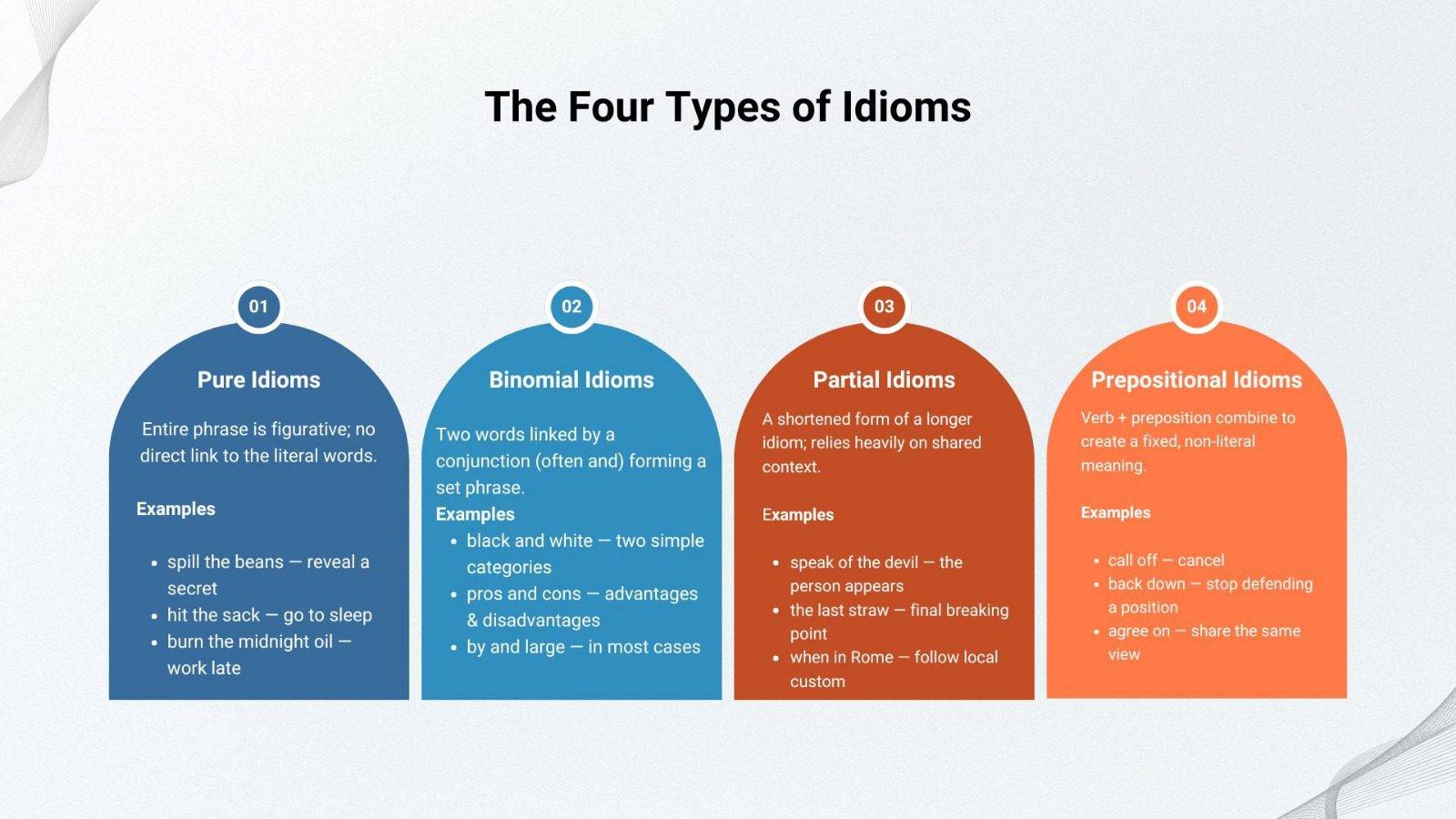
In English, there are 4 different types of idioms. These are called pure idioms, binomial idioms, partial idioms and prepositional idioms.
Here is an explanation on each type of idiom.
Pure Idioms
Pure idioms are the simplest form of idioms. They are the type of idiom where there are no connections to the meaning and what is actually being said. The phrase that came up earlier, “kick the bucket,” is a pure idiom meaning “to die.” Now you can probably tell why the person with the fish looked so sad. Pure idioms are probably the first types of idioms you learn about in school.
Binomial Idioms
Binomial idioms are idioms where the phrase has a conjunction connecting two or more words. Conjunctions are words that connect two different ideas together in some way. You probably already use conjunctions in your day, since a very common one to use is “and,” in fact you probably saw this guide use that word. Binomial idioms often use the structure “word+conjuction+word” with “and” being the most common one used. For example, “safe and sound” (which means unharmed), has two different words connected by “and” in the middle.
Partial Idioms
Sometimes when an idiom becomes particularly well known, people only start to say part of it. These are called partial idioms. While every idiom relies on cultural context and knowledge to understand it, this is twice as true for partial idioms. One example of this type of idiom is “if the shoe fits” which is short for “if the shoe fits, wear it”(means to accept a truth about yourself).
Prepositional Idioms
Oxford defines prepositions as “function words that typically combine with a noun phrase to form a phrase which usually expresses a modification or predication.” In other words, they are words that change something about the noun that comes after. This is related as a prepositional idiom is a phrase that has a preposition after a verb to create a non-literal meaning. One really good example for this one would be “in charge of”(which means be responsible for), which has the verb “charge” and preposition “of.” They may sound a little bit more technical than the other ones, but they are a type of idiom that can be very easily deduced with context.
12+ Idiom Examples (Across All Types of Idioms)
Here are a few examples for every type of idiom. Can you try to think of how you can use some of them next time your speaking or writing?
Examples of Pure Idioms
| Idiom | Meaning | Example |
| “Spill the beans” | To say something unknown or secret. | Are you going to spill the beans or not? |
| “Hit the sack” | To go to sleep. | It’s time for me to hit the sack. |
| “Burn the midnight oil” | To work very late into the night. | I’ve been burning the midnight oil all week. |
Examples of Binomial Idioms
| Idioms | Meaning | Example |
| “Black and white” | Very simply put in two different groups. | Morality isn’t black and white in real life. |
| “Pros and cons” | The good things and bad things about something. | What are the pros and cons of this? |
| “By and large” | In most cases. | By and large, people seem to like this movie. |
Examples of Partial Idioms
| Idioms | Meaning | Examples |
| “Speak of the devil” | Used to refer when speaking of someone then they appear in person. Short for “Speak of the devil and he shall appear.” | Speak of the devil, there is Lindsay. |
| “The last straw” | The final and usually most crippling of problems. Short for “The last straw that broke the camel’s back.” | Me losing my money was the last straw for me. |
| “When in Rome” | To follow custom in a new place. Short for “When in Rome do as the Romans do.” | I don’t like dancing, but when in Rome. |
Examples of Prepositional Idioms
| Idioms | Meaning | Examples |
| “Call off” | To cancel something. | I had to call off my meeting with Henry. |
| “Back down” | To stop defending something, usually an opinion. | I can’t believe he backed down |
| “Agree on” | To share an opinion with someone. | We agree on blue being a good colour. |
When Should You Use Each Type of Idiom?
Everyday Conversations
You can easily use idioms in your everyday conversations to keep things casual and friendly. You won’t need to use them all the time, but they can be helpful if the situation calls for it. Also, knowing when someone is using an idiom can help you understand and engage more with what the other person is saying.
Academic and Professional Settings
Most idioms are considered informal, but that is not to say that it’s absolutely impossible for you to use them in an academic or professional setting. You are most likely to use prepositional idioms since they often use very formal words, but if you are speaking instead of writing, you might want to use some of the other types as well. However, when choosing an idiom, you have to be sure it is fully clear what you are saying, otherwise it can easily start to sound informal and unnatural.
Creative Writing and Storytelling
Idioms in creative writing are often used to create vivid imagery and help avoid dull prose. However, it’s important to be careful when using very common idioms or it might feel like a cliche. A cliche is when a phrase is used so often that it starts to feel boring when saying it. Some idioms might start to feel like a cliche, so it is important to know what idioms you use, and if it’s a very overused one try to see if you can change it in some way.
How to Learn and Remember the Types of Idioms
Mastering the different types of idioms is just a matter of practice. Every type of idiom requires some context to understand, so don’t worry if you mess up or don’t understand a few times. Generally you can easily correct it by asking an English speaking friend or looking it up on the internet. If you have a friend that is fluent in English, try using the ones on this guide and try to see if there is anything they are saying that sounds like an idiom. If you find a new one, try grouping it up with one of the types of idioms you learned about in here so that you can remember more easily.
Conclusion
This guide shows how useful idioms can be to you writing and speaking wise. Of course, there are a ton of different idioms out there, so most of your understanding how to use these phrases will come with practice and a few times having to look up the meanings of phrases online. But to recap, you can group them into these 4 types of idioms:
- Pure idioms, where the whole phrase is figurative: “Kick the bucket.”
- Binomial idioms, that use conjunctions: “Short and sweet”
- Partial idioms, which use a part of another idiom: “Speak of the devil”
- Prepositional idioms, which are structured with ‘verb+preposition’ : “Disagree on”
If you have any interesting idioms you want to share, write them out in the comments below! Also be sure to download the cheat sheet above!