20+ Common English Idioms for Kids: Meanings and Examples
Idioms are an important part of any language. In any English setting, you might hear people say phrases that mean something different from what the words mean by themselves.
“Piece of cake!
“It’s raining cats and dogs.”
Research shows that children can understand idioms as early as preschool. Teaching young English learners idioms early is a fun way to boost their English vocabulary, cultural understanding, and creative thinking.
Table of Contents
Why Teach Idioms to Your Child?
Learning idioms helps kids:
- Understand figurative language in books and movies
- Improve reading comprehension
- Sound more natural when speaking English
- Discover cultural expressions and meanings
Kids often hear common idioms in daily conversations or in cartoons and movies. Helping them make sense of these phrases boosts their language understanding by a lot!
What makes an idiom easy for kids to learn and use?
- Its visual
- It connects to everyday situations
- It refers to concepts and situations kids are already familiar with
Below is a list of 20+ kid-friendly idioms commonly used in American English.
Check out this list of English idioms for broader usage beyond kid-friendly phrases.
20+dioms for Kids: Meanings and Examples
1. Feeling under the weather
If someone is feeling under the weather, that means they are feeling a little sick or unwell.
Example: “I might not go to school tomorrow. I’m feeling under the weather.”
2. Break a leg
When we say “break a leg,” it doesn’t mean we actually want someone to break a leg. It means we want to wish someone good luck or cheer someone up. Usually, we say “break a leg” to someone before a play, dance show, or performance.
Example:“Your dance recital is starting soon. Break a leg!”
3. Hang in there
Imagine someone is about to fall and is hanging onto a rope. Telling someone to “hang in there,” means telling them not to give up or to stay strong. It means to keep trying even when things are tough.
Example:“Hang in there, we’re almost at the finish line!”
4. Go the extra mile
To “go the extra mile” means someone tries extra hard, or does more than what people expect.
Example:“She went the extra mile at soccer practice”
5. The last straw
When someone’s patience has completely run out, that is when they reach their “last straw,”.
Example: “You’re always late. This is the last straw!”
6. It’s not rocket science
Rocket science is very complicated and hard to learn. When someone says “it’s not rocket science”, that means something is easy and simple to do or understand.
Example: “Just follow the recipe, it’s not rocket science.”
7. In hot water
If you’re “in hot water” that means you’re in trouble or about to be punished for doing something naughty.
Example: “Sarah is in hot water with the teacher after the prank she pulled.”
8. Hit the books
This phrase means to start studying extra hard. People use this when they need to do a lot of homework or study for a big test.
Example: “I have a big test tomorrow. Time to hit the books!”
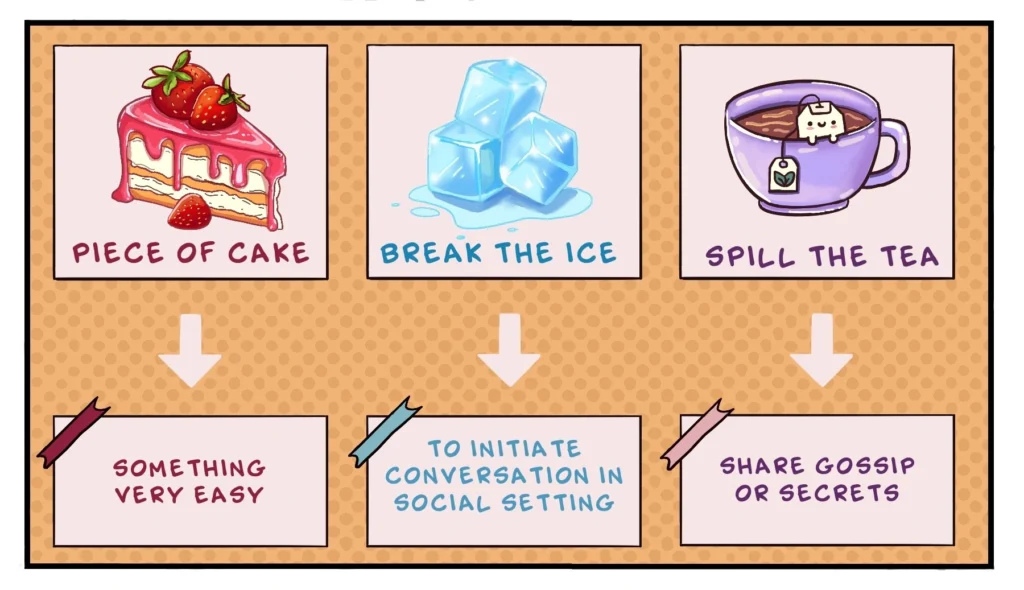
9. Break the ice
The first time you meet new people, it might be difficult to start a conversation or feel relaxed. To “break the ice” is to say something that helps people who don’t know each other start to feel more comfortable around each other.
Example: “The teacher broke the ice by asking everyone what their favourite cartoon was.”
Food Idioms for Kids
10. Piece of cake
How easy is it to take a bite of your favourite cake? When we say something is a “piece of cake,” that means it is very, very easy, just like eating cake.
Example: “I finished last night’s homework really quickly. That was a piece of cake!”
11. Spill the beans
Imagine someone knocking over a can of beans and accidentally revealing a secret. When someone “spills the beans,” that means they shared a secret, usually by accident.
Example: “Lisa spilled the beans on Frank to the teacher yesterday.”
12. Like two peas in a pod
When we say two people are like “peas in a pod,” that means they are very close, like two peas squished very close together in a pea pod.
Example: “Me and my best friend are like two peas in a pod. We do everything together!”
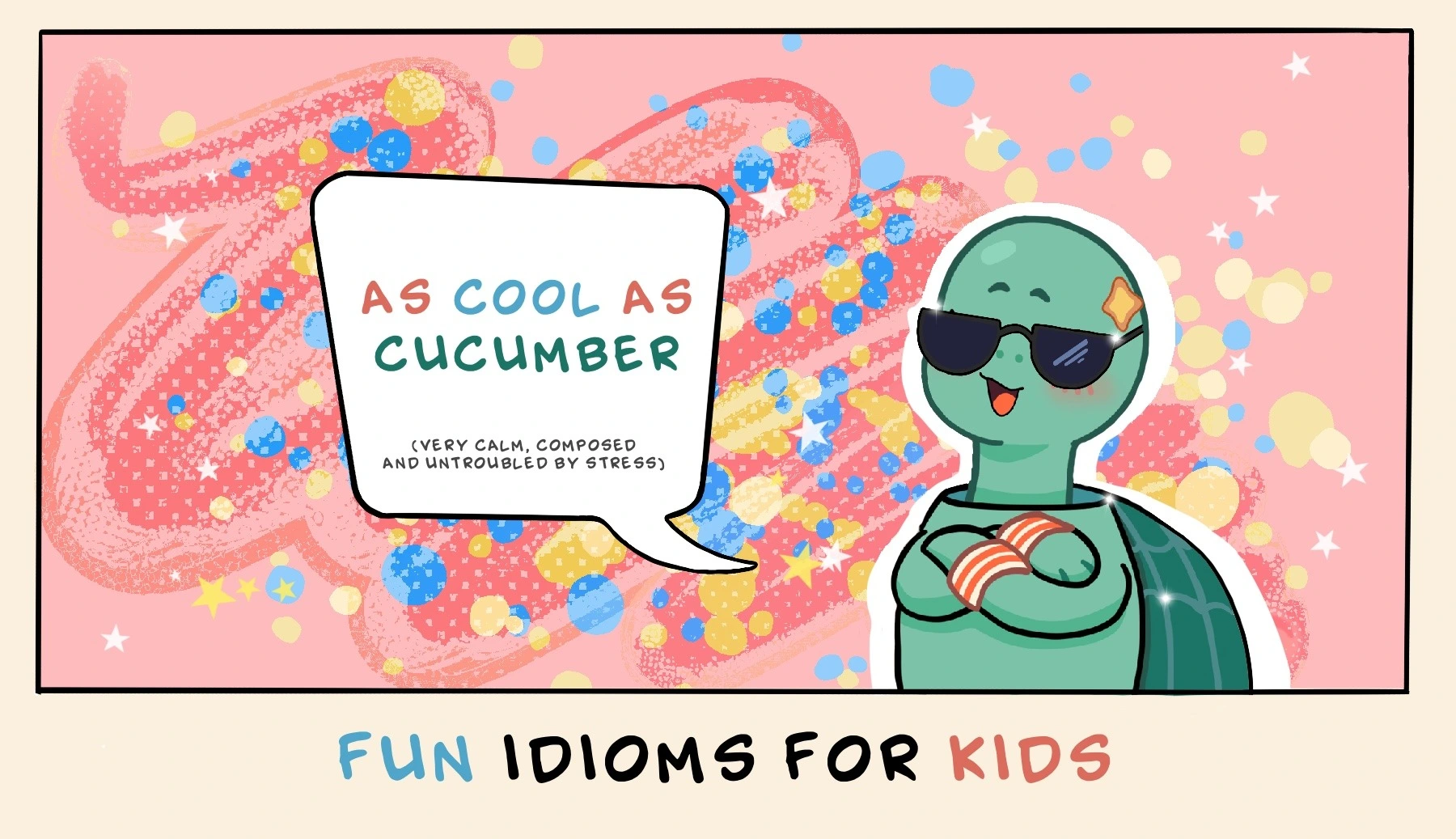
13. Cool as a cucumber
Cucumbers are very cold and refreshing. When someone is “cool as a cucumber,” that means they are calm, even in worrying situations.
Example: “Harry stayed cool as a cucumber during his presentation.”
14. Crying over spilled milk
Imagine accidentally knocking a cup of milk on the ground. You can’t put the milk back into the cup. When we say “don’t cry over spilled milk,” it means don’t worry about something that already happened and can’t be changed.
Example: “We missed the bus, but there’s no use crying over spilled milk. We’ll just take the next one”
15. Couch potato
Picture a potato, sitting all day on a couch. When we call someone a “couch potato,” that means we think they are lazy, just like the potato on a couch!
Example: “My brother’s a real couch potato. He didn’t do anything all day!
16. In a pickle
Think about a jar of pickles, and how closely packed together the pickles are. When someone is “in a pickle,” that means they are in a tricky situation that’s hard to get out of.
Example: “My dog ate my homework, and school starts in an hour. Now I’m in a real pickle!
17. Spill the tea
This phrase is a newly popular slang term that means to share gossip or secrets.
Example: “Ryan got in trouble yesterday? Spill the tea! I want to hear all about it.”
Animal Idioms for Kids
18. Hold your horses
Imagine riding a horse and pulling the reins to stop. When we say “hold your horses,” it means to be patient or slow down.
Example: “Hold your horses! The race hasn’t started yet.”
19. Let the cat out of the bag
Imagine you’re holding a bag with a cat in it. Suddenly, the cat jumps out! Now, imagine the cat is a secret you’re trying to keep in the bag. When we say someone “let the cat out of the bag”, it means they let out a secret, usually by accident.
Example: “May accidentally let the cat out of the bag and mentioned the surprise party.”
20. Butterflies in the stomach
How does it feel when you’re nervous? For some people, feeling nervous might feel like hundreds of butterflies flying around inside them.
Example: “I’m feeling butterflies in my stomach.”
21. Busy as a bee
When you see bees outside, they’re always working, trying to get nectar from flowers. When someone is “busy as a bee,” that means they are working hard and being busy, just like bees.
Example: “Sarah was busy as a bee getting her room ready for a sleepover”
22. Chicken out
Let’s say you were being brave and about to do something scary. Then, you decide not to do it at the very last minute because you are too scared. To “chicken out” means to decide not to do something at the last minute because you are too scared or nervous.
Example: “Peter was going to go on the rollercoaster but he chickened out.”
23. Horse around
“Horsing around” means to act in a silly or noisy way instead of being serious.
Example: “I can’t focus in class when those boys are horsing around.”
24. Raining cats and dogs
If someone says it is raining cats and dogs, that means it is raining very heavily outside.
Example: “I wanted to play soccer with my friends, but it’s raining cats and dogs out there.”
Looking for more material to teach kids English? These books for elementary students are a great place to start.
Writer: Christina Liu
Designer: Mariam Ismail