Reported Speech Examples: Rules, Types, and 30+ Examples
Introduction
Have you ever told a friend what someone else said without repeating their exact words?
If so, you’ve already used reported speech. Whether you’re chatting with friends, writing an email, or answering an exam question, reported speech helps you share conversations naturally without quoting every sentence.
You probably use reported speech every day without realizing it. Anytime you tell someone what another person said, you’re using reported speech!
Reported speech is one of the most useful grammar skills in English because it helps you share conversations, explain information, and tell stories naturally. Instead of quoting someone’s exact words, you simply report the meaning of what they said.
For example, imagine your friend says:
“I’m going to the library.”
Instead of repeating the sentence exactly, you could say:
She said that she was going to the library.
This small change makes conversations smoother and is commonly used in everyday English, academic writing, business communication, journalism, and storytelling.
Whether you’re preparing for an English exam, improving your speaking skills, or simply trying to sound more natural, understanding reported speech will help you communicate more confidently.
In this guide, you’ll learn:
- What reported speech is
- The difference between direct and reported speech
- The most important reported speech rules
- How to change pronouns, tenses, and time expressions
- Common reporting verbs and when to use them
- Step-by-step methods for changing direct speech into reported speech
- Real-life examples you can use immediately
- Common mistakes and how to avoid them
By the end of this guide, you’ll know exactly how to convert direct speech into reported speech with confidence.
Table of Contents
What Is Reported Speech?
Reported speech (also called indirect speech) is a way of telling someone what another person said without using their exact words.
Instead of repeating the original sentence inside quotation marks, you report its meaning using your own sentence structure.
Definition
Reported speech is used to communicate what someone said without quoting their exact words.
It allows conversations to flow naturally while keeping the original meaning.
Examples
| Direct Speech | Reported Speech |
| Sarah said, “I’m tired.” | Sarah said that she was tired. |
| Tom said, “I like coffee.” | Tom said that he liked coffee. |
| Anna said, “I’ll call you later.” | Anna said that she would call later. |
Notice that the meaning stays the same, but the grammar changes.
Reported speech is extremely common in:
- Everyday conversations
- News reports
- Books and stories
- Academic writing
- Workplace communication
- Interviews
Learning it will help your English sound smoother and more natural.
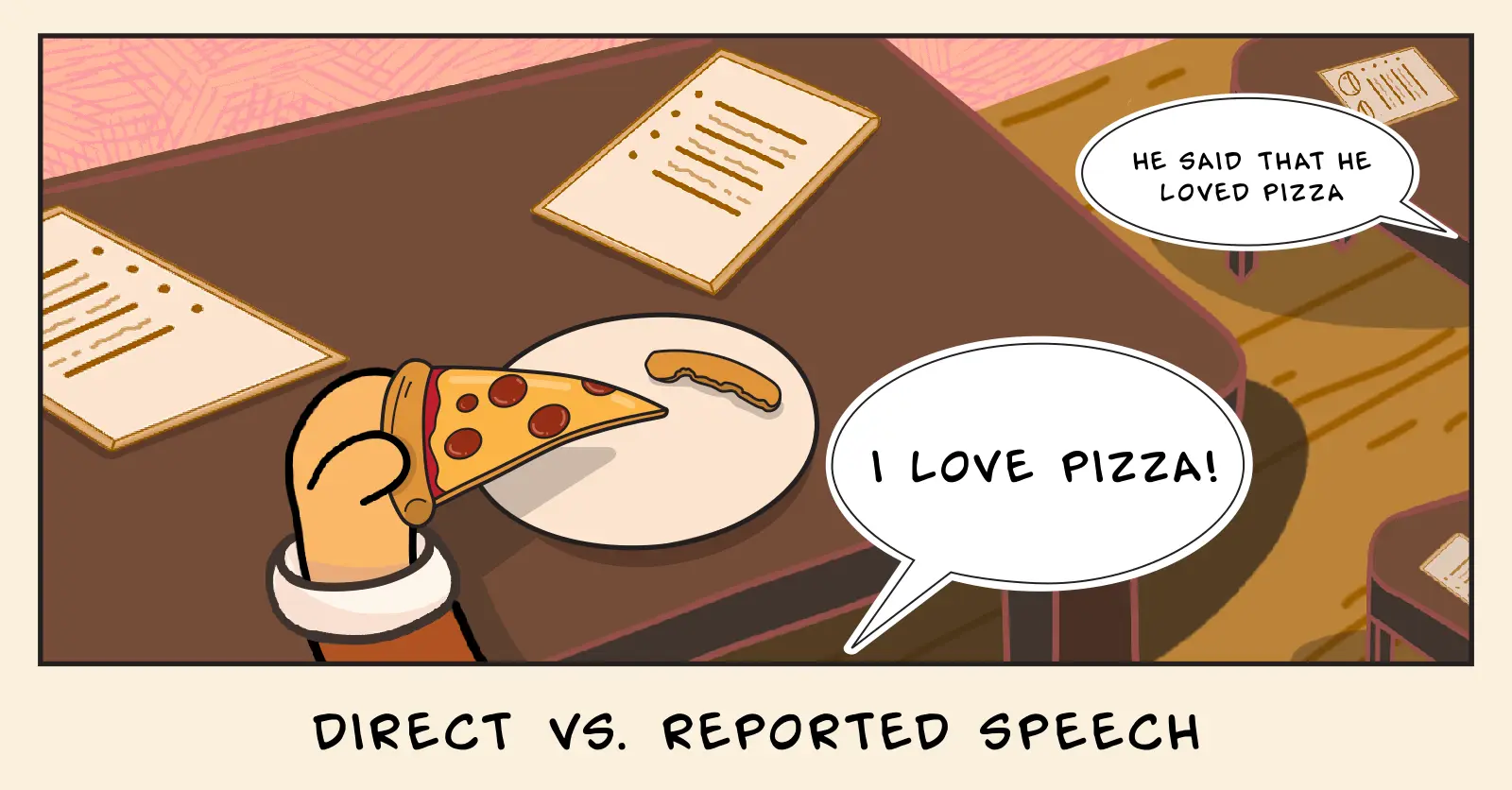
Direct Speech vs Reported Speech
| Direct Speech | Reported Speech |
| Uses quotation marks | No quotation marks |
| Repeats exact words | Reports the meaning |
| Original grammar stays the same | Grammar often changes |
| Common in dialogue | Common in conversation and writing |
Example
Direct Speech
Maria said,
“I have finished my homework.”
Reported Speech
Maria said that she had finished her homework.
Although the wording changes, the meaning remains exactly the same.
Why Is Reported Speech Important?
Reported speech appears almost everywhere in English. Native speakers use it constantly because it helps them summarize conversations instead of repeating every sentence exactly.
Understanding reported speech will help you:
- Share conversations naturally
- Improve your grammar accuracy
- Sound more fluent when speaking
- Write essays and reports more effectively
- Understand news articles and interviews
- Communicate professionally at work
Example
Instead of saying:
David said, “I’m busy today.”
You can simply report it as:
David said that he was busy that day.
This sounds much more natural in everyday communication.
Common Reporting Verbs
When changing direct speech into reported speech, the reporting verb shows how something was said. Choosing the right reporting verb makes your writing more accurate and natural because it reflects the speaker’s intention, such as explaining, suggesting, advising, or asking.
| Reporting Verb | When to Use | Example |
| said | general statements | She said she was tired. |
| told | giving information to someone | He told me he was leaving. |
| asked | questions | She asked where I lived. |
| explained | giving more details | The teacher explained that the lesson would continue. |
| advised | giving advice | The doctor advised me to rest. |
| suggested | making suggestions | She suggested going earlier. |
Reported Speech Rules at a Glance
Changing direct speech into reported speech involves a few simple grammar changes.
The table below summarizes the most important rules you’ll learn throughout this guide.
| Rule | Example |
| Change pronouns when needed | I → he, she, they |
| Change tenses when reporting in the past | am → was |
| Change time expressions | today → that day |
| Change place expressions | here → there |
| Remove quotation marks | “I’m happy.” → He said that he was happy. |
| Use appropriate reporting verbs | said, told, asked, explained |
Don’t worry if these changes seem confusing at first. We’ll go through each one with simple explanations and examples.
Rule 1: Changing Pronouns
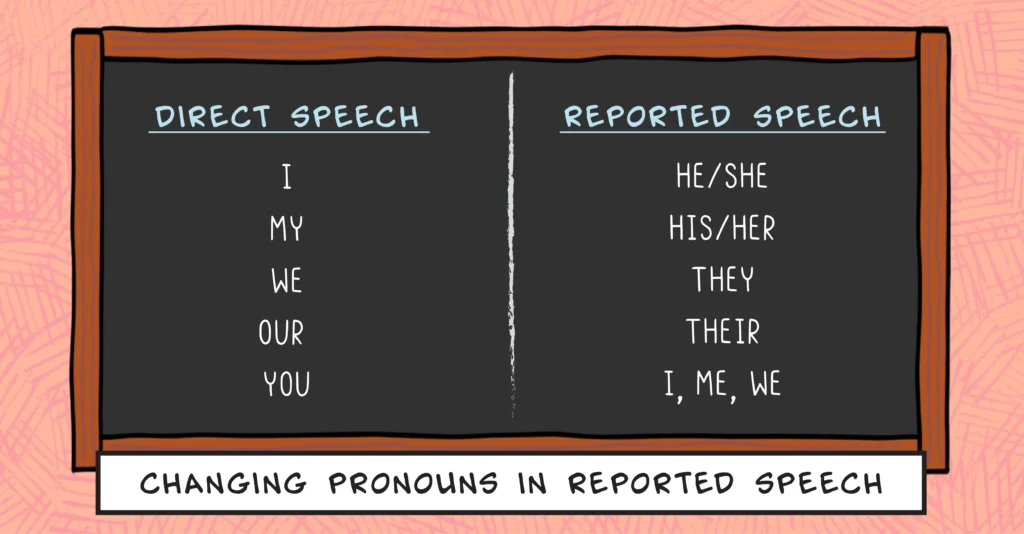
When reporting what someone said, pronouns often need to change so the sentence still makes sense.
Think about who is speaking and who they are speaking to. Pronouns often change in reported speech because the speaker or listener changes. The table below shows the most common pronoun changes.
Examples
Direct:
Emily said, “I love reading.”
Reported:
Emily said that she loved reading.
Direct:
John said, “My car is new.”
Reported:
John said that his car was new.
Direct:
They said, “We are excited.”
Reported:
They said that they were excited.
Tip
Always ask yourself:
Who originally said this?
The answer will usually help you choose the correct pronoun.
Rule 2: Changing Time and Place Words
Time and place expressions often change because you’re reporting the conversation at a different moment or from a different location. Time and place expressions usually change when you report something later. Here are the most common changes you’ll see.
| Direct Speech | Reported Speech |
| today | that day |
| tomorrow | the next day |
| yesterday | the day before |
| now | then |
| tonight | that night |
| next week | the following week |
| last month | the previous month |
| here | there |
| this | that |
| these | those |
Examples
Direct:
“I’ll meet you here tomorrow,” she said.
Reported:
She said that she would meet me there the next day.
Direct:
“I finished it yesterday.”
Reported:
He said that he had finished it the day before.
Direct:
“I’m busy today.”
Reported:
She said that she was busy that day.
Changing these words helps the sentence fit the new situation naturally.
Rule 3: Changing Tenses
One of the biggest grammar changes in reported speech is the shift in verb tense. When the reporting verb is in the past, the tense in the original sentence usually moves back one step.
| Direct Speech | Reported Speech |
| Present Simple | Past Simple |
| Present Continuous | Past Continuous |
| Present Perfect | Past Perfect |
| Past Simple | Past Perfect |
| Will | Would |
| Can | Could |
| May | Might |
Examples
| Direct Speech | Reported Speech |
| “I play football.” | He said that he played football. |
| “I am studying.” | She said that she was studying. |
| “I have finished.” | They said that they had finished. |
| “I saw the movie.” | He said that he had seen the movie. |
| “I will help you.” | She said that she would help me. |
| “I can swim.” | He said that he could swim. |
These tense changes help show that the conversation happened earlier.
However, remember that not every sentence requires a tense change. If the reporting verb is in the present (for example, she says), the original tense often stays the same.
30+ Reported Speech Examples
The best way to learn reported speech is by seeing it in different situations. The examples below cover statements, questions, commands, requests, and everyday conversations.
Statements
| Direct Speech | Reported Speech |
| “I like coffee.” | She said she liked coffee. |
| “I live in Toronto.” | He said he lived in Toronto. |
| “We finished early.” | They said they had finished early. |
| “I have a meeting.” | She said she had a meeting. |
| “I’ll help you.” | He said he would help me. |
| “I’m busy.” | She said she was busy. |
| “I forgot my keys.” | He said he had forgotten his keys. |
| “We are excited.” | They said they were excited. |
| “I can’t swim.” | She said she couldn’t swim. |
| “I bought a new laptop.” | He said he had bought a new laptop. |
Questions
Questions use words like asked, wanted to know, or wondered instead of said.
| Direct Speech | Reported Speech |
| “Where do you live?” | She asked where I lived. |
| “Are you ready?” | He asked if I was ready. |
| “When does the class start?” | She asked when the class started. |
| “Did you finish?” | They asked whether I had finished. |
| “Can you help me?” | He asked if I could help him. |
Commands and Requests
Commands usually use “told“, while polite requests often use “asked“.
| Direct Speech | Reported Speech |
| “Close the door.” | She told me to close the door. |
| “Please sit down.” | He asked us to sit down. |
| “Don’t be late.” | The teacher told us not to be late. |
| “Please call me.” | She asked him to call her. |
| “Finish your homework.” | Dad told me to finish my homework. |
Everyday Conversation Examples
These examples show how reported speech is used naturally.
Direct
Anna said, “I’m going shopping.”
Reported
Anna said she was going shopping.
Direct
My manager said, “The meeting starts at 10.”
Reported
My manager said the meeting started at 10.
Direct
The doctor said, “Drink plenty of water.”
Reported
The doctor told me to drink plenty of water.
Direct
Tom asked, “Have you seen my phone?”
Reported
Tom asked if I had seen his phone.
Common Mistakes in Reported Speech
Many English learners make the same mistakes when converting direct speech. Knowing these common errors will help you avoid them:
1. Forgetting to Change the Tense
❌ She said she is tired.
✅ She said she was tired.
2. Forgetting to Change Pronouns
❌ John said, “I lost my wallet.”
John said I had lost my wallet.
✅ John said he had lost his wallet.
3. Forgetting Time Changes
❌ She said she would visit tomorrow.
✅ She said she would visit the next day.
4. Using “Said” Instead of “Told”
❌ She told that she was busy.
✅ She said that she was busy.
or
✅ She told me that she was busy.
Tips to Master Reported Speech
Learning reported speech becomes much easier when you practise it regularly in real-life situations. The best way to master reported speech is to practise with real conversations instead of isolated grammar exercises.
Listening to interviews, podcasts, and everyday dialogue helps you notice how native speakers naturally report what others say.
Try these simple strategies:
- Read short conversations and rewrite them in reported speech.
- Watch interviews and report what people said.
- Listen to podcasts and summarize the speaker’s ideas.
- Practice changing direct speech into reported speech every day.
- Read English news articles and explain them using reported speech.
- Speak aloud to improve fluency and confidence.
Practising for just a few minutes every day is usually more effective than trying to memorize dozens of grammar rules in one sitting.
Continue Learning English Grammar
Once you’ve understood the basics of reported speech, continue building your grammar skills with these beginner-friendly guides. Each article focuses on a different part of English and will help you become a more confident speaker and writer. If you’re learning English step by step, the following guides will help strengthen your grammar, speaking, and pronunciation alongside reported speech.
- 8 Parts of Speech
https://englishlanguageandliterature.com/8-parts-of-speech/ - Types of Verbs in English
https://englishlanguageandliterature.com/types-of-verbs-in-english/ - Active and Passive Voice Examples
https://englishlanguageandliterature.com/active-and-passive-voice-examples/ - Intonation in English
https://englishlanguageandliterature.com/intonation-in-english/ - Tips to Start Speaking English Online
https://englishlanguageandliterature.com/mastering-english-speaking-online-tips-and-resources-for-fluency/
Learning grammar, pronunciation, and speaking together will help you become a more confident English speaker.
Frequently Asked Questions
What is reported speech?
Reported speech is used to tell someone what another person said without repeating their exact words.
What is the difference between direct and reported speech?
Direct speech repeats the speaker’s exact words using quotation marks.
Reported speech explains the message without quotation marks.
Does the tense always change?
No. If the statement is still true or expresses a universal fact, the tense may stay the same.
Which reporting verbs are most common?
The most common reporting verbs are:
said
told
asked
explained
suggested
advised
How can I improve my reported speech?
Practice changing conversations into reported speech, read English dialogues, and write summaries of interviews or articles.
Final Thoughts
Reported speech may seem challenging at first, but once you understand a few simple patterns, it becomes much easier to use. Start by changing short everyday conversations into reported speech, then gradually practise with longer dialogues, interviews, and stories. With regular practice, reporting what others say will become a natural part of your English.
Quick Challenge
Try changing these direct speech sentences into reported speech without looking back at the rules. Once you’ve finished, go back and check your answers.
- “I am learning English every day.”
- “Can you help me?”
- “We will arrive tomorrow.”
- “Please open the window.”
- “Where do you work?”
How many could you answer without looking back at the rules?
References
Answers
Here are the correct reported speech versions:
- Direct: “I am learning English every day.”
Reported: He/She said that he/she was learning English every day. - Direct: “Can you help me?”
Reported: He/She asked if I could help him/her. - Direct: “We will arrive tomorrow.”
Reported: They said that they would arrive the next day. - Direct: “Please open the window.”
Reported: He/She asked me to open the window.
(You can also say: “He/She told me to open the window.”) - Direct: “Where do you work?”
Reported: He/She asked me where I worked.
Note: The reporting verb (said, asked, told, etc.) and pronouns (I, you, we, he, she, they) may change depending on who is speaking and who is being addressed. In reported speech, the verb tense often shifts back when the reporting verb is in the past (for example, am learning → was learning, will → would), and time expressions may also change (for example, tomorrow → the next day).