How to Make Your English Writing Sound More Sophisticated Without Using Difficult Words
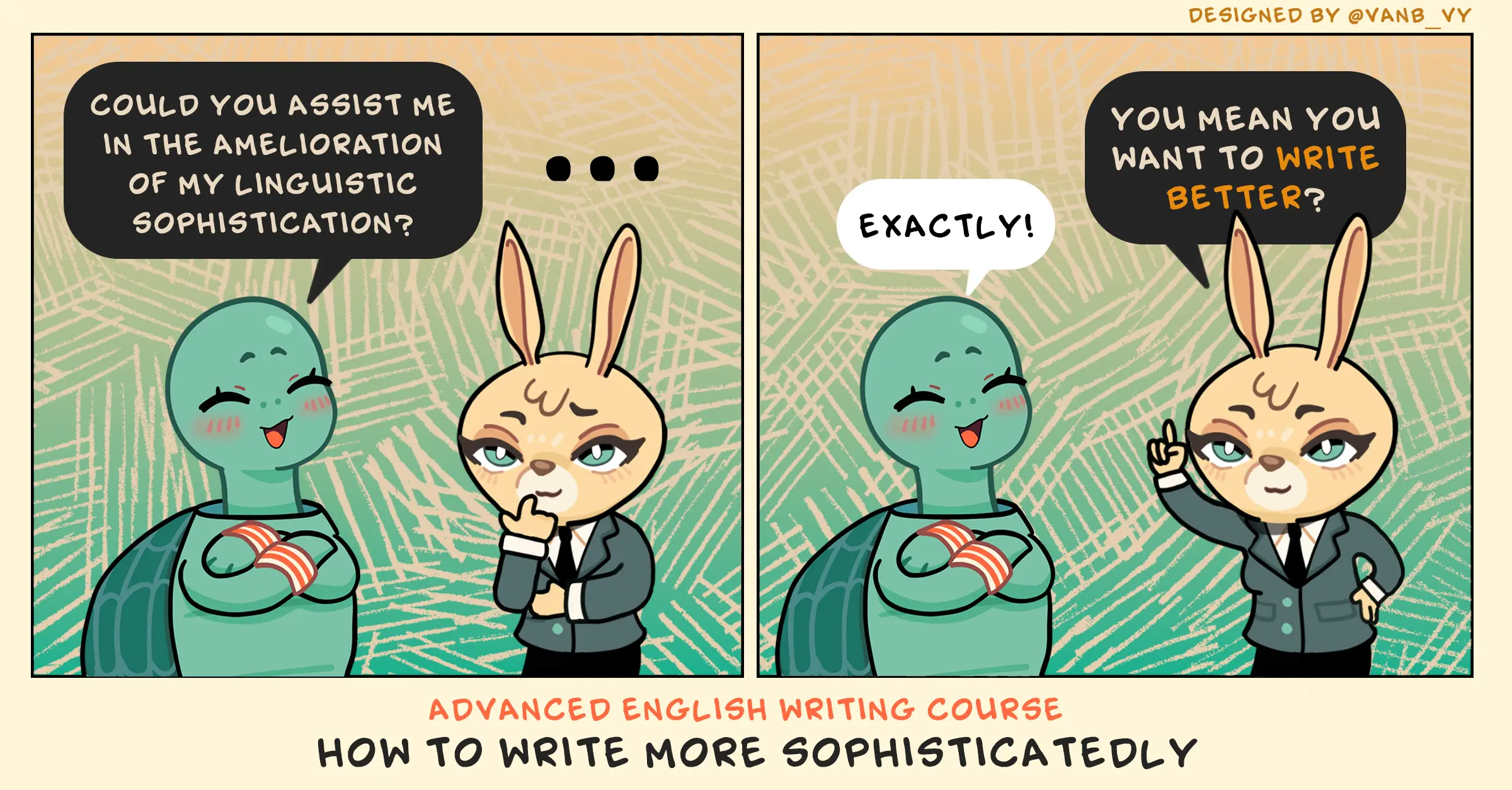
Do you think sophisticated English writing means filling every sentence with long, difficult words? It does not.
The Merriam-Webster Dictionary defines sophisticated as complex or refined. However, you don’t need to use complicated or lengthy words and phrases to make your writing sound more sophisticated.
In fact, using too many complicated words can make your writing sound unnatural, confusing, or difficult to read. Good writers do not always use the biggest words. They know how to choose the right words and arrange them clearly.
Whether you are writing an essay, an email, a story, or a social media post, you can make your English sound more polished with a few simple techniques. These skills can also support what you learn in English classes online for beginners, where clear communication matters just as much as vocabulary.
In this guide, you’ll learn:
- How to improve your sentence structure
- How to use transitions to connect your ideas
- How to avoid repetition
- How to choose precise words instead of difficult ones
- When to use active voice
- How to make your writing clearer and more natural
- Simple ways to edit your own writing
1. Improve Your Sentence Structure
Sophisticated writing is not about making every sentence long.
Instead, it is about creating variety. If every sentence has the same structure, your writing can sound repetitive.
For example:
Basic:
I woke up late. I missed the bus. I arrived at work late.
Improved:
I woke up late and missed the bus, so I arrived at work late.
The second sentence combines connected ideas more smoothly.
You can also vary the length of your sentences. Use a longer sentence when you need to explain an idea, then follow it with a shorter sentence for emphasis.
For example:
Basic:
The journey was difficult. We were tired. The weather was bad.
Improved:
The journey became increasingly difficult as the weather worsened. By the time we arrived, we were exhausted.
The vocabulary is still simple, but the sentence structure feels more natural and polished.
2. Use Transitions to Connect Your Ideas
Good writing should guide the reader from one idea to the next.
Transitions help you show relationships between your sentences and paragraphs. They can show contrast, addition, cause, or result.
Instead of repeatedly using and, but, or so, try words and phrases such as:
To add an idea:
- Furthermore
- In addition
- Also
- Similarly
To show contrast:
- However
- Although
- On the other hand
- Nevertheless
To show a result:
- Therefore
- As a result
- Consequently
- For this reason
For example:
Basic:
I studied hard, but I was nervous about the exam.
Improved:
I studied hard for the exam. However, I was still nervous on the day.
The improved sentence separates the ideas and uses “However” to clearly signal a contrast. This makes the writing easier to follow and gives each idea more emphasis without using complicated vocabulary.
You do not need to add a transition to every sentence. Too many transitions can make your writing sound forced. Use them when they genuinely help your ideas flow.
For example:
Basic:
I studied hard for the exam. I was still nervous that day.
Improved:
I studied hard for the exam. The thought of the exam still made me nervous.
Here, there is no obvious transition such as however, nevertheless, or although. Yet, the relationship between the two ideas is still clear from the meaning and sentence structure.
Good writing should guide the reader from one idea to the next. Transitions and conjunctions help show relationships between your sentences and paragraphs, whether you are adding information, showing contrast, or explaining a result.
If you want to practise connecting ideas more naturally, explore these conjunction examples in English Language Courses Online and see how they can make your writing smoother and more cohesive.
3. Choose Precise Words, Not Difficult Words
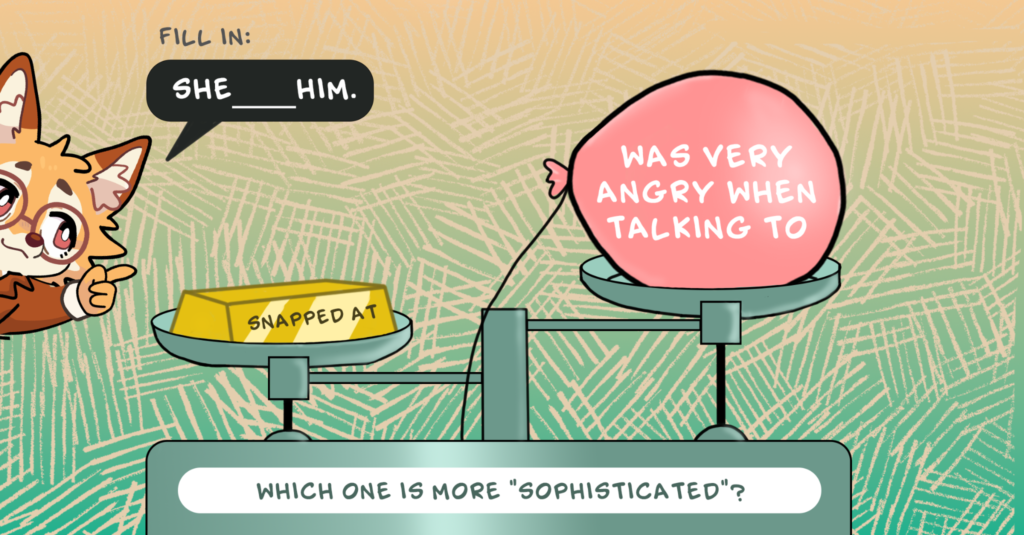
Sometimes, writing sounds less sophisticated because it uses too many unnecessary words. A sophisticated sentence does not need complicated vocabulary. Often, one precise word can replace a long explanation.
For example:
- Due to the fact that → because
- At this point in time → now
- In order to → to
- Has the ability to → can
- A large number of → many
- Very tired → exhausted
- Very happy → delighted
- Very important → essential
- Walked slowly → wandered
- Said angrily → snapped
Compare:
Wordy:
She was very angry when she talked to him.
Clearer:
She snapped at him.
The improved sentence is shorter, clearer, and more expressive.
Let’s look at another example:
Basic:
He looked at the painting carefully.
Clearer:
He examined the painting carefully.
“Examined” suggests that he looked at the painting closely and thoughtfully. It communicates more than simply “looked at”.
The goal is not to memorise a list of difficult words. Instead, focus on learning words that communicate your meaning more accurately. Many advanced English-speaking courses help learners develop this skill by teaching vocabulary in context rather than as isolated lists.
Sophisticated writing is often concise. If a word does not add meaning, consider removing it.
4. Avoid Repeating the Same Words
Repetition can make your writing sound less polished. While repetition is sometimes useful for emphasis, too much of it can make your ideas sound basic or make the reader lose interest.
The good news is that you do not need to replace every repeated word with a complicated synonym. Instead, you can make small changes to your sentence structure, remove unnecessary words, or choose a more precise word that fits your meaning.
Imagine reading this:
Basic:
The book was interesting because the book had an interesting story. The book also had interesting characters.
The words book and interesting appear too often.
A smoother version could be:
Improved:
The book was engaging because of its compelling story and memorable characters.
When editing your work, look for words you have used several times and then ask yourself:
- Can I remove the repeated word?
- Can I replace it with a more precise word?
- Can I rewrite the sentence?
However, don’t replace words with random synonyms just to sound more sophisticated. A synonym should always fit the meaning and context.
5. Use Active Voice for Clearer Writing
Active voice often makes writing more direct and confident.
In an active sentence, the subject performs the action.
Passive:
The report was written by Maria.
Active:
Maria wrote the report.
The active version is shorter and clearer.
This does not mean that passive voice is always wrong. Sometimes, you may want to focus on the action rather than the person doing it.
For example:
Passive:
The window was broken during the night.
Here, passive voice works because the person who broke the window may be unknown or unimportant.
The key is to choose the structure that makes your meaning clearest. Our English classes online for beginners on Active and Passive Voice teach learners to recognise this difference and use both forms effectively.
6. Focus on Clarity Before Style
The most sophisticated writing is not necessarily the writing that sounds the most impressive.
It is the writing that communicates clearly.
Before trying to make a sentence sound more advanced, ask yourself:
- Is my meaning clear?
- Does this sentence have a purpose?
- Could I say this more simply?
- Will the reader understand what I mean?
For example:
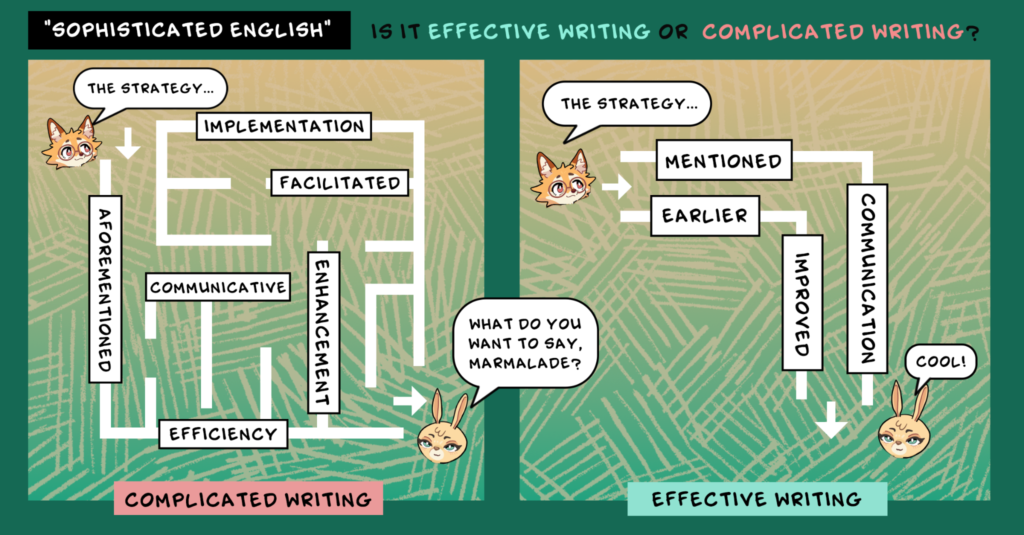
Overcomplicated:
The implementation of the aforementioned strategy facilitated an enhancement in communicative efficiency.
Clear and sophisticated:
The strategy mentioned earlier improved communication.
The second sentence is easier to understand and is more effective.
Remember that sophisticated writing does not mean using complicated language. The right tone depends on your audience and purpose, so learning how to switch between formal and informal English can help you make more effective choices. A good English practice Group Online Course can also help improve the vocabulary in your daily conversations.
A good English language online course should not only teach you new vocabulary. It should also help you communicate your ideas clearly, confidently, and naturally.
7. Read Your Writing Aloud
One of the easiest ways to improve your writing is to read it aloud.
When you hear your own words, you may notice:
- Sentences that are too long
- Repeated words
- Awkward phrases
- Missing transitions
- Unclear ideas
If a sentence feels difficult to say aloud, it may also be difficult to read.
For example, this sentence feels heavy:
The reason why I was unable to attend the meeting was because of the fact that I had another appointment.
A simpler version is:
I could not attend the meeting because I had another appointment.
Reading aloud can help you recognise these problems quickly.
Sophisticated Writing Is About Control
You do not need a dictionary full of difficult words to become a better writer.
Strong writing comes from making deliberate choices. Vary your sentence structure, choose precise words, connect your ideas, avoid unnecessary repetition, and keep your meaning clear.
The same principle applies to communication more broadly. An advanced English-speaking course can help you develop confidence, vocabulary, and control, but sophistication does not come from sounding complicated. It comes from knowing exactly what you want to say and saying it effectively.
So, the next time you finish a piece of writing, do not immediately search for bigger words.
Try this instead: choose one paragraph and improve it using at least three techniques from this guide. You could vary the sentence structure, remove repetition, and replace one vague phrase with a more precise word.
Then compare the two versions.
Which one is easier to understand? Which one sounds more confident?
Sophisticated writing may be simpler than you think.
FAQs About Improving English Writing
Q . How can I make my English writing sound more advanced?
Ans: Focus on clarity, sentence variety, precise word choice, and logical connections between ideas. You do not need to use difficult vocabulary to sound advanced.
Q. Should I use big words to make my writing sound sophisticated?
Ans: Not necessarily. A complicated word can make your writing less effective if it does not fit naturally. Choose the most accurate word for your meaning.
Q. How can I improve my English writing by myself?
Ans: Read regularly, write often, learn vocabulary in context, and edit your work carefully. Reading your writing aloud can also help you notice awkward sentences and repetition.
Q. How do I stop repeating the same words in my writing?
Ans: Whilst editing, look for words that appear too frequently. You can replace some with suitable alternatives, restructure the sentence, or remove unnecessary repetition.
Q. Can online English courses help improve my writing?
Ans: Yes. English Classes Online For Beginners and other structured programmes can help you practise grammar, vocabulary, sentence structure, and communication. The most useful course is one that gives you regular opportunities to apply and improve these skills.
Contact English Language & Literature for more information.
Writer: Mrunmayee Raut
Designer: Van Nguyen