The 4 Types of Sentences in English: Definitions, Examples, and Usage
Every day, you see, hear, and use different kinds of sentences without realizing it!
You see statements when you read the news, you ask questions when you feel curious about anything, you give instructions when you want to teach or help someone, and you express excitement when you’re surprised or shocked.
These ways to express yourself are clearly different. In English, these are identified as the four types of sentences. Understanding the types of sentences in English helps you write and speak more confidently.
Understanding how each of these sentences works helps you communicate better in everyday conversations, emails, essays, and more!
It can also improve how you grasp situations beyond your daily life, such as recognizing the context behind a book, movie, podcast, or TV series in English.
In this guide, you will learn:
- What the Four Types of Sentences are
- Declarative Sentences
- Interrogative Sentences
- Imperative Sentences
- Exclamatory Sentences
- Their Proper Structure
- Useful Sentence Examples
- How To Properly Use Them
- How To Compare Them
- And naturally, a Reinforcing Activity to integrate all the knowledge!
While the four types of sentences may seem simple at first, each one has a unique purpose that helps us communicate more effectively in different situations.
Let’s get this ball rolling…!
Table of Contents
What Are the Four Types of Sentences in English?
These sentences are grouped depending on their tone and purpose because they all communicate different things with a unique intention.
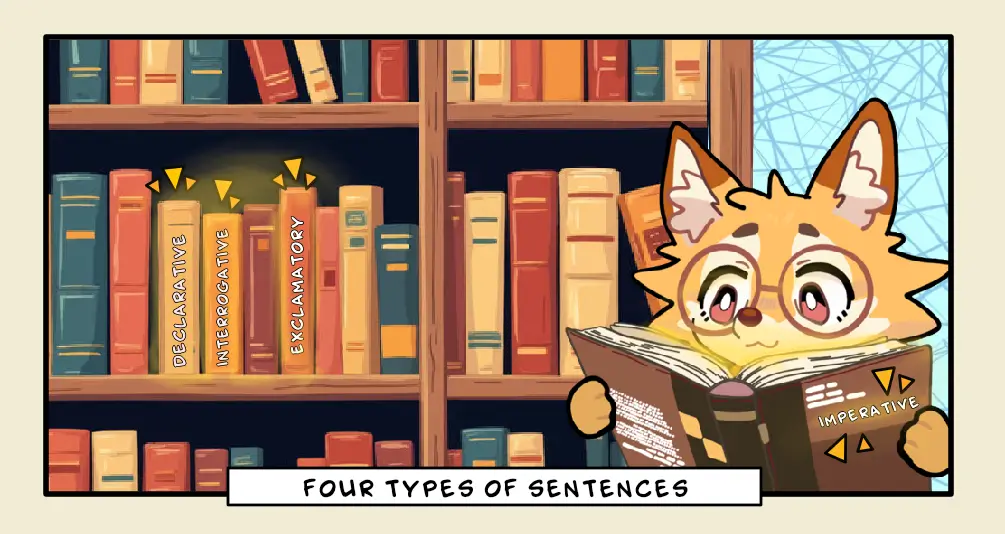
Every complete sentence falls into four categories:
- Declarative Sentences, which make statements.
- Interrogative Sentences, which ask questions.
- Imperative Sentences, which give orders, commands, instructions, or advice!
- And Exclamatory Sentences, which express excitement or strong emotions.
Even if the four types of sentences serve different objectives, they all play an important role in everyday communication!
Now, let’s look at each of them with a magnifying glass, shall we? Starting with…
Declarative Sentences
This one’s a classic and the one you’ll be using the most.
Declarative sentences are the foundation of any conversation you might have. These sentences allow us to communicate fun (or not-so-fun) facts, information, feelings, opinions, ideas, and more!
Whether you’re:
- Introducing yourself.
- Writing an essay.
- Doing daily journal entries.
- Expressing an opinion.
- Stating a fact.
- Explaining an idea.
- Or describing your vacation…
You’ll be using declarative sentences!
Now, let’s jump to their typical pattern.
Structure
Subject + Verb + Object
For example:
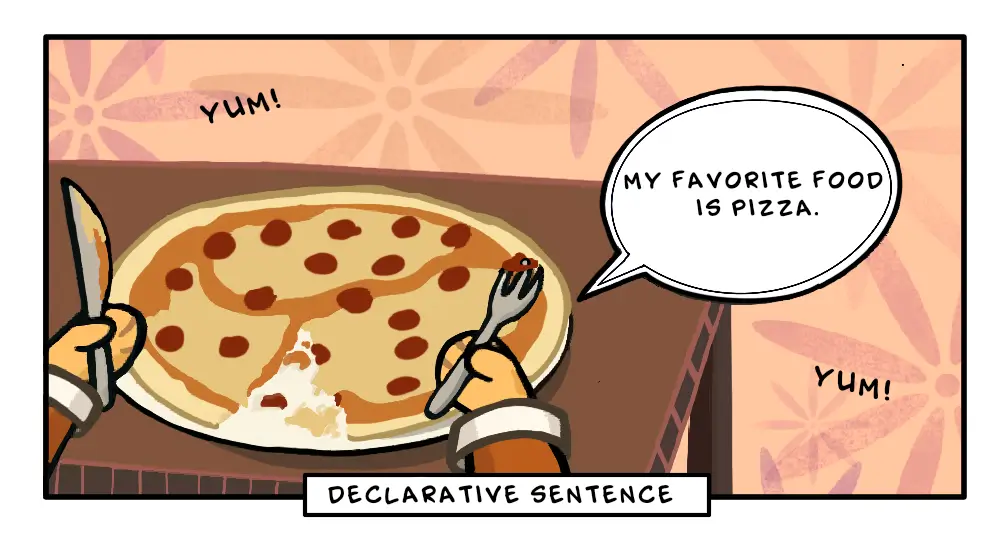
- My favorite food is pizza.
- He loves his dog.
- The party is on Saturday.
- I wish to study Medicine.
These sentences convey information to the reader. That’s why they end with a period (.).
Sometimes, though, they could end in exclamation marks. But… that’ll be something to look forward to as you keep reading!
Let’s keep this ball rolling and jump to…
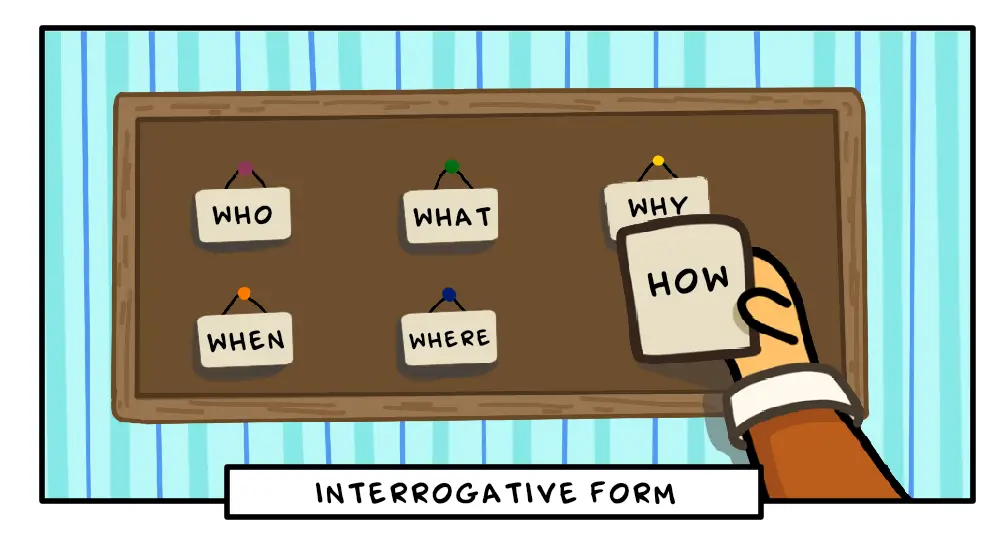
Interrogative Sentences
Just like a police interrogation, interrogative sentences are questions!
These sentences are all about asking for information. They’re designed to ask questions, which makes them essential for day-to-day conversations, interviews, and just about any conversation.
Some questions begin with auxiliary (helping) verbs and others with interrogative words. Let’s check that out!
| Interrogative Sentences | |
| With Auxiliary Verbs | With Interrogative words |
| Am I invited to the party? | How are you doing? |
| Is Sandra’s recovery going well? | Where is the wedding? |
| Did your father take out the trash? | Why was the bus late? |
| Have you done your homework? | What happened? |
| Were you at the job fair last Tuesday? | When is your plane arriving? |
| Do you speak Spanish? | Who is the new girl in class? |
Learning their structure is also useful!
Structure
- For Yes/No Questions:
- Auxiliary Verb + Subject + Main Verb + Object
- Here are some examples:
- Do you like sushi?
- Are your parents coming to the cinema?
- Have you drunk water?
- Did you finish your homework?
- For Wh-Questions:
- Interrogative word + Auxiliary Verb + Subject + Main Verb + Object
- For example:
- Where do you live?
- How can I improve my English?
- What is your favorite color?
- Why did the chicken cross the road?
- For example:
Since these sentences ask questions, they end with a question mark (?). If a sentence expects an answer, it’s always an interrogative sentence.
A common mistake in an interrogative sentence is misusing the word order or forgetting the auxiliary verb.
For example:
- Do you like coffee? (Incorrect)
- Do you like coffee? (Correct)
Now, let’s proceed with more! Now!
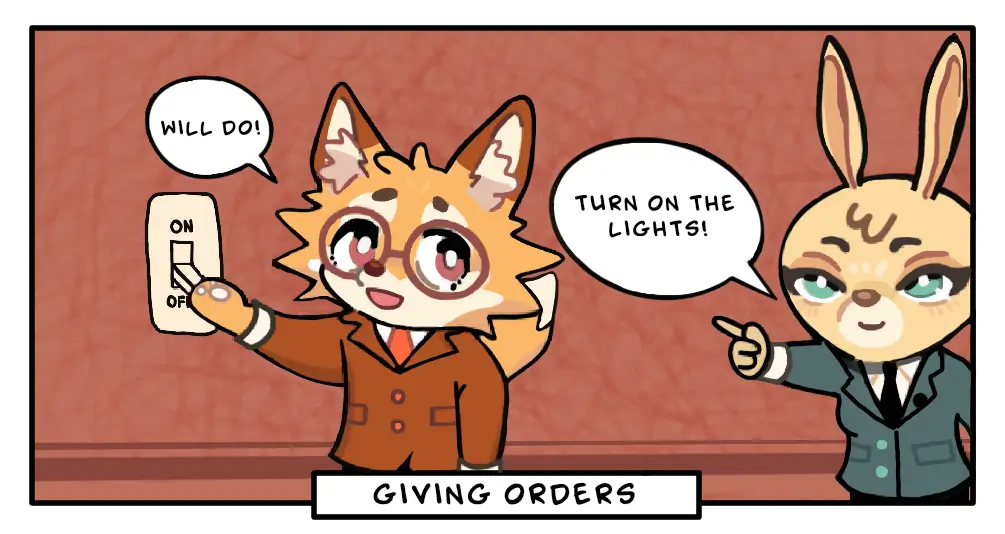
Imperative Sentences
You must learn about imperative sentences, because I say so!
That’s a perfect example of what the role of imperative sentences is: giving orders, demanding or warning about something, giving commands, or even giving advice.
You want someone to do something, and you request it from them either by ordering or by trying to guide them.
Structure
Base form of the verb + Object (optional)
Usually, the subject can be understood rather than written. For example:
- You close the window! (Incorrect)
- Close the window! (Correct)
Here are more examples:
- Remember to save your work before logging off.
- Turn off the lights!
- Drive carefully.
- Please send me the report by Monday.
- Follow the instructions.
- Do as I say!
- Take your umbrella.
- Turn left at the bus stop, please.
- Don’t run with scissors.
Imperative sentences end with either an exclamation point (!) or a period (.) depending on how serious and urgent the message is.
A common misunderstanding with imperative sentences is that most people view them as rude or aggressive. However, it all depends on the tone you add to it.
Well, we’ve come so far already. We have only one sentence type left, this is so exciting!
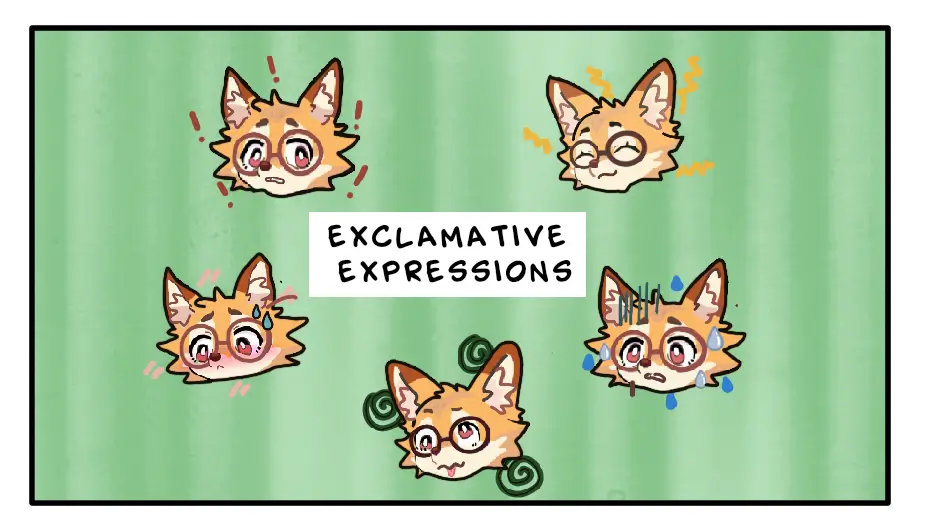
Exclamative Sentences
The last sentence type is all about emotion and lively expressions.
Exclamative sentences help us express excitement, surprise, anger, and many other strong feelings.
They’re part of everyday conversations!
Whether you’re gossiping, describing a movie plot, expressing your own feelings, or even reacting to falling down the stairs, you’ll absolutely be using exclamatory sentences!
Structure
There are three possible patterns to follow with exclamative sentences.
- For What Sentences:What + (a/an) + adjective + noun + subject + verb
- Check these sentences out:
- What an interesting book you’ve chosen!
- What a beautiful sunset it is!
- What an incredible performance!
- Check these sentences out:
- For How Sentences: How + adjective/adverb + subject + verb
- Here are some examples:
- How lucky we are!
- How quickly time flies!
- How crazy was that movie!
- Here are some examples:
Here are more examples:
- What wonderful news!
- How kind you are!
- What a surprise!
- How exciting this is!
- What an incredible view!
- What an outrageous display of anger!
- How thoughtful you are!
- How painful was that!
- How unfortunate that was!
- How busy the city becomes at night!
- How quiet the neighborhood is!
- What an interesting idea!
- What terrible luck!
- How well she speaks English!
Usually, a common confusion is that, at first glance, exclamatory sentences can look a lot like declarative sentences simply because they end in an exclamation mark (!).
Remember: exclamative sentences express, and declarative sentences declare. The real difference lies in the sentence’s purpose.
Check this out:
- Exclamatory sentence: What a beautiful terrace!
- Declarative sentence: This terrace is beautiful!
Another example:
- Exclamatory: What a surprise!
- Declarative: That was such a surprise!
Now, let’s review each of these sentences down to its basics: punctuation!
Compare and Contrast
Let’s compare each sentence type side by side to refresh their punctuation rules.
Conclusion
When you’re participating in class or chatting with your friends and family, choosing the right sentence type will enrich your dialect immensely. Using these four sentence types in English will certainly help you communicate more naturally!
As you keep enriching your learning process, remember to pay attention to any sentence’s intentions and purpose. That way, you’ll be able not only to identify them much better, but also to use punctuation correctly, improve your grammar, and use them confidently!
Wanna practice a bit? Identify which of these sentences are declarative, interrogative, imperative, or exclamative sentences!
- The store closes at 9 pm on Fridays.
- How quickly this year has gone by!
- Lock the car properly before entering your house.
- Have you memorized your speech?
- Could you, pretty please, with a cherry on top, lower your voice? I’m trying to sleep!
- What an insane turn of events!
- Remember to bring your passport tomorrow.
- I can’t believe I finally finished my thesis!
You got this!
References
- https://www.oxfordlearnersdictionaries.com/grammar/online-grammar/present-perfect-continuous
- https://dictionary.cambridge.org/dictionary/english/exclamatory-sentence?q=exclamatory+sentences
- https://dictionary.cambridge.org/dictionary/english/exclamatory-sentence
- https://dictionary.cambridge.org/dictionary/english/declarative-sentence
- https://dictionary.cambridge.org/dictionary/english/interrogative-sentence
- https://dictionary.cambridge.org/dictionary/english/imperative-sentence
Answers
- Declarative Sentence.
- Exclamative Sentence.
- Imperative Sentence.
- Interrogative Sentence.
- Interrogative Sentence.
- Exclamative Sentence.
- Imperative Sentence.
- Declarative Sentence.
Writer: María Carlota Coutinho Thomas
Designer: Isha Barua