30 Idiomatic Prepositions with Examples for Better English

If you’re trying to become a fluent English speaker, you’ll eventually need to learn a variety of idiomatic prepositions. These phrases are a fundamental part of the language and appear everywhere, from everyday conversations to formal writing.
However, idiomatic prepositions can be confusing for beginners because their meaning cannot be guessed from the individual words. For example, why do we say we are “good at a skill” but “interested in a topic”? Most of these are fixed and must be memorized.
Table of Contents
What Are Idiomatic Prepositions?
Idiomatic prepositions are prepositions that have a fixed, non-literal relationship with another word, usually a verb, adjective, or noun.
While regular prepositions show location or time, idiomatic prepositions have specific meanings that you’ll have to memorize.
For instance, “at” does not always describe a location, as in “He is good at math”. This means someone is skilled in something. So if you say, “He is good in math,” the natives would understand you, but that would not sound natural.
What Are the Different Types of Idiomatic Prepositions?
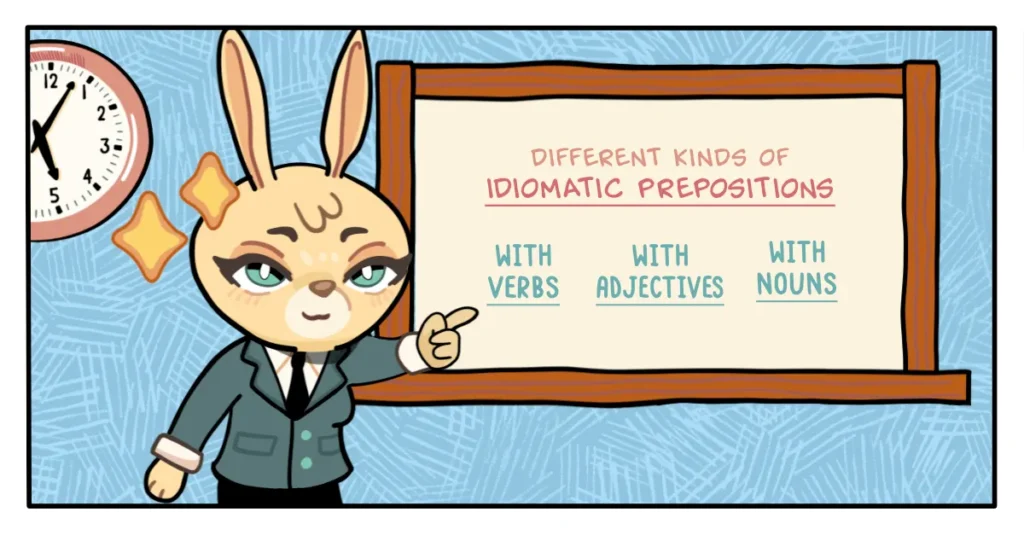
To improve grammar faster, it is better to learn the idiomatic prepositions. These prepositions can be divided into three primary categories of phrases.
A. Idiomatic Prepositions with Adjectives
In these phrases, a specific preposition is always used with a particular adjective, and the most common type of prepositional idiom that you’ll deal with when learning English is like this:
“Good at” not “good on”.
“Keen on” not “keen by”.
B. Idiomatic Prepositions with Verbs
In English, some specific meanings require a verb plus a preposition. Idiomatic use is essential for correct grammar and natural sentences throughout your pieces.
“Rely on” a friend, not “rely with a friend”.
C. Idiomatic Prepositions with Nouns
Some nouns are always paired with a certain preposition. These usually relate to concepts, ideas, or qualities.
“A reason for” a delay, not “a reason of” a delay.

30 Idiomatic Prepositions with Examples
Learning these phrases in chunks is much more effective than learning the individual words. Below is a list of 30 common idiomatic prepositions with a clear meaning and an example sentence to help you master them.
1. With Adjectives
- Angry with: Annoyed at a person.
- Example: She was angry with her brother for breaking the vase.
- Proud of: Pleased or satisfied with something.
- Example: He was so proud of his daughter for getting an A+ on her exam.
- Familiar with: Having knowledge or experience of something.
- Example: Are you familiar with this software program?
- Happy about:Pleased about a situation or event.
- Example: The team was happy about their win.
- Responsible for:Having a duty to take care of something.
- Example: The manager is responsible for making sure the project is finished on time.
- Interested in:Wanting to know about or take part in something.
- Example: I am very interested in learning about history.
- Good at:Having a skill or ability in something.
- Example: She is really good at playing the piano.
- Afraid of:Feeling fear or worry.
- Example: My little brother is afraid of the dark.
- Fond of:Having a liking or affection for someone or something.
- Example: He is very fond of his grandmother’s stories.
- Satisfied with: Feeling pleased with the outcome of something.
- Example: They were satisfied with the results of the survey.
2. With Verbs
- Believe in: To have confidence in or faith in something.
- Example: Do you believe in ghosts?
- Succeed in: To achieve a desired outcome.
- Example: She succeeded in passing her driving test on the first try.
- Belong to: To be a member of or to be owned by.
- Example: This book belongs to the school library.
- Apply for: To formally request something.
- Example: He decided to apply for the new job opening.
- Depend on: To be influenced by or need something/someone.
- Example: We can depend on her to tell the truth.
- Look after: To take care of someone or something.
- Example: My neighbor looks after my dog when I’m on vacation.
- Deal with: To handle or manage a situation.
- Example: How do you deal with stress at work?
- Dream of: To imagine or hope for something.
- Example: She always dreamed of traveling the world.
- Rely on: To have confidence in or trust in someone/something.
- Example: We can rely on his advice.
- Consist of: To be made up of something.
- Example: The dessert consists of cake, ice cream, and chocolate sauce.
3. With Nouns
- An increase in: A rise in the amount or number of something.
- Example: There has been an increase in traffic on this road recently.
- A solution to: A way to solve a problem.
- Example: The team found a creative solution to the problem.
- Belong to: To be a member of or to be owned by.
- Example: Is there a reason for this sudden policy change?
- A need for: A requirement for something.
- Example: There is a great need for clean water in many parts of the world.
- A key to: A way to understand or achieve something.
- Example: Patience is the key to success.
4. Mixed Examples
- In charge of: Having control over something or someone.
- Example: Who is in charge of this project?
- At risk of: In a situation where something bad could happen.
- Example: He is at risk of losing his job.
- By means of: By using something as a method or tool.
- Example: The rescue was conducted by means of a helicopter.
- On behalf of: Representing someone or something.
- Example: I am speaking on behalf of my entire family.
- In favor of: In support of or agreeing with something.
- Example: She voted in favor of the new proposal.
When to Use Idiomatic Prepositions?
A . Everyday Conversations
The correct idiomatic use of prepositions is key to making your speech sound natural. Using the right preposition can lightly change the meaning of your sentence and allow you to communicate more precisely.
For example:
compare “I’m looking for my keys” (searching) with “I’m looking after the dog” (caring for). Using the correct preposition is what separates a beginner English student from a native speaker.
B. Academic and Professional Writing
While you might be able to get by with simple prepositions in casual conversations, it’s critical to use the correct prepositional forms in formal writing.
A business proposal or an academic paper that uses incorrect prepositions can be confusing for readers, making the writer sound unprofessional. Getting accustomed to different idioms and prepositions will ensure your writing sounds more fluid while keeping it grammatically correct.
C. Exams and Language Learning
If you’re a student preparing for standardized language exams like IELTS, TOEFL, or Cambridge, a good grasp of prepositional idioms is really useful. These phrases are often tested and can be the difference between a good score and a great score.
Most English teachers dedicate specific lessons to idiomatic prepositions, as they are fundamental tools for communicating more effectively in English.
How to Master Idiomatic Prepositions
As these idioms are unpredictable, the best way to learn these prepositions is through constant exposure and practice.
Practice by reading and listening. Pay attention to how native speakers use these fixed phrases in books, articles, movies, and podcasts.
- Practice by reading and listening. Pay attention to how native speakers use these fixed phrases in books, articles, movies, and podcasts.
- Learn idiomatic prepositions in chunks. Instead of learning the word “rely,” learn the full phrase “rely on.”
- Use flashcards or quizzes for practice. Repetition is key to memorization.
Conclusion
Understanding how to use idiomatic prepositions is a crucial step towards becoming a more fluent and confident English speaker and writer. While they could feel confusing at first, as they don’t follow the rules you’re used to, they will become an integral part of your vocabulary after you practice enough.
Quick Quiz
Is there ___________ this attitude that you have?
What is the correct idiomatic preposition for this sentence?
- a solution to
- on behalf of
- a reason for
- depend on
References: