Differences in American vs. British English
Introduction
How are American and British English different? Spoken English sounds different in each region because of accents. But for beginner English language learners, the other differences may not be immediately obvious.
In this article, we will learn about commonly encountered differences between American and British English.
- Spelling differences
- Grammar differences
- Vocabulary differences
- How much does it matter?
Here at English Language and Literature, we offer English-speaking courses online. Improve your English speaking fluency with one of our tutors here : add link to courses
Spelling differences
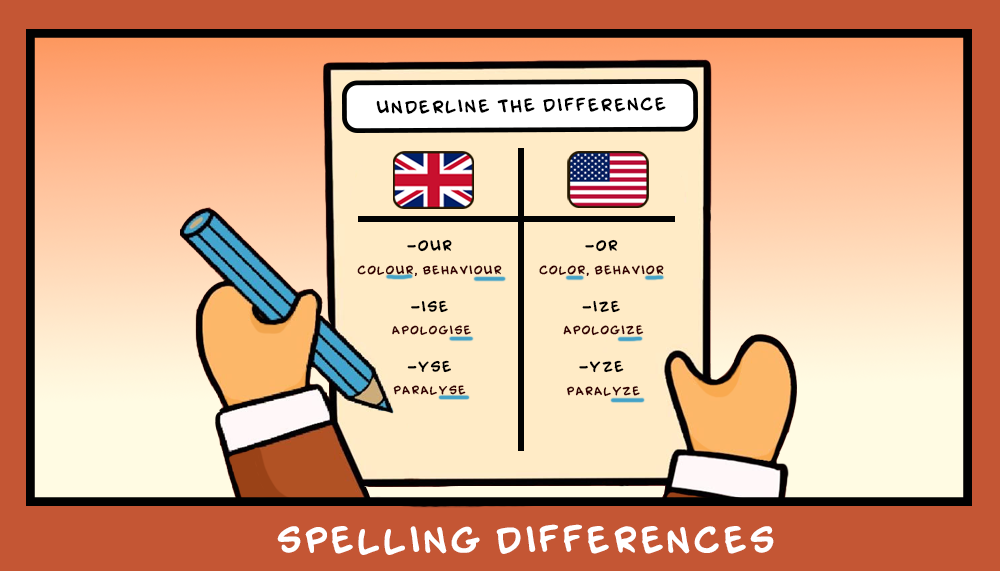
One of the most commonly encountered differences between American and British English is in the spelling of certain words. Below are some common examples.
Many words that end in -our in British English end in -or in American English.
| American English | British English |
| Color | Colour |
| Behavior | Behaviour |
| Neighbor | Neighbour |
| Flavor | Flavour |
| Rumor | Rumour |
Some words that use “ou” in the middle of the word are shortened to “o” in American English words (Mould vs. mold).
Some words that end in -re in British English end in -er in American spelling.
| American English | British English |
| Center | Centre |
| Meter | Metre |
| Theater | Theatre |
| Liter | Litre |
Words that end in -ize or -yze in American English tend to end in -ise or -yse in British English, although both spellings are considered correct in British English.
| American English | British English |
| Apologize | Apologise OR apologize |
| Paralyze | Paralyse OR paralyze |
| Analyze | Analyse OR Analyze |
| Recognize | Recognise OR Recognize |
The letter combination “oe” and “ae” in the middle of British words tends to be spelled with just an “e” or “i” in American English.
| American English | British English |
| Anemia | Anaemia |
| Diarrhea | Diarrhoea |
| Encyclopedia | Encyclopaedia |
| Airplane | Aeroplane |
There are many more specific spelling differences and exceptions between American and British English. Be sure to research a word if you are not sure about the proper spelling.
Grammar differences
American and British English have minor differences in grammatical habits. Sometimes, grammar rules are correct in both versions of English, as American and British English have influenced each other over the years. However, there are grammar applications that are more common in one region over the other.
Here, we’ll go over some common grammatical differences to make you sound more like a native in either variety of English.
Collective nouns
Collective nouns refer to a group of people, animals or things. Some examples of collective nouns include team, class, flock (of birds), and deck (of cards).
American English always treats collective nouns as singular, and so will use singular verbs like “is” or “was” for them.
Examples:
- The band was happy with its performance
- The team is playing tomorrow
- My family is moving to another city
In British English, collective nouns can be singular or plural, but more often treated as plural. Collective nouns will usually be used with verbs like “are” or “was”.
Examples:
- The band were happy with their performance
- The team are playing tomorrow
- My family are moving to another city
In American English, treating collective nouns as plural is grammatically incorrect.
The exception to this is when the members of a group are acting separately (i.e., as individuals). In this case, American English can use plural terms with a collective noun.
In British English, referring to collective nouns as singular or plural are both grammatically correct, although it is more common to treat them as plural.
Past Tense Verbs
The past tense of some verbs like learn, spoil, burn, dream, and leap tend to end differently in American and British English. American English prefers using -ed (dreamed, burned) while British English tends to use the irregular form -t (dreamt, burnt).
Here is a table of the common past tense verb endings per region:
| Verb | American English | British English |
| Learn | Learned“I learned this in class yesterday” | Learnt“I learnt this in class yesterday” |
| Spoil | Spoiled“My cake is spoiled” | Spoilt“My cake is spoilt” |
| Dream | Dreamed“I dreamed about my dog” | Dreamt“I dreamt about my dog” |
| Leap | Leaped“He leaped over the fence” | Leapt“He leapt over the fence” |
When describing a past event that has consequences in the present, different verb tenses are preferred in American vs. British English.
In American English, simple past tense is preferred in this scenario. For example:
- John ate too much at the buffet
British English prefers using the present perfect tense in these scenarios:
- John has eaten too much at the buffet
Practice
Vocabulary differences
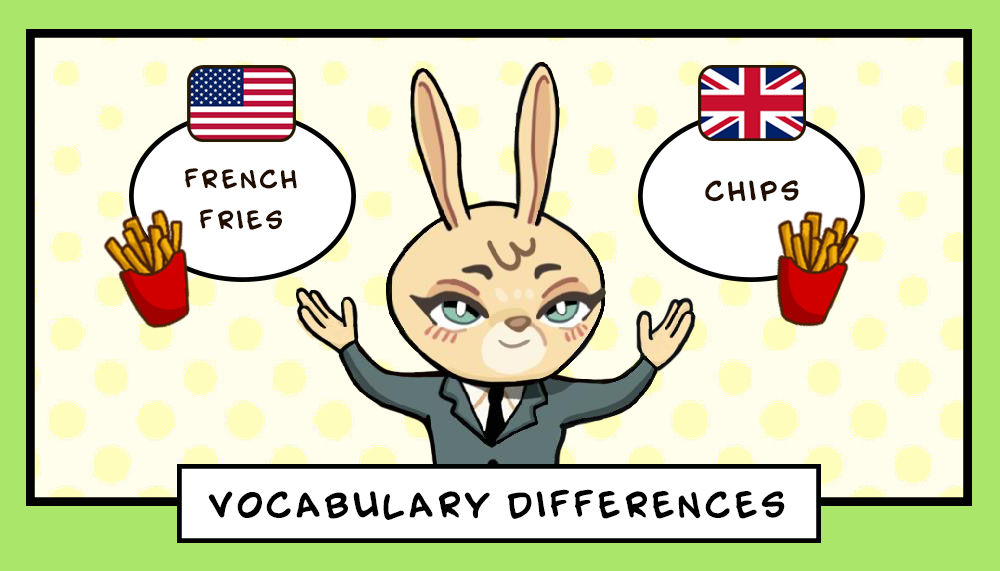
In conversation, you may find that American English speakers and British English speakers sometimes use different words to refer to the same thing. Here are some common vocabulary differences:
| American English | Britrish English |
| Soccer | Football |
| French fries | Chips |
| Pants | Trousers |
| Apartment | Flat |
| Truck | Lorry |
| Elevator | Lift |
| Garbage/trash | Rubbish |
| Chips(referring to potato chips) | Crisps |
| Sweater | Jumper |
| Sneakers | Trainers |
| Bill (as in paper money) | Banknote |
| Counter-clockwise | Anti-clockwise |
| Cookie | Biscuit |
| Trunk (of a car) | Boot |
How Much Does it Matter?
How much does properly adopting American vs British English really matter? For the everyday person, traveller, or even businessperson, these differences will not be very noticeable or important. Any version of English will be acceptable in everyday conversation.
Understanding the differences between American and British English are important in these situations:
- Academic writing: If you are studying at an American or British university, or writing academic papers, it is important to correctly use the standard English of that region.
- Exams and immigration: Certain standardized exams and tests will favour one English standard over another. English-speaking courses will often test you in the region’s standard English.
- Target audience: If you are writing or marketing for a specific group (such as US or UK clients), it is good practice to use the standard English of that market to build trust and maintain clarity.
- When picking courses: When taking English speaking courses online or in person, you will learn the English accent and vocabulary of the instructor. If you would prefer to learn a certain region’s accent, this is something to take into consideration in English learning for beginners.
- Cultural integration: If you have the goal of fully culturally integrating into an English-speaking region, adopting that region’s English quirks, vocabulary, and accent helps you blend seamlessly into the culture.
FAQs
Q. What is the difference between American and British English?
Ans: The main differences are in spelling, vocabulary, and grammar, such as “color” vs. “colour” or “apartment” vs. “flat.” Both are correct, and speakers of each understand the other easily.
Q. Which English should beginners learn, American or British?
Ans: Neither is better, so choose the one that fits your goals, such as where you plan to study, work or live. Then use it consistently in your speaking and writing.
Q. Why do American and British spellings differ?
Ans: Many American spellings come from Noah Webster’s dictionary, which simplified words to match how they sound. That is why American English uses “-or” and “-er” where British English uses “-our” and “-re.”
Q. Can I mix American and British English?
Ans: Mixing them is fine in everyday conversation. In academic writing, exams and professional work, pick one style and use it throughout.
Q. Do IELTS and TOEFL accept both American and British English?
Ans: Yes, both exams accept either spelling as long as you use it consistently. TOEFL follows American English, and IELTS leans toward British English.
Writer: Christina Liu
Designer: Amelia L