30+ Idioms vs Metaphors: Key Differences & Easy Examples
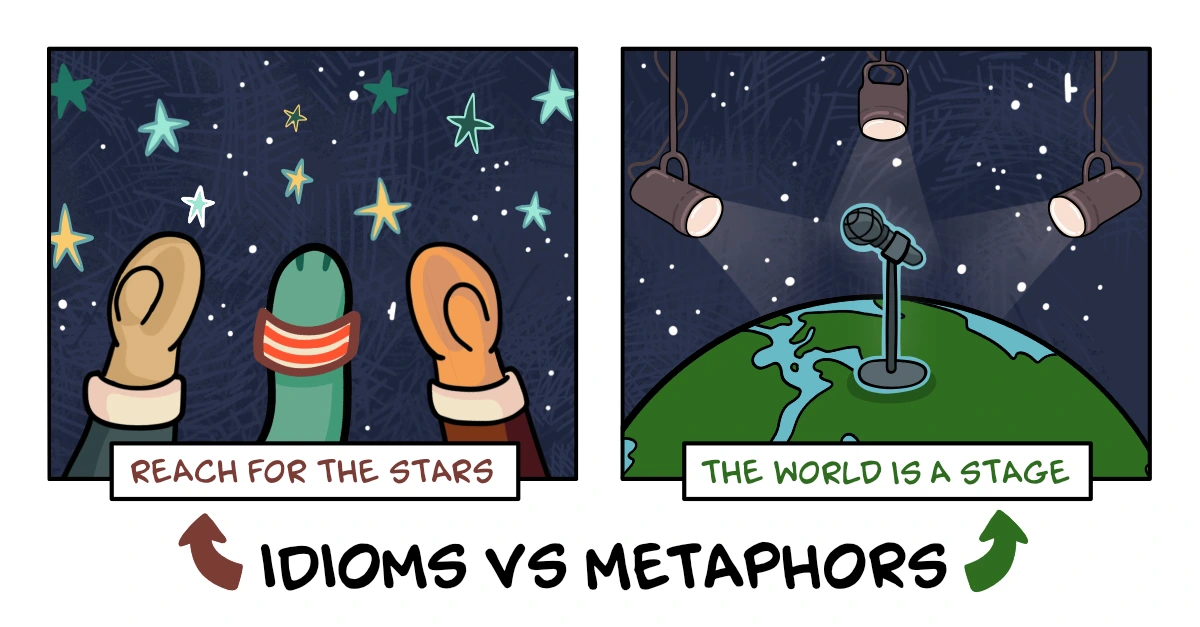
Understanding the difference between idioms vs metaphors can instantly improve your English fluency, writing clarity and confidence.
- Idioms are fixed expressions with non-literal meanings
- Metaphors are creative comparisons used to explain ideas
Mastering both helps you sound more natural and expressive.
Table of Contents
What Are Idioms?
An idiom is a fixed phrase where the meaning is different from the literal words.
Examples:
- “Kick the bucket” → to die
- “Break the ice” → start a conversation
- “Spill the beans” → reveal a secret
Why are idioms so hard to learn?
Because they depend on culture—you can’t translate them word-for-word.
Key Features:
- Fixed structure
- Cultural meaning
- Common in informal speech
What Are Metaphors?
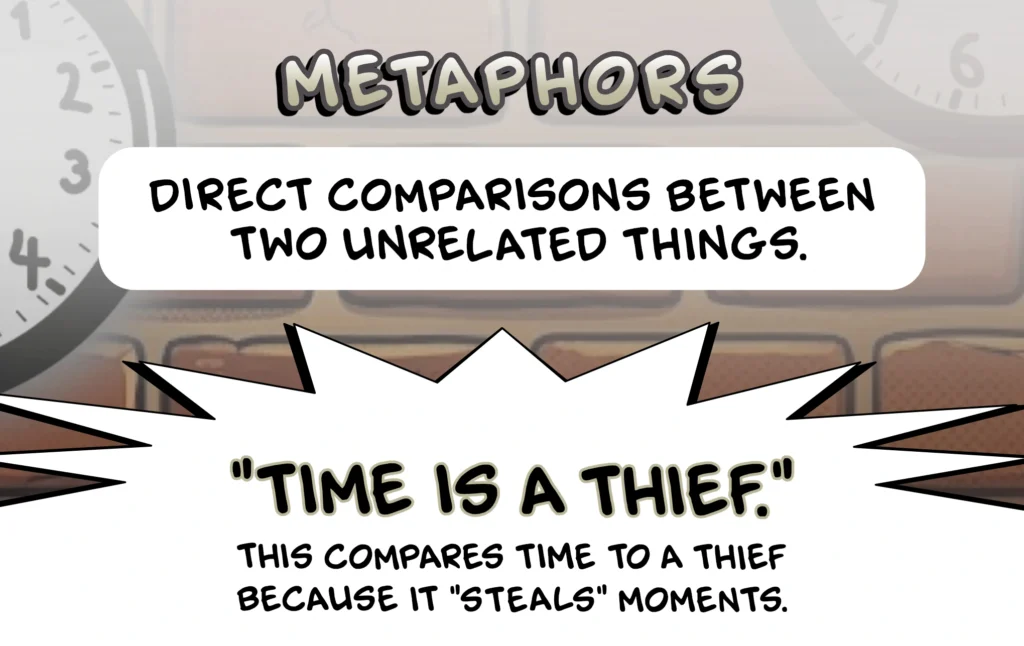
A metaphor compares two unrelated things directly to explain an idea.
Examples:
- “Time is a thief”
- “He’s a shining star”
- “Her voice was music to my ears”
Ever thought “Can I create my own metaphors?”
Yes—you can invent them anytime!
Key Features:
- Flexible and creative
- Easier to understand
- Used in writing and speeches
Idioms vs Metaphors: Key Differences
| Feature | Idioms | Metaphors |
| Structure | Fixed phrases, cannot be altered | Flexible, creative, can be invented |
| Meaning | Figurative and cultural | Figurative and relative |
| Usage | Informal speech, humor, storytelling | Literature, speeches, academic writing |
Example
- Idiom: “Burn the midnight oil” → work late
- Metaphor: “My brain is an overworked engine”
Many idioms started as metaphors—but now they are fixed expressions.
Idioms vs Metaphors in Conversations
Idioms:
- “Bite the bullet”
- “Let the cat out of the bag”
- “Go the distance”
Metaphors:
- “My mind is a storm”
- “She’s a rock”
- “He’s my muse”
Which is more common in daily speech?
Idioms—especially in casual conversations.
Idioms Vs Metaphors: In Writing and Media
- Idioms → add cultural tone
- Metaphors → add imagery and emotion
Example:
- Idiom: “It’s raining cats and dogs”
- Metaphor: “Her eyes were oceans of mystery”
Idioms Vs Metaphors: In Academic & Professional Writing
- Idioms → rarely used (can confuse readers)
- Metaphors → useful for explaining ideas
Are idioms used in academic writing?
Rarely. Clear language is preferred.
Idioms in Action (15 Examples)
- Kick the bucket – die
- Break the ice – start talking
- Spill the beans – reveal a secret
- Get cold feet – nervous
- Hit the sack – sleep
- Throw in the towel – give up
- A blessing in disguise – hidden benefit
- Burn the midnight oil – work late
- Cry over spilled milk – regret
- Cost an arm and a leg – expensive
- Piece of cake – easy
- Under the weather – sick
- The ball is in your court – your move
- A dime a dozen – common
- Once in a blue moon – rare
Metaphors in Action (15 Examples)
- Time is a thief
- The world is a stage
- He’s a shining star
- The classroom was a zoo
- My heart is a stereo
- The road ahead is tough
- Her eyes were oceans
- He’s a rock
- The internet is a library without walls
- Love is a battlefield
- Her words cut deep
- My brain is a sponge
- Laughter is the best medicine
- He carries the weight of the world
- Her smile is sunshine
How to Practice (Smart Way)
- Read books and articles
- Write your own examples
- Use them in conversation
- Practice with games
How do I actually improve fast?
Use idioms in daily speech and create your own metaphors while writing.
When to Use Idioms vs Metaphors
Use Idioms:
- Casual conversations
- Humor
Use Metaphors:
- Writing and speeches
- Explaining ideas
Common Mistakes (Myth vs Fact)
Myth: You can create your own idioms
Fact: Idioms are fixed—you must learn them
Myth: Idioms translate easily
Fact: They are culture-specific
Myth: Figurative language is always good
Fact: Overuse can confuse readers
Do idioms and metaphors exist in all languages?
Yes—but idioms vary by culture, while metaphors are more universal.
Looking Ahead
Before you go, ask yourself:
- Do I need a ready-made phrase? → Use an idiom
- Do I want to explain creatively? → Use a metaphor
Did You Know?
Famous writers used metaphors to create powerful imagery.
One classic example from William Shakespeare:
“All the world’s a stage”
This metaphor compares life to a performance, making a complex idea simple and memorable.
Curious to see idioms in real-life use? Learn more by exploring our list of 20 powerful English idioms to instantly elevate your speaking and writing.
References:
- 50 Everyday English Idioms List: Meanings and Examples for Daily Use – Learn English Language and Literature
- List of Metaphors: 50+ Powerful Examples with Meanings – Learn English Language and Literature
- 20 Powerful English Idioms to Instantly Elevate Your Speaking and Writing – Learn English Language and Literature
- Fun Idioms for Kids: Simple Definitions, Examples & Learning Tips – Learn English Language and Literature
- IDIOM | English meaning – Cambridge Dictionary
- Teaching Metaphors: A Guide for Educators – Learn English Language and Literature
- Metaphors About Life: 50+ Inspiring Examples, Deep Meanings & Life Lessons – Learn English Language and Literature
- 40 Funny Metaphors That Will Improve Your Writing – Learn English Language and Literature
- 7 Best Word Games For Learning English – Learn English Language and Literature