Speak English More Naturally with 30+ Contraction Examples
Table of Contents
30+ English Contraction Examples to Help You Speak English More Naturally
Speaking a new language can be extremely challenging, but remember: you got this! If you take it step by step, you’ll feel more confident by the day.
Let’s focus on improving your speech today, shall we? If you want to sound more like a native English speaker, contractions are a must. No worries, though, I bear good news:
1) Contractions are everywhere to be found: movies, text messages, social media posts, books… even music!
2) Since they’re so noticeable and easy to spot, you can easily learn them with enough practice.
Nothing helps you sound more like a native speaker than using contractions correctly.
That said… Let’s get started!
In this guide, you’ll learn:
- What contractions are – and some basic examples.
- How native speakers use them.
- When contractions are appropriate (and when they aren’t)
- 30+ Common Contraction Examples
- Common Contraction Examples
- Negative Contraction Examples
- Question Contraction Examples
- Advanced Contraction Examples
- And a little assignment to practice! 🙂
What Are Contractions?
A contraction is a shortened version of a word or a group of words, using an apostrophe to replace the missing letters.
Contractions are often formed by combining a verb with a pronoun or the word ‘not’.
For example, you combine ‘I’ and ‘am’ to create ‘I’m’. The apostrophe takes the place of the ‘a’. A full sentence using this contraction would be: “I’m not in kindergarten anymore”.
Contractions are different from abbreviations or acronyms. An abbreviation is a shortened version of a word, and an acronym is formed from the first letters of a group of words.
Here is a quick visual:
| Contraction | Abbreviation | Acronym |
| I’m for I am. | Dr. for Doctor. | NASA for National Aeronautics and Space Administration. |
Using contractions in sentences is key if you wish to sound like a native English speaker. So, let’s get to know them better, shall we?
Where Are Contractions Commonly Used?
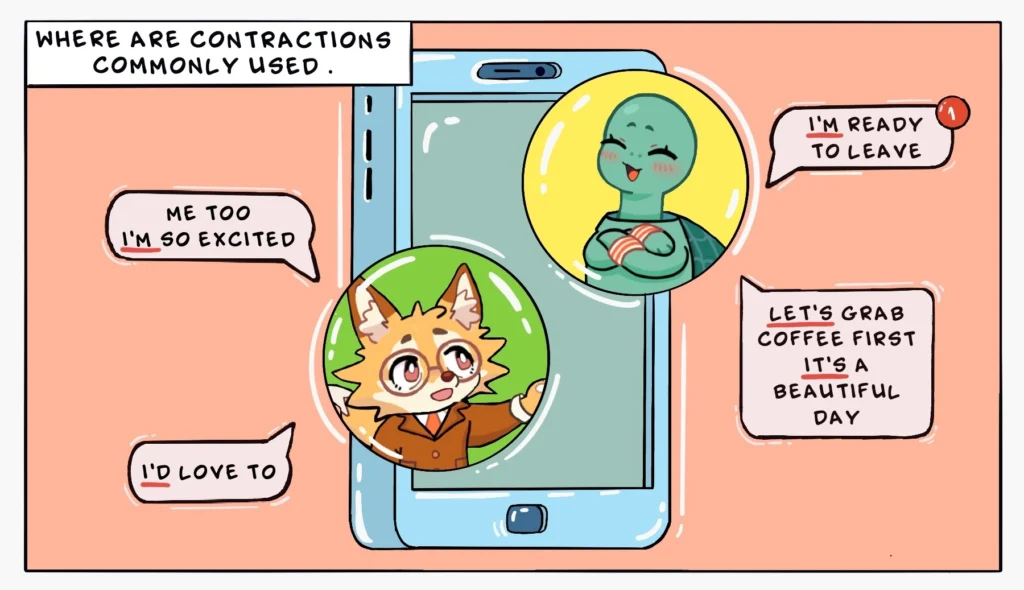
You’ll find contractions everywhere, from casual chats to popular culture! But mostly you will find them in daily conversations.
Contractions in Everyday Speech
Using contractions in everyday speech helps you connect with people in a more casual, socially common way.
In which contexts are they used in everyday life? So many! Here are a few:
- Informal conversations with friends, family, or colleagues.
- Text messages.
- Casual emails.
- Literature (novels, poetry, short stories, magazines, articles, etc).
- Social media (Facebook, Instagram, X, Snapchat, Tumblr).
- Pop culture (movies, TV shows, music, etc).
Here is a visual contrast so you have an idea of how it goes:
| No ✖ | Yes ✔ |
| I am going to the movies. | I’m going to the movies. |
| Do not forget your jacket! | Don’t forget your jacket! |
| What is happening? | What’s happening? |
| It is such a beautiful day. | It’s such a beautiful day! |
| I cannot stop this feeling. | I can’t stop this feeling. |
| Please, do not stop the music. | Please don’t stop the music. |
Inappropriate Uses of Contractions
- Formal academic writing: It’s best to avoid contractions in academic essays, research papers, and dissertations.
- Legal documents or contracts: These documents must leave no room for informalities.
- Professional emails in conservative workplaces: In many business settings, a formal tone is preferred.
30+ Contraction Examples
Here is a reliable list of highly common contraction examples.
You will be able to see not only the contraction but also its full form, and a sentence example!
Common Contraction Examples
| Contraction | Full form | Sentence example |
| I’m | I am | I’m ready to leave. |
| You’re | You are | You’re my bestie! |
| He’s | He isHe has | He’s working on his essay. He’s finished his homework. |
| She’s | She isShe has | She’s amazing!She’s already left for the airport. |
| It’s | It isIt has | It’s raining outside.It’s been a long time since we last met. |
| We’re | We are | We’re on our way! |
| They’re | They are | They’re planning a trip to Jamaica. |
| That’s | That isThat has | That’s an excellent idea!That’s been a problem for her lately. |
| Here’s | Here is | Here’s the book you asked to borrow. |
| There’s | There isThere has | There’s a cat on the roof!There’s been a misunderstanding. |
Negative Contraction Examples
| Contraction | Full form | Sentence example |
| Can’t | Cannot | I can’t believe this! |
| Don’t | Do not | Don’t forget about me. |
| Doesn’t | Does not | She doesn’t like spicy food. |
| Isn’t | Is not | Isn’t it time to go? |
| Aren’t | Are not | We aren’t friends anymore. |
| Won’t | Will not | He won’t be able to join us. |
| Wouldn’t | Would not | I wouldn’t do that if I were you. |
| Shouldn’t | Should not | You shouldn’t blame yourself. |
| Haven’t | Have not | I haven’t seen her in a while. |
| Hadn’t | Had not | We hadn’t heard the news until today. |
Question Contraction Examples
| Contraction | Full form | Example |
| What’s | What isWhat has | What’s up?What’s been happening? |
| Who’s | Who isWho has | Who’s coming to the party?Who’s got the keys? |
| Where’s | Where isWhere has | Where’s the remote?Where’s she gone? |
| Why’s | Why isWhy has | Why’s he so happy today?Why’s the project been delayed? |
| When’s | When isWhen has | When’s the next bus arriving?When’s he been here before? |
| How’s | How isHow has | How’s your new job doing?How’s it been? |
Advanced Contraction Examples
| Contraction | Full form | Sentence Example |
| Could’ve | Could have | I could’ve gotten there on time if it weren’t for the traffic. |
| Should’ve | Should have | You should’ve told me you were coming! |
| Would’ve | Would have | We would’ve helped you earlier. |
| Might’ve | Might have | I might’ve made a mistake. |
| Must’ve | Must have | They must’ve forgotten to lock the door. |
| I’d | I wouldI had | I’d love to go with you!I’d already left. |
| You’d | You wouldYou had | You’d love this movie.You’d finished before I started. |
| He’d | He wouldHe had | He’d rather stay home.He’d been waiting for ages! |
| She’d | She wouldShe had | She’d call if she could.She’d never seen that film. |
| They’d | They wouldThey had | They’d be here by now.They’d already gone to his place. |
| Shouldn’t’ve | Should not have | I shouldn’t’ve said that. |
Conclusion
Contractions are one of the easiest ways to make your English sound smoother, more natural, and more confident.
So, how about some practice?
Think about things you could text a friend when:
- You will not attend his party.
- You want to get coffee with them.
- You cannot believe the weekend flew by so fast.
Lastly, before you leave… A little reading exercise!
- How many hidden contractions can you spot in this article?
- Can you identify their full form?
Put yourself to the test and be amazed at how natural contractions are to the eyes and also the ears.
Remember to be on the lookout for more when you watch and listen to any reels, movies, or podcasts!
P.S. Are you looking to take your English fluency to the next level? Practice regularly and intelligently with our WhatsApp groups or, better yet, join our courses!