“How do you do?” or “What’s up?” 10+ Tips on Informal vs. Formal Language
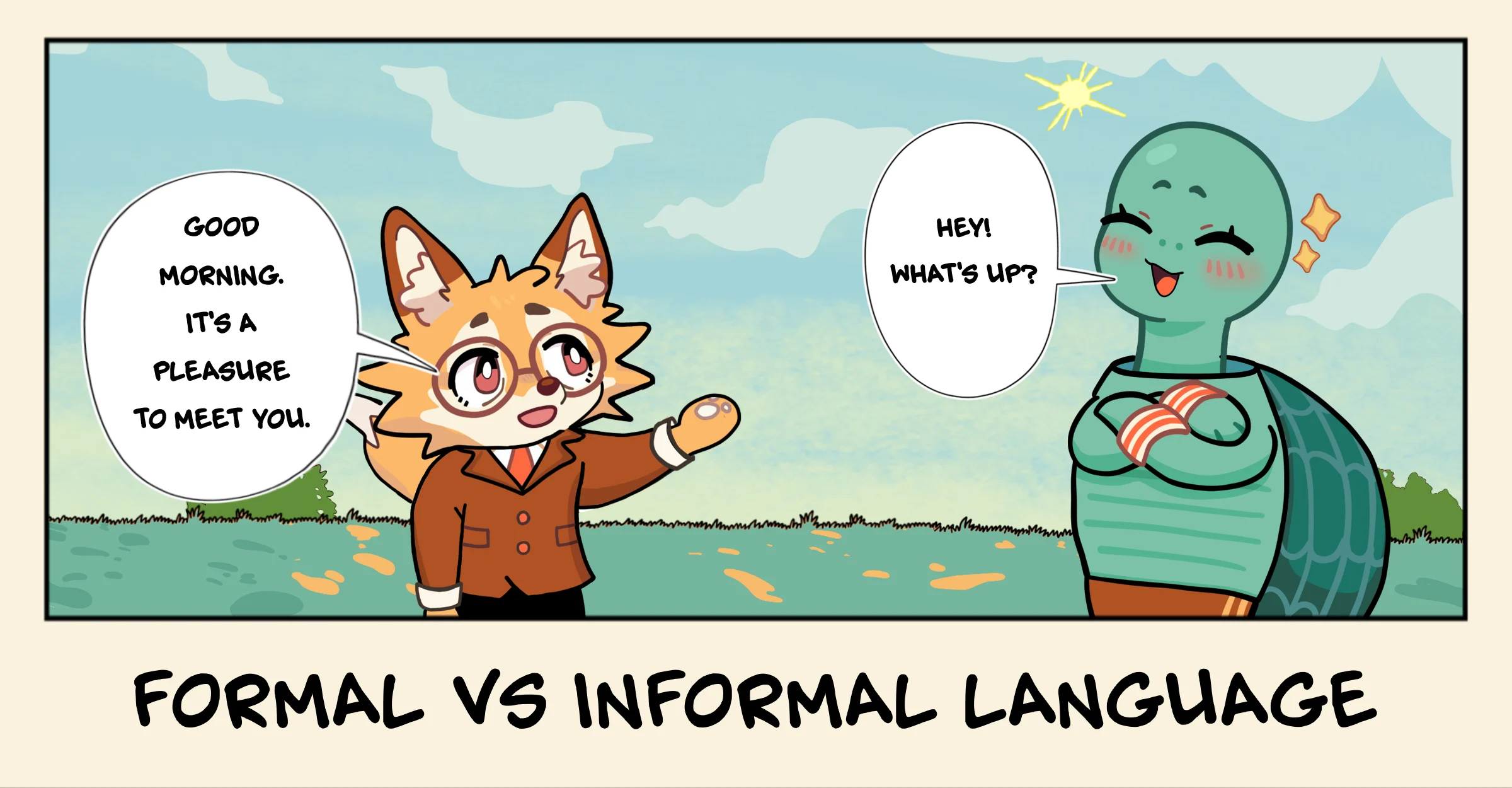
Hey! What’s up? Check out this cool article I wrote about formal vs. informal language- Apologies, that was rather informal of me. What I should have written is; Hello, I have written an informative article on when to use formal vs. informal language. Do you see the difference? Informal vs formal language is one of the first communication skills every English learner should understand.
Informal language is used when speaking with friends, family and peers. It includes slang, abbreviations and contractions.
Formal language uses proper English grammar. It excludes contractions, abbreviations and slang and is used in professional settings.
Learning the difference between the two is important. If you use informal words in a serious setting, you may come across as disrespectful or unprofessional. However, if you use formal language with your friends they may think you are uncomfortable or uptight.
In this guide I will give you clear guidelines on when to use informal and formal language so that you can communicate effectively in any situation.
Table of Contents
The Difference Between Formal and Informal Language
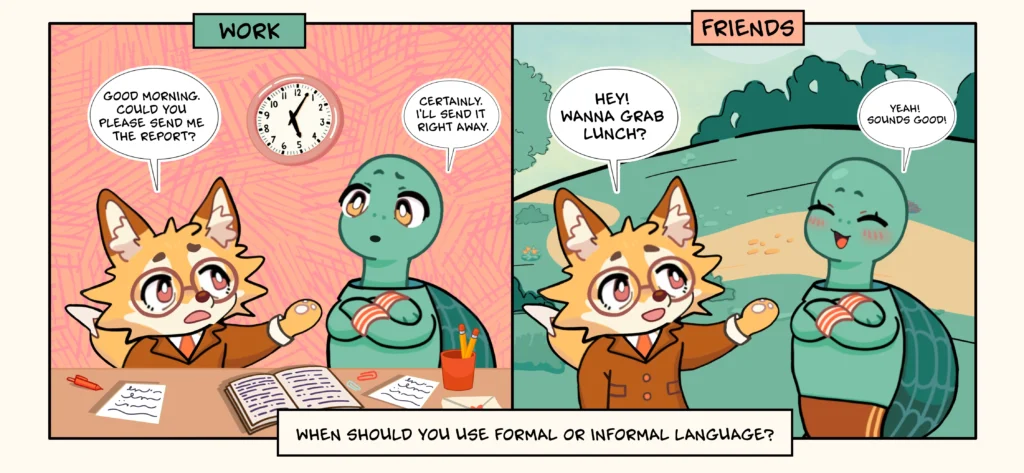
Formal language is used in professional settings such as at work, in school, or when writing professional emails. It is serious and respectful. It uses more complex words, proper grammar, and avoids contractions and slang.
Informal language is much more relaxed and friendly. It is used to speak with friends, family and peers. Slang and contractions are used frequently and the grammar might not be correct.
To sum it up, here are the key differences:
Tone: Formal language is serious and professional. Informal language is relaxed and friendly.
Vocabulary: Formal language uses more complex words. In informal language, slang and contractions are used.
Structure: Formal language uses longer and proper sentence structure and grammar. In informal language, sentences may be short or end in questions and is much more conversational.
Why Should You Know the Difference?
Using the wrong language for a situation can affect how people view you. It can impact your connection with others and harm relationships.
If you use informal language in a professional setting, you might come across as unprofessional or rude. For instance, using emojis or slang in a work email might cause you to not be taken seriously.
However, if you use formal language in an informal setting, you might be seen as uptight or disconnected. This is especially true for text messages which are usually short and concise.
Learning the difference between formal and informal language can impact both your professional and social life.
Examples of Formal and Informal Language
Examples are a good way of learning any language. The differences between informal and formal language can seem unimportant but they are key for proper communication.
Vocabulary
Words are the most important aspect of formal and informal language. The vocabulary you use can easily change the tone of a message.
| Formal | Informal | Example |
| Hello, Good Morning | What’s up? Hey, Hi | “Good morning, Mr. Smith.”“Hey! Allie, what’s up?” |
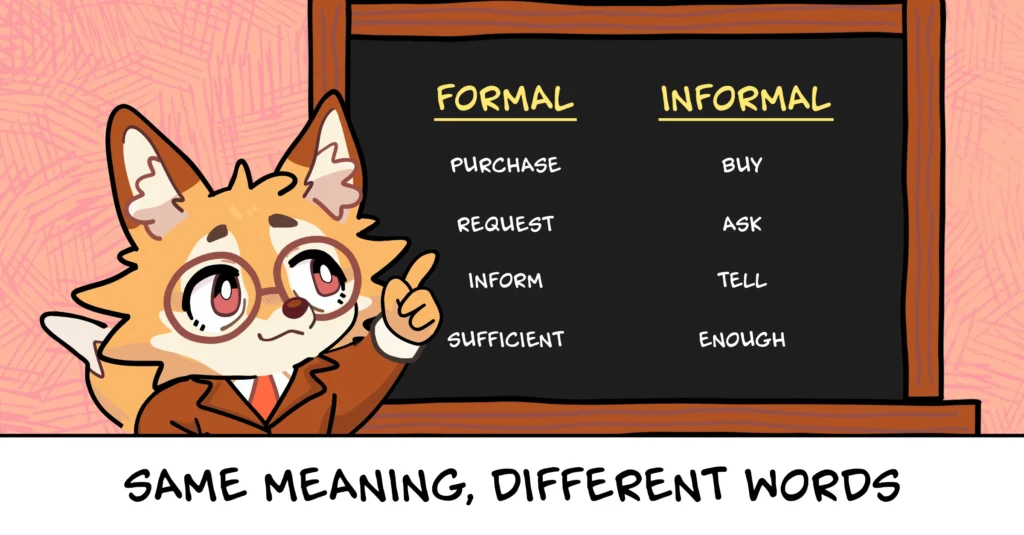
| Request | Ask | “I request that you reply to this email at your earliest convenience.”“Can I ask you something?” |
| Purchase | Buy | “Have you purchased more supplies for the office?”“Can I buy some snacks?” |
| Inform | Tell | “Can you inform me on this week’s results?”“Tell me a secret.” |
| Sufficient | Enough | “We have a sufficient number of employees.”“I’ve had enough cake.” |
| Postpone | Put off | “We are postponing the project.”“Let’s put off our chores and go play.” |
| Omit | Leave out | “I have omitted the person’s name from the record.”“I left out some details.” |
| Oppose | Go against | “I oppose this decision.”“This goes against my beliefs.” |
| Contact | Get in touch with | “I need to contact the client.”“I need to get in touch with Bob.” |
| Goodbye | Bye, See you later, See ya | “Goodbye Ms. Smith.”“See ya, Ashley!” |
Using the Proper Language in Emails
as the greeting is someone’s first impression of you. If you are writing an email for a job interview, you might want to learn a few tips.
| Type | Formal | Informal |
| Greetings | Dear Ms. Allen/ Dear Sir or Madam, To Whom it May Concern, Hello | Hey, Hi, What’s up? |
| Closings | Sincerely, Respectfully, With Regards | Bye, Talk to you later, See you soon |
Guidelines for Formal and Informal Language
There are not any rules per say for formal and informal language, more like guidelines. The more you speak and write, the easier it will be to understand.
Formal Language Guidelines
- Write in full, thought out sentences.
- Never use slang or contractions.
- Use advanced, precise vocabulary. Think of more complex synonyms. For instance instead of bad use; horrible, awful or deplorable.
Informal Language Guidelines
- You may use sentence fragments or one word answers.
- Slang and contractions are common.
- Use relatable vocabulary. Keep up on trends to know what words are “in”
Situations for Formal and Informal Language
It is important to understand what type of language a situation requires in order for you to best represent yourself.
Situations for Formal Language
- Academic settings such as speaking with a professor or writing papers, presentations and emails.
- Professional settings such as speaking with your boss, coworkers, employees or clients or writing a professional email.
Situations for Informal Language
- Conversations with friends or family.
- Text messaging and casual emails.
- Social media
- Storytelling and creative writing.
How to Switch Between Formal and Informal Language
Knowing the right time to use formal or informal language is key to not uncomfortably standing out in a situation.
- Who are you speaking to? A friend? Your teacher? Your boss?
- What is your goal? To make friends? To impress an employer?
- When in doubt, use formal language.
Conclusion
Knowing the differences between formal and informal language is important. It can;
- Affect how someone views you.
- Make you come across as professional or friendly.
- Help you fit in a social situation.
Formal language
- Uses full sentences.
- Doesn’t use slang or contractions.
- Uses more complex words and sentence structure.
Informal language:
- Might use sentences fragments
- Uses slang and contractions.
- Uses simple words and short sentences.
Remember, practice makes perfect. Analyze every situation to determine what type of language to use. Pretty soon, you will be a natural. Phrasal verbs like these can be helpful in both formal and informal language.Talk to you later.
Try writing a practice email in formal language and a text message in informal language.