Master Colloquial Language: 50+ Essential Examples & Tips

When you learn English in a class, you learn the formal rules, like grammar or sentence structure. But when you step out into the real world, you may notice something confusing.
Native speakers don’t always sound like your textbook. They speak fast and sound relaxed. They use words you haven’t studied.
This is where colloquial language comes in. If you rely too much on formal English, you might sound stiff or distant. To truly connect with people, you need to understand how they actually speak in their day-to-day lives.
Table of Contents
What Is Colloquial Language?
Colloquial language (or a colloquialism) is the casual, informal style of communication that people use naturally. You hear it between friends, family members, and coworkers.
- Think of it this way: Formal English is like wearing a suit and tie. Colloquial language is like wearing jeans and a t-shirt. Both are useful, but you wouldn’t wear a suit to a beach party, right?
Colloquial Language vs. Slang vs. Jargon
Many people confuse colloquialisms with slang or jargon. While they are all forms of informal English, they have differences.
| Feature | Colloquialism | Slang | Jargon |
|---|---|---|---|
| Definition | General informal | Trendy words used by sub-groups. | Technical terms for a profession. |
| Duration | Lasts for generations. | Changes very quickly. | Lasts as long as the industry. |
| Example | “I’m gonna grab a soda.” | “That party was lit.” | “We need to optimize the backend API.” |
Where Is Colloquial Language Commonly Used?
You won’t find this type of speech in a business contract, but you will find it almost everywhere else. Here is where you will encounter it most often;
- In Everyday Speech
This is the most common home for colloquial language. It happens in personal conversations between people who know each other.
You can also use it to build friendships. For example, if you invite a coworker to happy hour, switching from formal business speak to a casual tone helps them relax.
- In Media and Pop Culture
Movies and TV shows use colloquial language to make characters feel real. If a character speaks perfectly grammatically correct English all the time, they sound robotic.
Screenwriters use casual phrasing to show that a character is laid back, angry, or from a specific part of the world.
- On Social Media
Scroll through Reddit, Twitter (X), or Instagram, and you will rarely see formal writing. Social media is a conversation, not a lecture.
However, be careful with professional networks. LinkedIn is the exception. While it is becoming more casual, it is still a place for professional networking, so you should limit your use of informal terms there.
- In Literature
Authors use colloquialisms to establish a “voice.” If a story is written in the first person (using “I”), the narrator will often use casual language to make you feel as if you are inside their head.
Why Is It Important to Know Colloquial Language?
You might wonder, “Why can’t I just speak all the time formally?” You can, but you might miss out on deeper connections.
- Understand native speakers: Native speakers use contractions, idioms, and shortcuts constantly.
- Evaluate tone: Understanding casual phrasing helps you read the room. You will know if someone is joking, angry, or being sarcastic.
- Build rapport: Mirroring the language of those around you makes you more relatable. It removes the barrier between “foreigner” and “local.”
- Show personality: Formal language can be dry. Casual language allows you to be funny, warm, and expressive.
Also Read – 30+ Emphatic Anaphora Examples for Stronger English
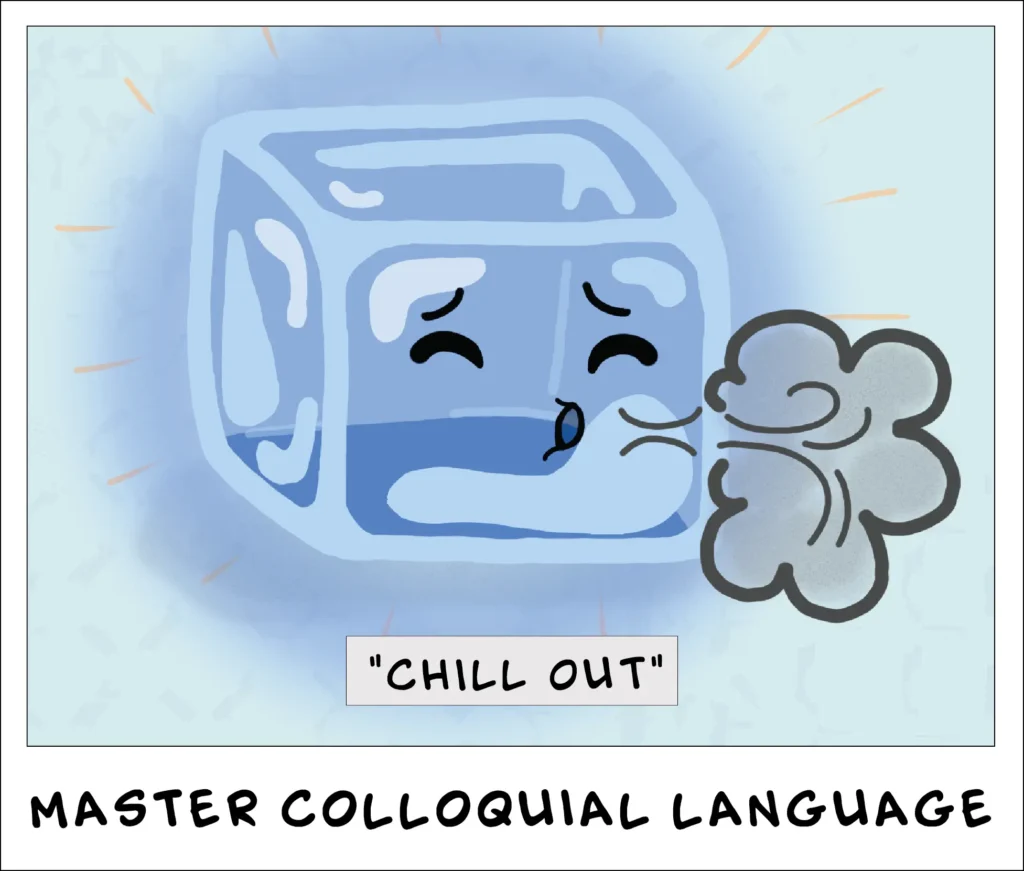
50+ Examples of Colloquial Language
To help you get started, we have categorized the most common examples into tables. We included the phrase, the meaning, and an example sentence to help you practice.
Everyday Expressions
These are phrases you might hear in the grocery store, at a park, or at a casual lunch.
| Phrase | Meaning | Example Sentence |
| “Gonna” | Going to | “I’m gonna buy some milk.” |
| “Y’all” | You all (plural you) | “Are y’all coming to the party?” |
| “Ain’t” | Is not / Are not / Have not | “That ain’t the right answer.” |
| “No dice” | No chance / It didn’t work | “I asked for a refund, but no dice.” |
| “Easy peasy” | Very easy | “The exam was easy peasy.” |
| “Takes the biscuit.” | Something annoying or surprising | “He arrived an hour late? That really takes the biscuit.” |
| “Wicked” | Amazing / Cool | “That guitar solo was wicked!” |
| “Glow up” | Positive change in appearance | “She really had a glow up over the summer.” |
Colloquial Language About People
Use these terms when referring to friends, family, or strangers in a casual setting.
| Phrase | Meaning | Example Sentence |
| “Dude” | Friend / Male person (can be gender-neutral) | “Hey, dude, what’s up?” |
| “Bro” | Brother / Friend | “Thanks for the help, bro.” |
| “Old man” | Father | “My old man is teaching me to drive.” |
| “Babe” | Romantic partner | “Love you, babe.” |
| “Love” | Romantic partner (or friendly term in the UK) | “You alright, love?” |
| “Old lady” | Mother (or sometimes wife/girlfriend) | “I’m going to visit my old lady this weekend.” |
| “Bestie” | Best friend | “She’s my bestie, we tell each other everything.” |
| “Gramps” | Grandfather / Old person | “Take it easy, gramps.” |
| “Doc” | Doctor | “What’s the diagnosis, Doc?” |
| “My angel” | A person deeply cared for | “You are my angel for helping me move house.” |
Colloquial Language About Feelings
Formal English describes emotions clinically (e.g., “I am fatigued”). Colloquial language paints a picture.
| Phrase | Meaning | Example Sentence |
| “Chill out” | Relax / Calm down | “You need to chill out, it’s not a big deal.” |
| “Beat” | Very tired | “I worked 12 hours today, I’m totally beat.” |
| “Bummed” | Disappointed | “I’m bummed that the concert was canceled.” |
| “Spent” | Exhausted / Out of energy | “After the marathon, I was physically spent.” |
| “Burnt out” | Tired due to chronic stress/work | “I need a vacation, I’m feeling burnt out.” |
| “Hyped” | Excited | “I am so hyped for the new movie.” |
| “Spooked” | Scared or nervous | “That noise really spooked me.” |
| “Baffled” | Confused | “I am baffled by these instructions.” |
| “Gives me the ick.” | Sudden feeling of disgust | “The way he chews loudly gives me the ick.” |
| “Head over heels.” | Deeply in love | “They are head over heels for each other.” |
Colloquial Language in Situations
These are action-oriented phrases often used to describe plans.
| Phrase | Meaning | Example Sentence |
| “Hit the books.” | Study | “I have a test tomorrow, so I have to hit the books.” |
| “Crash” | Fall asleep quickly / Sleep at someone’s house | “Can I crash on your sofa tonight?” |
| “Hang out” | Spend time socially | “Let’s hang out this weekend.” |
| “Hit the sack.” | Go to bed | “It’s late, I’m going to hit the sack.” |
| “Cooked” | In trouble / Exhausted / Done | “If I don’t finish this report, I am cooked.” |
| “Hit it” | Start something / Play music | “Okay, band, let’s hit it!” |
| “Kill time” | Keep busy while waiting | “I played games on my phone to kill time.” |
| “Book it” | Move very fast | “We had to book it to catch the train.” |
| “Screwed” | In a bad situation / Done for | “I forgot my wallet, I’m screwed.” |
| “Give a hand.” | Help someone | “Can you give me a hand with these boxes?” |
Regional Colloquial Language Examples
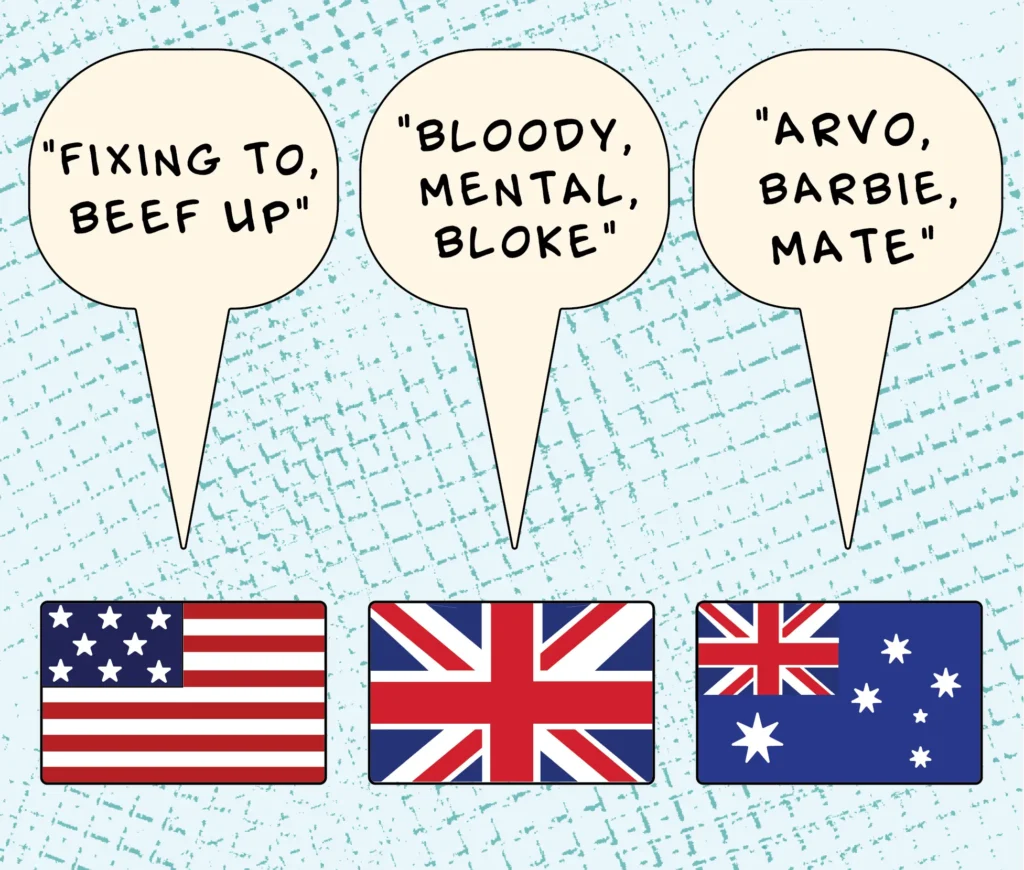
English changes depending on where you are. Here is how different regions use colloquial language.
| Phrase | Region | Meaning |
| “Fixing to” | Southern US | Preparing to do something |
| “Bloody” | UK | Very / Really (Emphasis) |
| “Arvo” | Australia | Afternoon |
| “Mate” | UK / Australia | Friend or buddy |
| “Mental” | UK | Crazy / Wild |
| “Gobsmacked” | UK | Shocked / Speechless |
| “Barbie” | Australia | Barbeque |
| “Beef up” | USA | Strengthen or improve something |
| “Bloke” | UK | Man |
| “Snag” | Australia | Sausage |
The Pros and Cons of Colloquial Language
Just because it is popular doesn’t mean it is always perfect. You need to weigh the benefits against the risks.
Pros: Why Use It?
- Makes communication natural.
- Strengthens group identity.
- Adds humor and personality
Cons: The Risks
- Regional misunderstandings
- Appears unprofessional
- Risk of offense.
How to Detect Colloquial Language
- Compare the phrase you are hearing with its formal equivalent.
- Look for contractions such as saying “don’t” instead of “do not”.
- Look for figurative language such as “It’s raining cats and dogs,” which does not mean animals are falling from the sky.
When Is Colloquial Language Appropriate?
Context is everything. You wouldn’t wear pajamas to a wedding, and you shouldn’t use slang in a court of law.
Appropriate Uses
- Conversations with friends and peers: This builds rapport and strengthens bonds.
- Creative writing and storytelling: Essential for making dialogue sound human.
- Social media posts: Helps you sound genuine and engage with followers.
- Casual blogs: Make the reader feel like you are speaking directly to them.
Inappropriate Uses
- Academic essays: Professors expect formal analysis. Slang detracts from your authority.
- Job interviews: Unless the company culture is famously relaxed, stick to professional English to show respect.
- Legal or formal communication: Clarity is the priority here. Colloquialisms can be vague and lead to misinterpretation.
Conclusion
Mastering colloquial language is the key to unlocking better relationships with English speakers. It allows you to understand local culture, get the joke, and express your true personality.
However, remember that it is a tool. You need to know when to use it and when to leave it in your toolbox. Aim for a balance: maintain a professional tone in formal situations, but don’t be afraid to loosen up.
References: https://en.wikipedia.org/wiki/Colloquialism