30 Idioms About Work for Better Business English
If you’ve ever participated in a business meeting, read a corporate blog, or even watched a movie about office life, you’ve probably noticed how often people use idioms about work.
These phrases add vividness, humor, and clarity to communication, while making the description of situations regarding the workplace and the business world sound more natural, confident, and fluent.
Table of Contents
By the end, you’ll see how these expressions can boost your workplace English, improve communication, and even help kids and learners adapt them naturally.
- What Are Idioms in English?
An idiom is a fixed phrase or expression whose meaning is different from the literal meanings of its words.
For example:
- “Burning the midnight oil” doesn’t mean someone is literally lighting oil at midnight; it means working late into the night.
- Idioms are part of what makes English exciting but also tricky. They reflect culture, humor, and shared experiences.
If you’re new to idioms, check out this English idioms list for a wider overview.
- How do Idioms About Work Differ from Everyday Idioms?
Idioms about work are focused on professional life, teamwork, challenges, and success. While everyday idioms may talk about subjects common to everyone (like idioms about food), workplace idioms come alive in offices, meetings, and business writing.
Example:
- Everyday idiom: “It’s raining cats and dogs” → heavy rain.
- Work idiom: “Climb the corporate ladder” → advance in your career.
Idioms vs. Metaphors: A Quick Note
People often confuse idioms with metaphors.
- An idiom is a fixed expression that you can’t change without losing its meaning.
Example: “Back to square one.” - A metaphor is a broader comparison where one thing represents another.
Example: “Life is a journey.”
Idioms are like “set recipes,” while metaphors are flexible cooking experiments. If you want to dive deeper, here’s a full guide with a list of common metaphors that will help you understand how they are constructed.
- Where Are Idioms about Work Commonly Used?
Work idioms appear in many professional and casual settings:
1. Everyday Workplace Conversations
- Small talk with colleagues: Even the phrase “water cooler talk” is a work idiom.
- Friendly reminders like “Don’t bite off more than you can chew”
2. Meetings and Brainstorming Sessions
- Motivating a team by saying “let’s think outside the box” or similar.
- Wrapping up with “We’re all on the same page”
3. Professional Writing
- Polishing emails and presentations
- Strengthening resumes and cover letters with idioms (sparingly)
Learn more about writing style in “What is Academic Writing?”.
4. Media and Business Culture
- Business magazines often use idioms like “against the clock”. Work idioms add drama to these stories.
- Motivational speeches highlight idioms like “Pull your weight”. As idioms are more evocative than simply explanatory speech, they can be a powerful inspirational tool.
- 30 Idioms About Work with Meanings and Examples
Now let’s dive into 30 of the most powerful workplace idioms, grouped by theme. Each idiom comes with:
- Definition
- Professional example
- Professional example
Teamwork and Collaboration Idioms
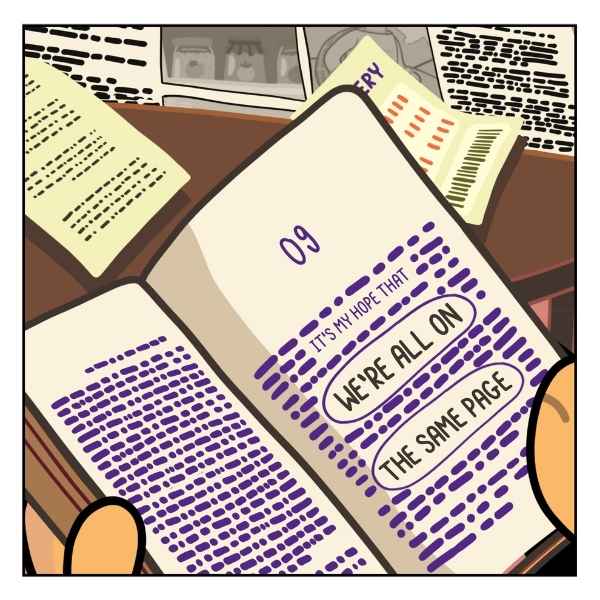
- On the Same Page
Meaning: To be in agreement.
- Work Example: “Before we launch the project, let’s make sure we’re all on the same page.”
- Learner Example: A teacher says, “Before we start drawing, let’s make sure we’re all on the same page about the rules.”
2. Pull Your Weight
Meaning: To do your fair share of work.
- Work Example: “Every team member needs to pull their weight for this campaign to succeed.”
- Learner Example: On a school project, a student reminds a friend, “We all need to pull our weight if we want an A.”
3. Too Many Cooks Spoil the Broth
Meaning: Too many people working on the same task can cause confusion.
- Work Example: “We can’t have five managers editing the same document; too many cooks spoil the broth.”
- Learner Example: A group of friends decorating a cake argue too much, and one laughs, “See? Too many cooks spoil the broth!”
4. Keep the Ball Rolling
Meaning: To maintain progress.
- Work Example: “Let’s assign tasks now to keep the ball rolling.”
- Learner Example: A coach tells kids, “Pass quickly to keep the ball rolling during practice.”
5. Hit the Ground Running
Meaning: To start a task with great energy and speed.
- Work Example: “The new intern hit the ground running with fresh ideas.”
- Learner Example: A child starting a puzzle quickly finds the corner pieces and “hits the ground running.”
Time and Productivity Idioms
6. Burning the Midnight Oil
Meaning: Working late into the night.
- Work Example: “She’s burning the midnight oil to finish the report.”
- Learner Example: A student says, “I burned the midnight oil finishing my art project.”
7. Against the Clock
Meaning: Working under time pressure.
- Work Example: “We’re racing against the clock to meet this deadline.”
- Learner Example: During a timed quiz, a teacher says, “You’re working against the clock, kids; five minutes left!”
8. A Race Against Time
Meaning: Very little time to finish something.
- Work Example: “Delivering the vaccine was a race against time.”
- Learner Example: Two children cleaning their room before dinner say, “It’s a race against time!”
9. Time is Money
Meaning: Time is valuable and shouldn’t be wasted.
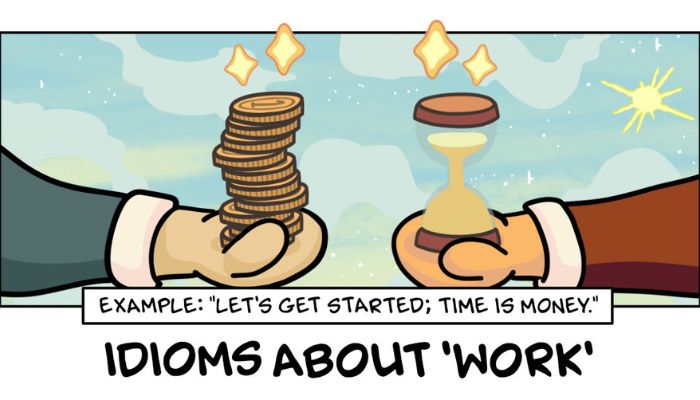
- Work Example: “Let’s get started; time is money.”
- Learner Example: A parent says, “Finish your homework quickly; time is money!”
10. Beat the Clock
Meaning: To finish before a deadline.
- Work Example: “We beat the clock and submitted early.”
- Learner Example: Kids racing to tidy up before a show starts cheer, “We beat the clock!”
Success and Failure Idioms
11. Climb the Corporate Ladder
Meaning: Advance in one’s career.
- Work Example: “She climbed the corporate ladder to become CEO.”
- Learner Example: A child mastering different levels in a game says, “I’m climbing the ladder!”
12. Back to Square One
Meaning: Start over after failure.
- Work Example: “The client rejected our idea, so it’s back to square one.”
- Learner Example: A student erases a wrong drawing and says, “Back to square one.”
13. Corner the Market
Meaning: To dominate an industry or area.
- Work Example: “That company cornered the market in smartphones.”
- Learner Example: A child with the most trading cards boasts, “I’ve cornered the market!”
14. In the Driver’s Seat
Meaning: To be in control.
- Work Example: “After the promotion, she’s in the driver’s seat.”
- Learner Example: A kid playing a racing game says, “I’m in the driver’s seat now!”
15. Ahead of the Curve
Meaning: Innovative, more advanced than others.
- Work Example: “Our AI tool keeps us ahead of the curve.”
- Learner Example: A student who finishes homework before others is “ahead of the curve.”
Challenge and Problem-Solving Idioms
16. Think Outside the Box
Meaning: Be creative and innovative.
- Work Example: “We need to think outside the box to attract new clients.”
- Learner Example: A teacher praises a child’s unique idea, “That’s really thinking outside the box!”
17. Bite the Bullet
Meaning: Face a difficult situation bravely.
- Work Example: “I had to bite the bullet and present alone.”
- Learner Example: A child finally visits the dentist and says, “I bit the bullet.”
18. Cut Corners
Meaning: To do something cheaply or carelessly.
- Work Example: “We can’t cut corners on safety.”
- Learner Example: A child rushing art homework hears, “Don’t cut corners; take your time.”
19. Hit a Snag
Meaning: Encounter a small problem.
- Work Example: “We hit a snag with the budget.”
- Learner Example: A child’s kite gets stuck in a tree: “We’ve hit a snag!”
20. Throw in the Towel
Meaning: To give up.
- Work Example: “After many failed attempts, he threw in the towel.”
- Learner Example: A student says, “I threw in the towel on the puzzle.”
Motivation and Progress Idioms
21. Raise the Bar
Meaning: To set higher standards.
- Work Example: “The new policy raises the bar for performance.”
- Learner Example: A coach says, “Let’s raise the bar in practice today.”
22. Step Up to the Plate
Meaning: To take responsibility.
- Work Example: “She stepped up to the plate and led the project.”
- Learner Example: A child volunteers to answer a hard question, “stepping up to the plate.”
23. The Ball is in Your Court
Meaning: It’s your decision or responsibility.
- Work Example: “I’ve given my feedback; the ball is in your court.”
- Learner Example: After explaining homework, a teacher says, “Now the ball is in your court.”
24. Break New Ground
Meaning: Do something innovative.
- Work Example: “This startup is breaking new ground in healthcare.”
- Learner Example: A child trying a new Lego design is “breaking new ground.”
25. A Win-Win Situation
Meaning: A solution beneficial to all.
- Work Example: “This partnership is a win-win for both companies.”
- Learner Example: Two friends swapping snacks both love call it a “win-win.”
Workplace Stress & Problem Idioms
26. In Over Your Head
Meaning: Overwhelmed by something too difficult.
- Work Example: “He was in over his head with too many tasks.”
- Learner Example: A child holding too many toys sighs, “I’m in over my head!”
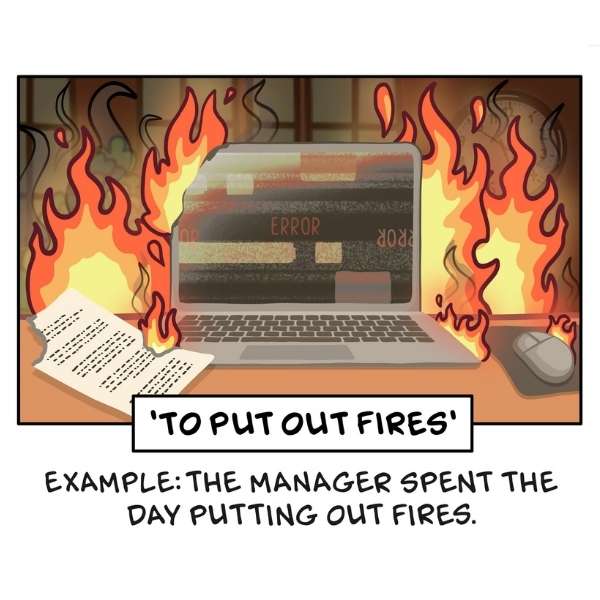
27. Put Out Fires
Meaning: Solve urgent small problems.
- Work Example: “The manager spent the day putting out fires.”
- Learner Example: A parent fixing a sibling fight says, “I’m just putting out fires here!”
28. Middle of Nowhere
Meaning: A very remote place.
- Work Example: “The warehouse was in the middle of nowhere, perfect for our quiet team retreat.”
- Learner Example: “Our camping site was really the middle of nowhere, a great adventure spot for us.”
“This phrase is also noted in authoritative sources like Merriam-Webster for its figurative meaning.”
29. At the Eleventh Hour
Meaning: At the last possible moment.
- Work Example: “They delivered at the eleventh hour.”
- Learner Example: A child finishing homework before class says, “Done at the eleventh hour!”
30. Hit the Road
Meaning: To leave or start a journey.
- Work Example: “After the client meeting, it was time to hit the road and prepare for the next appointment.”
- Learner Example: “We packed our bags and hit the road for the school field trip.”
“You can also find this idiom listed in the Cambridge Dictionary as a common figurative expression.”
- How to Practice Using Idioms about Work Correctly
- Listen and Note: Business podcasts, shows, and speeches are full of idioms
- Roleplay: Practice meetings or interviews with idioms. Have one person act as interviewer and one person act as the interviewed.
- Write Samples: Draft emails using one or two idioms.
- Use Sparingly: Idioms add color, but too many may be confusing for readers.
If you’re balancing a busy schedule, check out these strategies to help maximize your time with English learning.
Situations Where You’d Use Idioms
Appropriate Uses
- Team discussions and brainstorming. When talking amongst yourselves, idioms help exchange ideas and speed up collaboration.
- Motivational speeches. Again, since motivation is often internal communication, and is designed to be more persuasive than completely formal, work idioms are a strong device for communicating emphatically with others.
- Networking events. Idioms are built on shared references, which makes them a great fit for networking. When you can establish common ground with someone easily, you’re able to build your business relationship.
Inappropriate Uses
- Legal contracts.
- Highly formal communication.
- International settings where idioms may confuse non-natives.
For clarity in global settings, see English: The Key to Global Communication and Success.
- Idioms About Work: Final Thoughts
Idioms about work make English richer, sharper, and more relatable. They help you:
- Communicate ideas more vividly in the workplace.
- Build rapport with colleagues.
- Show confidence in both formal and casual terms in business settings.
They also slip naturally into kids’ daily learning, whether it’s finishing homework “against the clock” or stepping up in a classroom.
And remember: idioms are different from metaphors, but both add color to your speech. Mastering them boosts your confidence, fluency, and professional impact.
Ready to grow further? Explore more expressions in advanced English idioms or sharpen your skills with business English online.
FAQs
What are idioms about work?
They are fixed phrases used to describe workplace situations in colorful ways.
Can idioms about work be used in resumes?
Yes, but sparingly. For example: “Proven ability to think outside the box.”
How can kids learn idioms?
Through stories, school projects, or games where idioms fit naturally.
Are idioms the same as slang?
No. Idioms are widely understood; slang is more informal and culture-specific.
Which idioms are most common in business?
“On the same page,” “Think outside the box,” and “Pull your weight.”
Should I avoid idioms in formal writing?
Yes. Use them in speeches, blogs, and presentations, but not contracts.
How do idioms improve fluency?
They make your English sound natural, relatable, and confident.
Do all cultures use idioms?
Yes, but expressions vary. Learning English idioms helps bridge cultural gaps.
How do I practice idioms daily?
Try using one idiom a day in writing or conversation.
Where can I find more idioms?
Check out sports idioms, idioms for IELTS, and idioms about money.