30+ Idioms vs Metaphors: Key Differences & Easy Examples
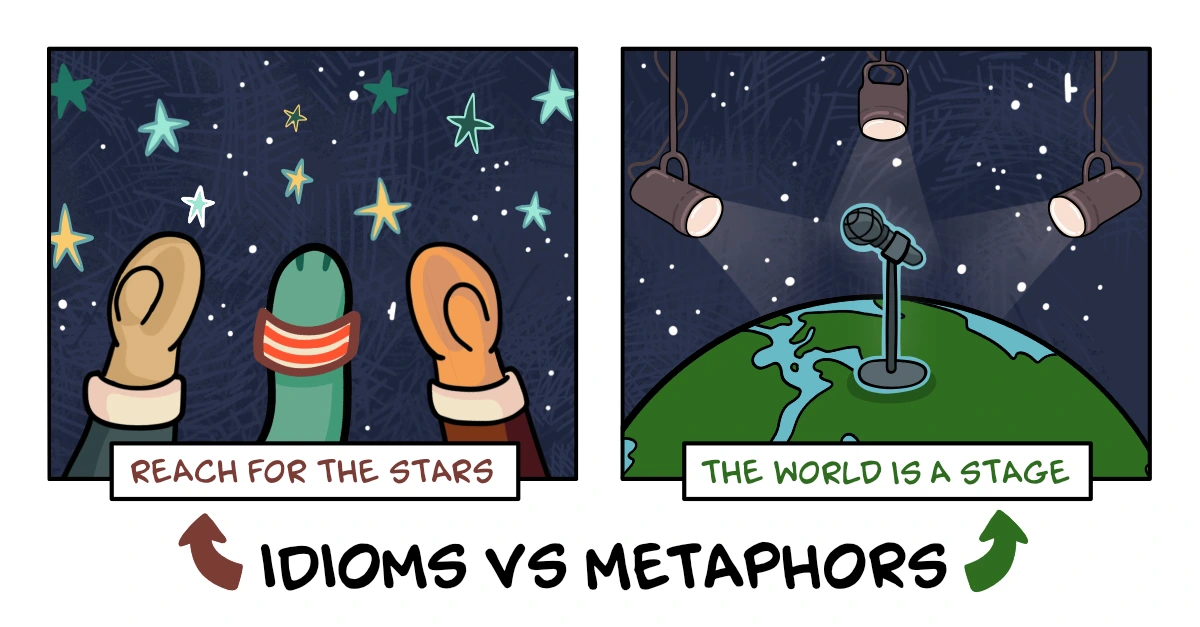
English learners are often confused by the difference between Idioms vs metaphors, but understanding this can instantly make your speaking and writing clearer. Idioms are fixed cultural phrases with meanings that aren’t literal, while metaphors are creative comparisons you can invent to explain ideas. Mastering both will boost your fluency, comprehension, and confidence.

Understanding the difference between idioms and metaphors is more than a grammar lesson. It’s a doorway into cultural awareness, storytelling power, and sharper communication. Idioms are like secret codes shared by communities, while metaphors are universal keys that unlock imagination.

In this guide, we’ll break down the definitions of each, show you the key differences, explore where and how they’re used, and give you 30+ fresh examples. By the end, you’ll know not just what they mean, but also when and how to use them naturally.

If you’re looking to become fluent in English, check out our Advanced English Idioms guide after this article.

What Are Idioms?

An idiom is a fixed expression that carries a figurative meaning different from its literal words. You can’t translate idioms word-by-word. For example:

  • “Kick the bucket” → means to die, not literally kick a bucket.
  • “Break the ice” → means to start a conversation in a friendly way.
  • “Spill the beans” → means to reveal a secret.

Idioms live in the cultural DNA of a language. They’re shaped by history, jokes, daily life, and traditions. That’s why an idiom familiar in the U.K. might puzzle someone in Asia.

Idioms often:

  • Appear in informal conversations.
  • Express humor, feelings, or cultural references.
  • Don’t change structure if you try to alter words, they lose meaning.

For children, idioms can feel like riddles. That’s why resources like Fun Idioms for Kids help make them playful and easy.

Examples in Business and Learning Contexts

  • “Get the ball rolling” → start a project.
  • “On the same page” → agree on a plan.

Idioms even appear in English exams. See our guide on Idioms for IELTS Speaking for targeted practice.

Think of idioms as “secret codes” you can only unlock by knowing the cultural context.

According to the Cambridge Dictionary, an idiom is a phrase whose meaning isn’t obvious from the words alone.

What Are Metaphors?

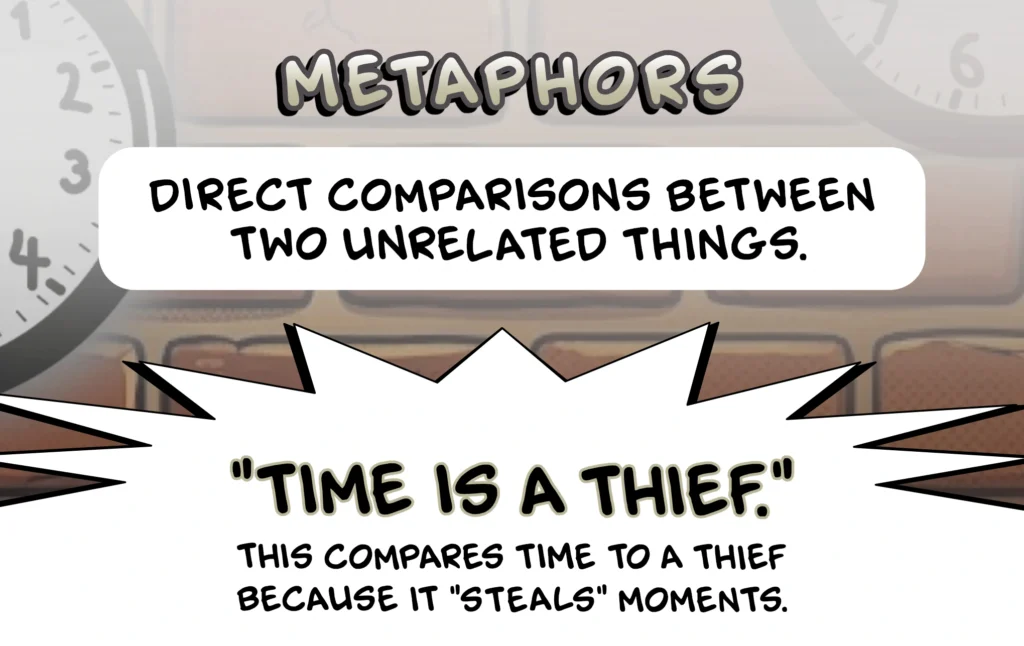
A metaphor is a direct comparison between two unrelated things. Unlike idioms, metaphors are not fixed expressions. They are flexible, creative, and often easier to understand from the words used.

Examples:

  • “Time is a thief” → compares time to a thief because it “steals” moments.
  • “He’s a shining star” → highlights talent and success.
  • “Her voice was music to my ears” → emphasizes pleasure and beauty.

Unlike idioms, metaphors can be invented on the spot. That’s why writers and poets love them—they make abstract ideas vivid and are a flexible way to communicate concepts.

Teachers often use metaphors to simplify complex ideas. For example, calling the internet a library without walls helps students grasp its scope. See our Teaching Metaphors guide for classroom strategies.

Where Metaphors Appear

  • Poetry and novels – e.g., Shakespeare’s “All the world’s a stage.”
  • Speeches – Martin Luther King Jr.’s “Let freedom ring.”
  • Everyday life — parents saying, “My child is my sunshine,” something prohbitive being described as “a ball and chain”, etc.

Metaphors are deeply tied to imagination and universal concepts. That’s why they resonate across cultures, unlike idioms, which often feel speicifc to locals.

See our full List of Metaphors for more inspiration.

Key Differences Between Idioms vs Metaphors

Here’s a clear breakdown of idioms vs metaphors:

FeatureIdiomsMetaphors
StructureFixed phrases, cannot be alteredFlexible, creative, can be invented
MeaningFigurative and culturalFigurative and universal
UnderstandingDifficult without cultural contextEasier to decode logically
UsageInformal speech, humor, storytellingLiterature, speeches, academic writing
FlexibilityRarely change wordsCan adapt or expand

Example side by side:

  • Idiom: “Burn the midnight oil” = work late into the night.
  • Metaphor: “My brain is an overworked engine” = mentally exhausted.

You can see that both idioms and metaphors can be used to express the same idea. Which you choose depends whether you think your audience will understand a given idiom, as well as whether you want to add extra creativity into your language or not.

For a full dive into idioms, visit our English Idioms List.
For metaphors, explore our Metaphors About Life.

Idioms vs Metaphors in Everyday Conversations

Language lives in conversation. Idioms and metaphors both shape how we speak casually with friends, family, or coworkers.

Idioms in Conversations

  • “Bite the bullet” → face a tough situation bravely
  • “Let the cat out of the bag” → reveal a secret
  • “Go the distance” → to complete something or finish an ordeal

Idioms often add humor or cultural flavor.

Metaphors in Conversations

  • “My mind is a storm” → feeling overwhelmed
  • “She’s a rock in my life” → someone reliable
  • “He’s my muse” → someone who inspires you, e.g. to create

Metaphors often add emotional depth.

If you want more practice with conversational idioms and metaphors, check out Daily English Conversation Topics.

Idioms vs Metaphors in Literature and Media

Literature thrives on figurative language. Idioms and metaphors are the colors painters use on the canvas of storytelling.

  • Idioms: Authors use them to build cultural realism. Example: Characters in a novel might say “It’s raining cats and dogs” to show authenticity.
  • Metaphors: Writers use them for imagery. Example: “Her eyes were oceans of mystery.”

Films and songs also love figurative language.

  • Idiom in film: “Break a leg” before a performance.
  • Metaphor in song: “You are the sunshine of my life.”

To see how figurative symbols shape stories, read Symbols in Literature.

Idioms vs Metaphors in Academic and Professional Writing

Academic and professional contexts demand clarity, which is why you need to be careful how you use figurative language.

  • Idioms: Rarely used in research papers, but may appear in motivational talks or training sessions.
  • Metaphors: Common in essays, TED Talks, and speeches as a means of explaining explain abstract ideas.

Example in business writing:

  • Metaphor: “The market is a battlefield.”
  • Idiom: “Level playing field.”

For formal writing insights, visit What Is Academic Writing?.
Also see Business English Online.

Idioms in Action (15 Examples)

  1. Kick the bucket – die.
  2. Break the ice – start a conversation.
  3. Spill the beans – reveal a secret.
  4. Get cold feet – become nervous.
  5. Hit the sack – go to bed.
  6. Throw in the towel – give up.
  7. A blessing in disguise – something bad with hidden good.
  8. Burn the midnight oil – work late.
  9. Cry over spilled milk – regret the past.
  10. Cost an arm and a leg – very expensive.
  11. Piece of cake – very easy.
  12. Under the weather – feeling sick.
  13. The ball is in your court – your decision, your move.
  14. A dime a dozen – very common.
  15. Once in a blue moon – very rare.

Explore themed idioms: Sports Idioms, Animal Idioms, Food Idioms.

Metaphors in Action (15 Examples)

  1. Time is a thief – time steals.
  2. The world is a stage – life is a performance.
  3. He’s a shining star – very talented.
  4. The classroom was a zoo – chaotic.
  5. My heart is a stereo – full of feelings.
  6. The road ahead is tough – difficult journey.
  7. Her eyes were oceans – deep and mysterious.
  8. He’s a rock – reliable person.
  9. The internet is a library without walls – unlimited info.
  10. Love is a battlefield – struggle and passion.
  11. Her words cut deep – painful.
  12. My brain is a sponge – absorbs knowledge.
  13. Laughter is the best medicine – heals emotions.
  14. He carries the weight of the world – overwhelmed.
  15. Her smile is sunshine – warmth and joy.

More here: Metaphors About Life and Funny Metaphors in English.

Idioms offer ready-made expressions. Metaphors allow personal creativity.

How to Practice Using Idioms vs Metaphors Correctly

  1. Read – novels, articles, poems. The more forms of media you read where idioms and/or metaphors appear, the better you will be at recognizing them and understanding where they are appropriate to use.
  2. Write – try replacing literal sentences with figurative ones. See how idioms and metaphors can change the effect of a sentence.
  3. Speak – drop idioms in casual chats, try using metaphors in speeches. Using figurative language live and observing peoples’ reactions will test whether you understand the concepts correctly.
  4. Play games – quizzes, flashcards, roleplays, and other word games can help teach you common idioms or metaphors. These are ideal for learning in quick bursts and practicing a little each day.

Start playful drills with Games for Learning English.

When to Use Idioms vs Metaphors

  • Idioms:
    • Informal conversations.
    • Jokes, humor, cultural stories.
  • Metaphors:
    • Creative writing.
    • Speeches.
    • Explaining abstract concepts.

For professional usage, check The Importance of Business English.

Common Mistakes to Avoid

  • Overusing figurative language in technical contexts. Technical writing is much less creatively-oriented than other writing, and thus using figurative language can confuse readers. This form of writing needs to be as clear and factual as possible.
  • Mixing idioms and metaphors incorrectly. When you use multiple idioms and metaphors in your writing or speech, you need to make sure they all fit together and do not send conflicting messages.
  • Using idioms that don’t translate across cultures. Just like non-native speakers need to practice and make an effort to understand English idioms, you need to be mindful of the fact that people from different cultures will have different idioms according to their own set of cultural norms and understanding. They may not understand an idiom that’s too specific to one place.

Improve the clarity of your English with our Common Grammar Mistakes guide.

Conclusion

Idioms and metaphors are cousins in the family of figurative language. Idioms carry cultural wisdom and humor, while metaphors bring imagination and universal truth.

  • Idioms = fixed, cultural, and often playful.
  • Metaphors = flexible, universal, and creative.

Both can express similar ideas, and you will come across people using both metaphors and idioms to make points. Mastering each makes you a more engaging speaker, writer, and thinker.

Ready to dive deeper? Explore Examples of Personification to see how figurative language keeps English alive and exciting.

FAQs

1: What is the main difference between idioms and metaphors?

Idioms are fixed cultural phrases with figurative meaning, while metaphors are creative comparisons you can invent to make ideas vivid.

2: Can idioms also be metaphors?

Yes. Some idioms have metaphorical roots, but idioms are frozen expressions while metaphors remain flexible and adaptable.

3: Are idioms used in academic writing?

Rarely. Academic writing favors clarity. Metaphors may appear for explanation, but idioms are mostly avoided.

4: How do I practice using idioms vs metaphors?

Read widely, write figurative sentences, practice in conversation, and use learning games to master when each fits best.

5: Why are idioms harder to learn than metaphors?

Idioms require cultural knowledge and can’t be translated word-for-word. Metaphors, however, are logical comparisons that make sense universally.

6: Which is more common in everyday speech, idioms or metaphors?

Idioms are more common in casual conversations, while metaphors often appear in storytelling, speeches, and creative writing.

7: Do idioms and metaphors exist in all languages?

Yes. Every language has idiomatic expressions and metaphorical thinking, though the forms and cultural meanings vary.

8: How do idioms and metaphors help in exams like IELTS or TOEFL?

Idioms show cultural fluency, while metaphors demonstrate creativity and vocabulary depth. Both can boost speaking and writing scores.

9: Can I create my own idioms?

No. Idioms are set by cultural usage. You can’t invent one and expect others to understand. But you can freely create metaphors.

10: Which is easier to teach idioms or metaphors?

Metaphors are easier to teach because they rely on logic. Idioms take longer since they depend on cultural background and memorization.