30+ Place Idioms That Enrich Your Vocabulary
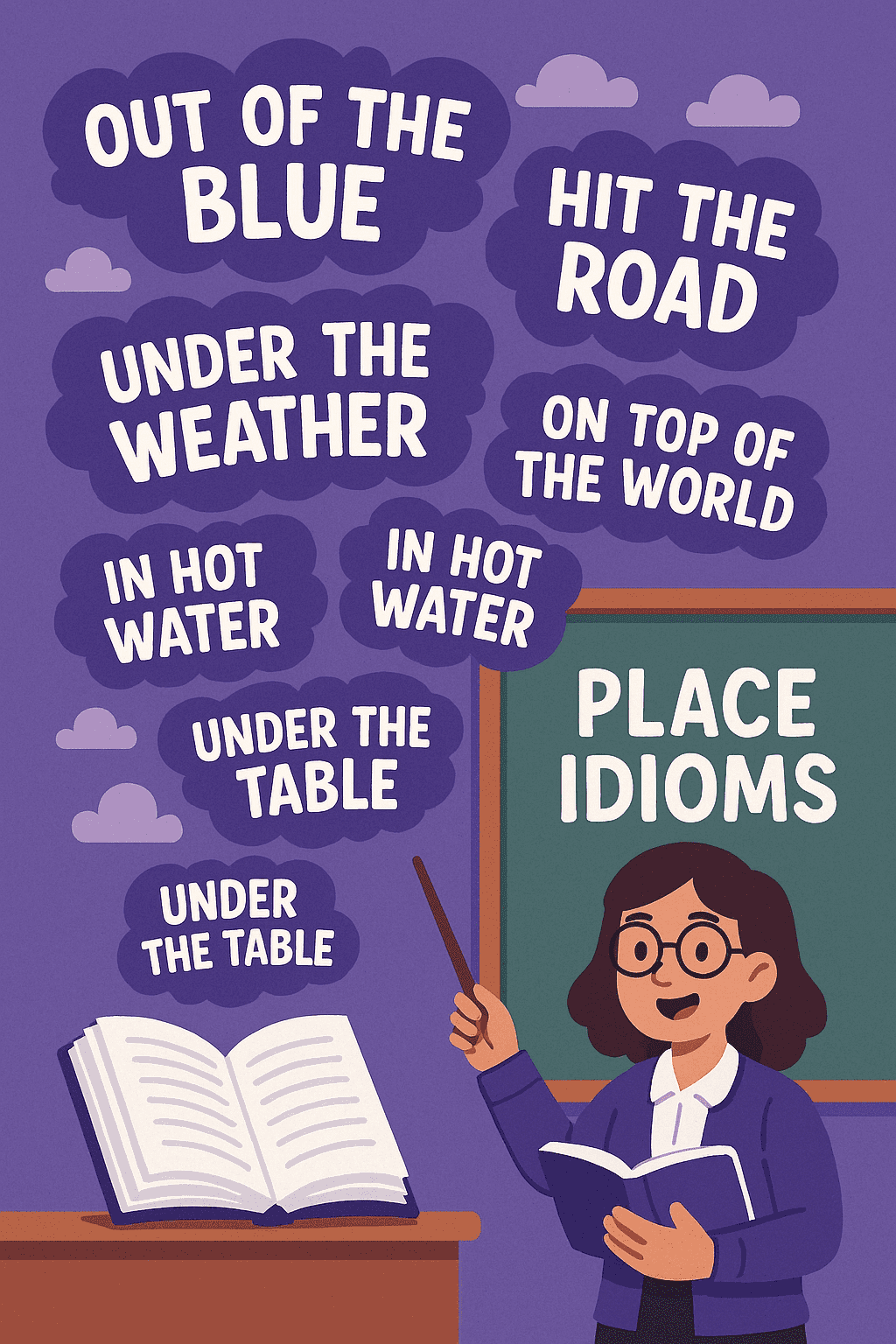
Have you ever wondered why some English conversations sound so colorful, natural, and full of life? The secret often lies in idioms. Idioms are expressions that are unique to a specfic culture, and carry a different meaning than the literal words used. Among them, place idioms stand out because they connect language with physical or imagined spaces that signify meaning.
Think about it; when someone says they’re “between a rock and a hard place,” you instantly know they feel stuck, even without extra explanation. Place idioms like this don’t just tell you facts; they paint pictures, share emotions, and reveal cultural wisdom.
In this article, you’ll explore:
- What place idioms are
- How they differ from regular idioms
- Where they’re commonly used (in daily speech, media, business, and beyond)
- Why they matter for fluency
- A detailed table of 30 place idioms with meanings and examples
By the end, you’ll not only recognize these idioms, but you’ll also feel confident enough to use them in conversations, stories, or even presentations.
Table of Contents
Definition of Place Idioms
A place idiom is an expression that uses the name of a place (real or imaginary) to describe an idea, feeling, or situation.
For example:
- “Rome wasn’t built in a day” means that important things take time.
- “In the same boat” means people are in the same situation.
Unlike literal phrases, these idioms don’t always refer to actual an place. Instead, they mention that place symbolically to communicate something deeper.
According to Cambridge Dictionary, idioms are phrases whose meanings aren’t always clear from the words themselves. Place idioms are just one type, and understanding how to use them makes everyday English richer and more fun.
How Place Idioms Differ from Regular Idioms
Not all idioms involve places. Some are about animals (“let the cat out of the bag”), objects (“hit the nail on the head”), or actions (“bite the bullet”).
What makes place idioms special?
- Their imagery is tied to locations – They link meaning to geography, buildings, or travel.
- They draw on cultural roots – Many come from history (Rome, Babylon, Waterloo) or daily life (the same boat).
- They involve relatable contexts – Everyone has been “home,” “at a crossroads,” or “on the road.”
This makes them easier for learners to understand and remember.
The Role of Place Idioms in Cultural and Figurative Language
Place idioms often reflect history, geography, and cultural values.
- “All roads lead to Rome” comes from the Roman Empire’s famous road network.
- “Crossing the Rubicon” refers to Julius Caesar’s point of no return.
- “Down-to-earth” highlights humility by linking it to being close to the ground.
Learning these idioms helps you not just with English fluencym but also with understanding the stories and cultures behind the words.
You can read more on this in our post about unlocking better English through understanding Western culture.
Where Are Place Idioms Commonly Used?
Place idioms aren’t limited to textbooks; they show up everywhere.
Place Idioms in Everyday Conversations
In chats with friends or family, idioms make speech lively.
- “We’re in the same boat with homework today.”
- “Don’t worry, you’re in a good place right now.”
Place Idioms in Media and Pop Culture
TV shows, movies, and books often use idioms for humor and relatability.
- In sitcoms, you’ll hear phrases like “a safe place” or “back to square one.”
- Movies use “hit the road” when characters start a journey.
For more, check out our blog: Top TV shows and movies to improve your English skills.
Place Idioms in Education and Business
Even in schools and workplaces, place idioms pop up.
- Teachers may say, “We’re on the same page today.”
- Business leaders use, “We need to get back on track.”
For a business-focused guide, read Business English Online: Essential Skills for Professional Success.
Why Is It Important to Know Place Idioms?
- Place idioms help you understand native speakers – Idioms are common in daily English, TV, books, and songs. People use them in conversations all the time, so it’s important that any English speaker become familiar with these phrases.
- Place idioms add color and creativity – They make speech memorable and vivid. Incorporating these phrases when communicating will help people remember your words.
- Place idioms reflect culture and geography – The more of these idioms you learn, the more you’ll learn about history and cultural values.
- Place idioms improve fluency and comprehension – Knowing idioms prevents confusion in casual settings.
For extra practice, see Mastering English speaking online: tips and resources for fluency.
30 Examples of Place Idioms and Their Meanings
Here’s a table grouping place idioms by theme.
Common Everyday Place Idioms
| Idiom | Meaning | Example Sentence |
| In the same boat | In the same situation as others | “We’re all in the same boat with exams coming.” |
| A safe place | A supportive, comforting environment | “My grandmother’s house has always been my safe place.” |
| Back to square one | Returning to the beginning after failure | “After the project failed, we were back to square one.” |
| At home with | Comfortable or familiar with something | “She’s at home with new technology.” |
| In hot water | In trouble | “He got in hot water for missing the deadline.” |
Place Idioms About Success and Failure
| Idiom | Meaning | Example Sentence |
| Hit the road | To leave or depart | “Let’s hit the road before it gets dark.” |
| Go places | To become successful | “She’s talented and will definitely go places.” |
| On the map | Gaining recognition or fame | “That award put the small town on the map.” |
| At the top of the ladder | Highest level of success | “He’s at the top of the corporate ladder.” |
| A stepping stone | Something that helps progress | “This internship is a stepping stone to my dream job.” |
Place Idioms About Emotions
| Idiom | Meaning | Example Sentence |
| Between a rock and a hard place | Stuck between two tough choices | “I was between a rock and a hard place choosing schools.” |
| In a good place | Feeling stable or content | “I’m finally in a good place in life.” |
| Out of place | Feeling uncomfortable or not fitting in | “He felt out of place at the fancy dinner.” |
| In high places | Having powerful connections | “She got the job with help from friends in high places.” |
| Down-to-earth | Humble, practical | “Despite her fame, she’s very down-to-earth.” |
Cultural and Regional Place Idioms
| Idiom | Meaning | Example Sentence |
| Rome wasn’t built in a day | Important things take time | “Learning English takes patience—Rome wasn’t built in a day.” |
| All roads lead to Rome | Many paths to the same goal | “Different methods work; all roads lead to Rome.” |
| Crossing the Rubicon | Passing the point of no return | “He crossed the Rubicon when he signed the contract.” |
| Meet your Waterloo | Face ultimate defeat | “The champion met his Waterloo in the final game.” |
| The promised land | A place of hope or success | “For many, college feels like the promised land.” |
How to Use Place Idioms Effectively
- Choose idioms that fit your context – “Hit the road” works in casual talk, not in an academic essay. Know the way your audience is expecting to be spoken to.
- Avoid overuse – Using too many idioms in your sentences can confuse listeners. It’s best to stick with a few tht make your message clear.
- Use idioms in stories – All types of idioms are especially useful in storytelling and make your narrative sound more lively and natural.
Pro tip: Practice in supportive environments like an English learning WhatsApp group.
When Place Idioms Are Appropriate vs. Inappropriate
Appropriate Uses
- Informal conversations with friends; idioms are ideal in less-formal settings where everyone involved has the same shared understanding and cultural framework. That way, you can be sure your use of place idioms will be understood.
- Creative writing and storytelling. Idioms lead to more evocative and engaging language. Phrses like “he was really going places” paint a stronger picture of aomeone successful and moving forward than “he had great success”.
- Motivational speeches or life lessons. Because idioms are naturally more emphatic, they’re great tools for driving home points in a speech or a lesson.
Inappropriate Uses
- Academic essays or research papers. Idioms are too casual for formal academic writing and may give the impression you are being too flippant with your phrasing. Scientific research should be free of culturally-specific or overly colloquial language
- Legal and formal reports. Like scientifc writing/research, legal writing is very exact. so idioms are not the best fit.
- International communication where idioms confuse learners. Idioms are naturally culturally-specific; that’s why they’re often a challenge for English learners. It’s also what makes understandig idioms such a good bar for English fluency. But if your goal is to communicate with an international audience, using too many idioms can make your words harder to understand, because your readers won’t share your cultural context.
For formal alternatives to idioms, check:What is academic writing?.
Conclusion
Place idioms aren’t just fun phrases; they’re powerful tools that make your English sound fluid, expressive, and intuitive.
- They help you communicate feelings and ideas quickly.
- They make stories and conversations more vivid.
- And they connect you to the cultural depth of the English language.
Sovthe next time you hear “Rome wasn’t built in a day” or “back to square one,” don’t just smile; try using it yourself. The more you practice, the more confident and fluent you’ll sound.
If you’d like to explore more, check out our guide on advanced English idioms or take a look at these fun idioms for kids for lighter learning. Both will help you build fluency step by step.
Your turn.
Which of these place idioms will you try first in your writing or speaking? Drop your pick in the comments, or share this guide with a friend who’s learning English so you can grow faster together.
What are place idioms?
Place idioms are expressions that mention specific places (like the wall, the street, or the sky) but don’t always mean the literal place. Instead, they carry a hidden, figurative meaning.
Example: “Between a rock and a hard place” means being stuck in a difficult situation, not literally between two rocks.
Why should I learn idioms related to places?
Because they make your English sound more natural, fun, and expressive. Native speakers use idioms daily in movies, books, and conversations.
Example: Saying “hit the road” is more engaging than just saying “leave.”
Are place idioms hard to learn?
Not at all! Once you understand the figurative meaning and see examples, they become easy to remember.
Tip: Create flashcards with the idiom on one side and its meaning and example on the other.
Can kids learn place idioms?
Yes! Place idioms are a great way for kids to build vocabulary and storytelling skills. Many idioms are simple enough for children.
Example: “Down to earth” means “humble” or “realistic,” which is easy for kids to get.
Where are place idioms commonly used?
In daily conversations (“on the fence about it”)
In books and stories (“through the looking glass”)
In movies and songs (“over the rainbow”), they’re everywhere once you start noticing them!
How can I practice placing idioms?
Use them in short stories you write.
Try idiom quizzes (like the ones we post on English Language and Literature).
Watch English movies or cartoons and write down idioms you hear.
What’s the difference between place idioms and normal idioms?
Normal idioms can use anything (animals, colors, weather), while place idioms specifically use locations or places in their wording.
Example: “Kick the bucket” (general idiom) vs. “in the same boat” (place idiom).
Can I use place idioms in school writing or essays?
Yes, but carefully. They work best in creative writing, storytelling, or when you want to sound natural in speech. In formal essays, keep them minimal.
How many place idioms should I learn first?
Start with 5–10 common ones. Once you’re comfortable, grow your list. This article already gives you 30+ idioms to start with perfect for beginners and learners.
Where can I learn more idioms?
You can explore more idioms, meanings, and examples in our blog section on Idioms & Phrases. We keep updating it with kid-friendly explanations and fun tips.