English Words You Can’t Translate Directly- Origins & Meanings: An Online English Fluency Course
Have you ever come across an English word that seems to mean more than its dictionary definition suggests? Sometimes, translating a word into another language isn’t as simple as finding an equivalent and replacing it. A word may carry a particular cultural association, historical background, emotional nuance, or social meaning that is difficult to reproduce in another language with a single expression.
For learners taking an english fluency course online, exploring these borrowed words can be an interesting way to understand how English works beyond grammar and vocabulary lists.
In this article, we will explore where some unusual English words come from, what they mean today, and why their meanings can be hard to translate directly.
English Is a Language Built From Many Languages
English did not develop in isolation. Modern English has roots in the Germanic languages spoken by Anglo-Saxon communities in Britain, but contact with Old Norse, French, Latin, Greek, Arabic, languages of South Asia, Japanese, German, and many others shaped its vocabulary.
Understanding these origins can therefore be useful alongside spoken english practice online because learning vocabulary is not only about memorising definitions. It is also about understanding how words are used and what associations they carry.
Words Borrowed From French
French has had an enormous influence on English vocabulary. Thousands of English words have French or Anglo-French connections, particularly in areas such as law, government, food, fashion, art, and social life.
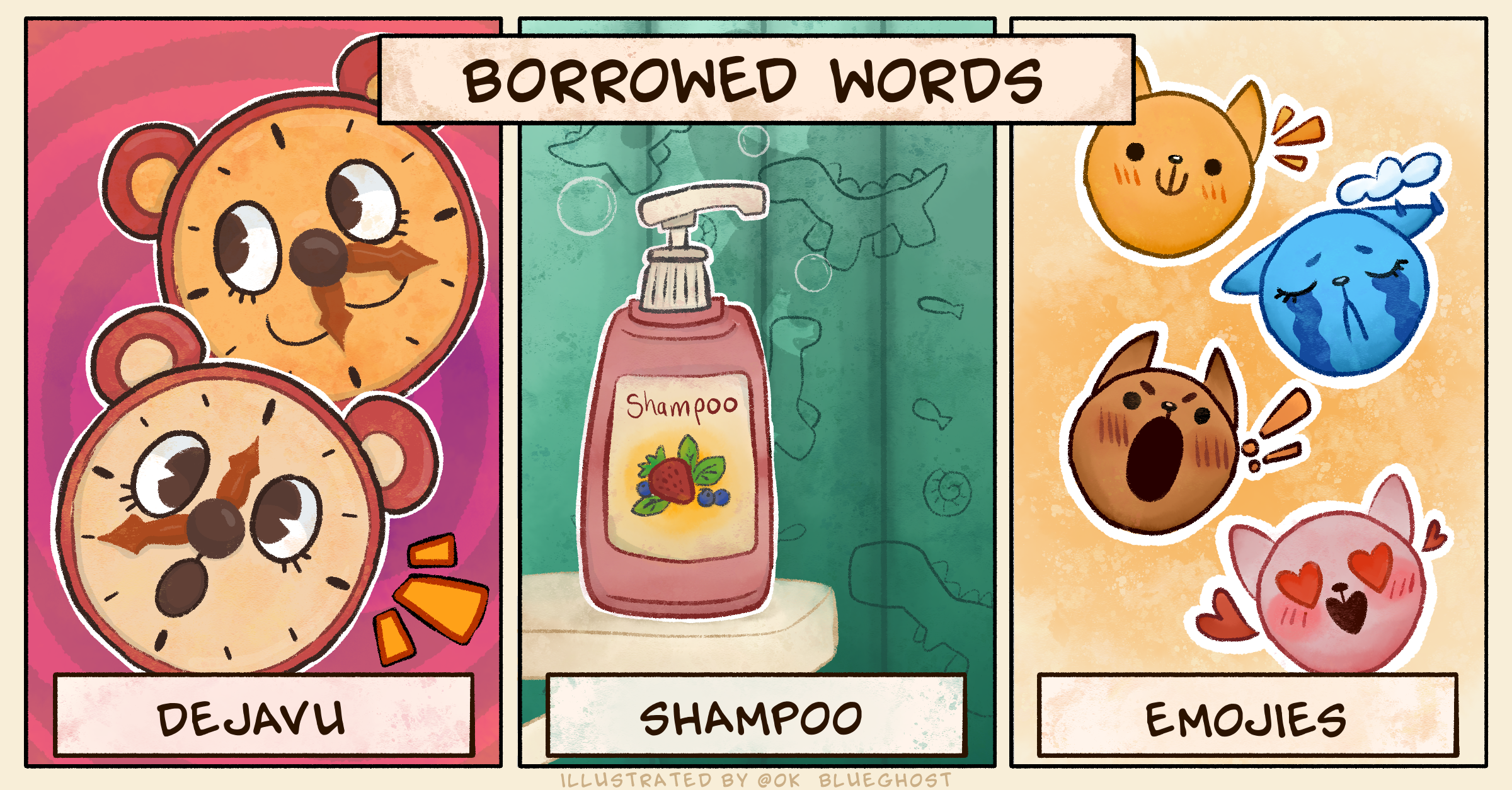
Déjà vu
Origin: French
Meaning: The unsettling or familiar sensation that you have experienced a present situation before.
The literal French expression déjà vu means “already seen”. However, its meaning in English refers specifically to the psychological experience of feeling that a current event or situation has happened previously.
A longer English explanation can communicate the meaning, but the compact expression déjà vu has become established in English itself. It is now commonly used in everyday conversation as well as in psychological discussions.
Rendezvous
Origin: French
Meaning: A meeting, usually at an agreed place and time.
English could simply use “meeting” in many contexts, but rendezvous has developed particular associations. It can suggest a planned meeting at a specific location and sometimes carries a sense of secrecy, romance, or adventure depending on context.
This demonstrates an important feature of borrowing: English does not always import a foreign word with the same range of meanings and associations it has in its original language.
Entrepreneur
Origin: French
Meaning: A person who starts and develops a business, typically taking on financial risk.
The English word comes from French entreprendre, meaning “to undertake”. In modern English, however, entrepreneur has become closely associated with business creation, innovation, and commercial enterprise.
Its history therefore shows how a borrowed word can acquire a specialised meaning in its new linguistic environment.
Words With Arabic Origins
Arabic has contributed significantly to English vocabulary, particularly through mathematics, astronomy, science, commerce, and trade. Some Arabic-derived words entered English through medieval Latin, Italian, Spanish, or French rather than travelling directly from Arabic into English.
Algebra
Origin: Arabic
Meaning: A branch of mathematics involving symbols and rules for representing and solving relationships and equations.
The word comes from Arabic al-jabr, associated with a mathematical method described in the work of the Persian scholar Muhammad ibn Musa al-Khwarizmi.
The Arabic definite article al- is also visible in a number of English words of Arabic origin. This provides a linguistic reminder of the transmission of scientific knowledge between cultures.
Alchemy
Origin: Arabic, with earlier roots in Greek
Meaning: A historical tradition concerned with transforming matter and seeking substances such as the philosopher’s stone.
Alchemy entered English through medieval European languages and ultimately has connections with Arabic al-kīmiyāʾ, itself related to the earlier Greek tradition of chēmeia.
The modern English word refers primarily to a historical practice, but it can also be used metaphorically to describe a mysterious process of transformation.
Coffee
Origin: Ultimately associated with Arabic qahwa, through other languages including Turkish and Italian.
Meaning: A drink made from roasted and ground coffee beans.
Unlike some borrowed words, coffee does not feel foreign to most English speakers. It is an ordinary part of everyday vocabulary.
Its history nevertheless demonstrates how words can travel alongside objects and cultural practices. Coffee culture spread across regions through trade and social exchange, and the word travelled with it.
Sofa
Origin: Arabic, through Turkish and European languages
Meaning: A long upholstered seat designed for several people.
The English word sofa ultimately traces back to Arabic ṣuffa, referring to a raised platform or bench.
The modern English meaning is not identical to the earliest sense of the word. It has become associated with a particular type of furniture.
Words Borrowed From Hindi and Other Indian Languages
English has absorbed many words from languages spoken in South Asia, particularly during centuries of contact between Britain and the Indian subcontinent.
Some of these words are so familiar that their foreign origins are easy to overlook.
Shampoo
Origin: Hindi
Meaning: A substance used to wash the hair.
The word comes from Hindi chāmpo, meaning to press or massage. The term entered English in the colonial period in connection with head massage and washing.
Over time, its meaning in English became associated primarily with the product used for washing hair.
Pyjamas
Origin: Hindi/Urdu, ultimately from Persian
Meaning: Loose-fitting clothing worn for sleeping or relaxing.
The word comes from pāy-jāma in Persian and pajama in Hindi/Urdu, literally referring to a garment for the legs or feet. In English, pyjamas became the familiar term for nightwear.
The spelling also varies between varieties of English. British English commonly uses pyjamas, while American English generally uses pajamas. If you want to know more words that are used differently in British and American English, check out this article: Differences Between British and American English
Bungalow
Origin: Hindi, from baṅglā, meaning “Bengali” or “in the Bengali style”.
Meaning: A house, typically with a single storey.
The word originally referred to a type of house associated with Bengal. English later adopted it as a general term for a particular kind of low-rise dwelling.
This is a useful example of how a word can move from a specific geographical and cultural context into a broader everyday meaning.
Jungle
Origin: Hindi jaṅgal, ultimately from Sanskrit
Meaning: Land covered densely with vegetation; commonly, a wild or tropical forest.
The original South Asian word had a broader meaning relating to uncultivated or wild land. English developed its own associations, particularly with dense tropical vegetation.
Guru
Origin: Sanskrit
Meaning: A spiritual teacher or guide.
In its original religious and philosophical contexts, guru refers to a teacher or spiritual guide. Modern English has also developed a broader informal use.
English speakers may describe someone as a “business guru”, “fitness guru”, or “technology guru”, meaning that person is regarded as highly knowledgeable or influential in a particular field.
This is a clear example of semantic change: the borrowed word has acquired additional uses in English.
Words From German and Other European Languages
German has contributed several words that English speakers often use because translating them requires a longer expression.
Schadenfreude
Origin: German
Meaning: Pleasure or satisfaction derived from another person’s misfortune.
The word combines Schaden, meaning “harm” or “damage”, with Freude, meaning “joy”.
English can certainly express the concept with a phrase such as “pleasure at someone else’s misfortune”. However, schadenfreude packages the idea into a single, recognisable term.
It is a useful example of the difference between translating meaning and translating form. The concept can be explained perfectly well in English, but no equally compact everyday English word carries the same meaning.
Wanderlust
Origin: German
Meaning: A strong desire to travel or explore.
The word combines wandern, meaning “to wander”, with Lust, meaning “desire” or “pleasure”.
English has expressions such as “a desire to travel” or “a passion for travel”, but wanderlust has become established as a concise expression for this particular feeling.
Zeitgeist
Origin: German
Meaning: The characteristic ideas, attitudes, and cultural atmosphere of a particular period.
The word literally combines Zeit, meaning “time”, and Geist, meaning “spirit”.
In English, zeitgeist is often used when discussing culture, politics, literature, art, or society. Instead of referring simply to the events of a particular historical period, it describes something closer to the prevailing intellectual or cultural mood.
For students developing their vocabulary through english speaking training online, words like zeitgeist are particularly useful because understanding them requires more than memorising a definition. The context in which they appear is part of their meaning.
Words From Japanese and Other Languages
Modern English continues to borrow words from languages around the world. Japanese has contributed vocabulary associated with food, technology, popular culture, art, and natural phenomena.
Karaoke
Origin: Japanese
Meaning: Entertainment in which people sing along to recorded instrumental versions of songs, usually while following displayed lyrics.
The Japanese word combines kara, meaning “empty”, and ōkesutora, meaning “orchestra”. The original idea therefore referred to an “empty orchestra”, which means music recorded without the original singer.
English adopted the word rather than creating an entirely new expression. Today, karaoke is internationally recognisable.
Tsunami
Origin: Japanese
Meaning: A series of large waves caused by the displacement of a large volume of water, often by an undersea earthquake.
Tsunami is sometimes incorrectly treated as simply another word for a “big wave”. It is not. The term describes a particular geophysical phenomenon.
This illustrates why direct translation can sometimes be misleading. A word may contain technical information that would disappear if it were replaced with a loose synonym.
Origami
Origin: Japanese
Meaning: The art of folding paper into decorative or representational forms.
The Japanese word combines terms associated with folding and paper. English uses origami as a specific name for the art form rather than translating it into a general phrase such as “paper folding”.
Emoji
Origin: Japanese
Meaning: A small digital symbol or image used to communicate an idea, emotion, object, or other concept in electronic communication.
Although the word resembles the English word “emotion”, the two are not linguistically related. The Japanese term comes from e (“picture”) and moji (“character”).
The worldwide adoption of emoji is a modern example of how technology can accelerate the movement of vocabulary between languages.
When English Borrows a Word, Does Its Meaning Change?
Borrowing a word does not mean that English necessarily preserves every aspect of its original meaning.
A borrowed word can become more specific or more general. It can acquire new associations, change its pronunciation, develop informal meanings, or become detached from the cultural context in which it originated.
Consider guru. Its traditional meaning refers to a teacher or spiritual guide, but contemporary English can use it for an expert in almost any subject.
Bungalow provides another example. Its history is connected with Bengal and a particular architectural tradition, while modern English uses the word as a general term for a type of house.
Coffee demonstrates a different kind of linguistic journey. The word travelled through several languages alongside the drink itself before becoming completely ordinary in English.
This is one reason learning English through english speaking courses can involve more than studying grammar rules. Vocabulary carries traces of history, geography, culture, and social change. An english fluency course online can help you understand how to use grammar and vocabulary to help.
Is There Really Such a Thing as an “Untranslatable” Word?
The word “untranslatable” can be misleading.
In most cases, the meaning of a word can be communicated in another language. The difficulty is that there may not be a single word that reproduces all of its meaning, associations, tone, and cultural context.
Take Schadenfreude. English can express its meaning as “pleasure at someone else’s misfortune”. Nothing essential has to remain completely mysterious.
What is lost is the compactness of the original expression.
The same principle applies to many words that are described as “untranslatable”. A translator might need a phrase instead of a word, a sentence instead of a phrase, or additional cultural context to communicate the same idea.
Translation is therefore often less about matching individual words and more about transferring meaning.
For English learners, this distinction is important. If you are taking an english fluency course online, encountering a word that does not have a neat equivalent in your first language is not necessarily a problem. Instead, it can reveal something about how English speakers organise and express ideas.
The history of English vocabulary also shows that languages are not closed systems. They continually change as people interact with one another.
Words move across borders. Their meanings evolve. Pronunciations change. New associations develop. Eventually, a word borrowed from another language can become so familiar that speakers forget it was ever foreign.
That is part of what makes English such a rich and sometimes unpredictable language.
Final Thoughts
English vocabulary is a record of contact between cultures. Words that seem completely ordinary today can contain stories about migration, trade, scholarship, religion, food, architecture, science, technology, and popular culture.
The next time you use a word such as bungalow, algebra, karaoke, schadenfreude, or déjà vu, consider where it came from and how its meaning changed along the way. English speaking training online courses can help you learn how to use these words smoothly and efficiently in your vocabulary.
Learning these histories can make vocabulary more memorable, but it can also change the way you think about translation. A language does not simply provide labels for things. Its words carry histories and associations that may not fit neatly into another language.
That is why the most interesting English words are sometimes the ones that cannot be replaced by a single equivalent word. Their meanings have travelled across languages, and their stories are now part of English itself.
Frequently Asked Questions
Q. What is an untranslatable English word?
Ans: An “untranslatable” English word is usually a word that does not have an exact one-word equivalent in another language. Its meaning may include cultural context, emotion, or historical associations that require a phrase or explanation to translate fully. Learning these differences can be a useful part of an english fluency course online, especially when developing a more natural and nuanced vocabulary. Want to learn words that shape academic vocabulary? Check out this article: Academic Vocabulary Words: Definition, Examples, and Tips
Q. Why does English have words from so many different languages?
Ans: English has borrowed vocabulary from many languages as a result of migration, conquest, trade, science, literature, religion, and cultural exchange. Words from French, Arabic, Hindi, German, Japanese, Latin, Greek, and Old Norse have all become part of modern English. Understanding word origins can also make spoken english practice online more meaningful because learners begin to recognise why certain words are used in particular contexts.
Q. What English words originally came from Hindi?
Ans: Several common English words have roots in Hindi or related South Asian languages, including shampoo, bungalow, pyjama, jungle, and guru. Many of these words have developed slightly different meanings or broader uses in modern English. Exploring this kind of vocabulary can complement english speaking training online by helping learners understand the cultural background behind everyday English words.
Q. Which English words come from German?
Ans: English includes several well-known German borrowings, such as schadenfreude, wanderlust, and zeitgeist. These words are often used in English because they express ideas that may otherwise require a longer phrase. Studying vocabulary like this alongside english speaking courses can help learners express more precise ideas and understand advanced English in articles, conversations, and literature.
Q. Can every English word be translated into another language?
Ans: Almost every English word can be explained in another language, but not every word has a direct one-word equivalent. Translation may require a phrase, several words, or additional cultural context. This is why developing vocabulary through an english fluency course online involves learning not only dictionary definitions but also context, connotation, and real-world usage.
Writer: Mrunmayee Raut
Designer: Gesiah