30+ Powerful Anaphora Examples in English Writing
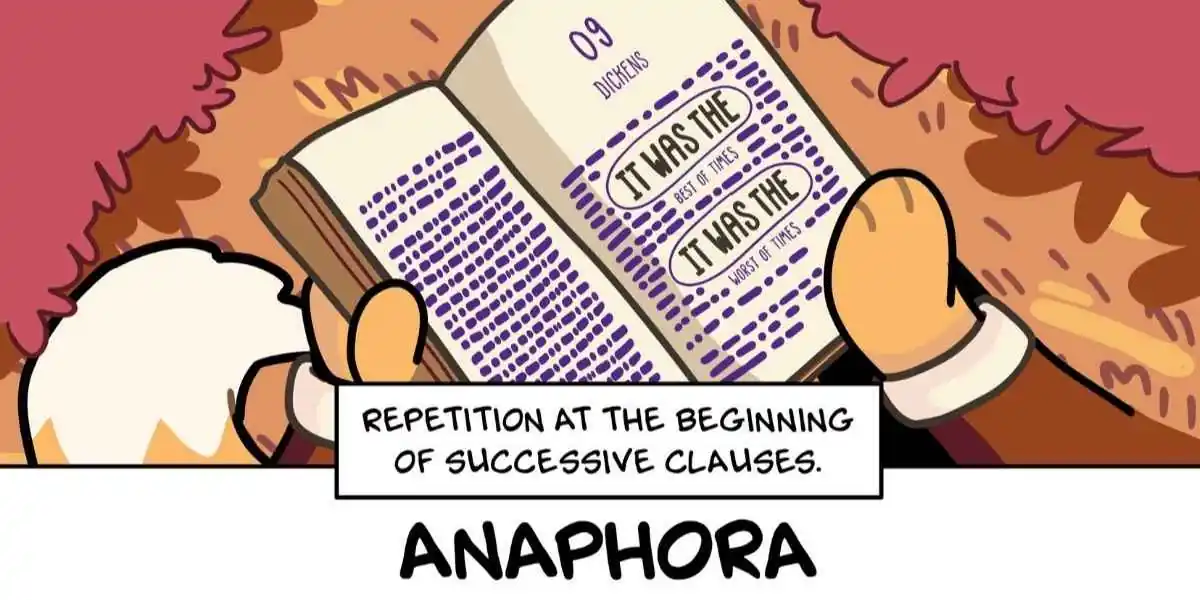
“It was the best of times, it was the worst of times.”
This famous opening from Charles Dickens is one of the most well-known anaphora examples in English literature. But does the word anaphora ring a bell?
Let’s break it down. You have probably seen phrases or words repeated to emphasise an idea. This type of repetition is called anaphora, and it’s a powerful technique in creative writing and rhetoric.
Anaphora is different from simple repetition because the repeated words appear at the beginning of consecutive clauses or sentences.
Writers use this technique to create rhythm, highlight important ideas, and make their message more memorable.
In this guide, you’ll learn what anaphora is, explore anaphora examples, and discover how to use it effectively to elevate your writing.
Table of Contents
Where Are Anaphora Examples Commonly Used?
Anaphora Examples in Literature
Anaphora appears frequently in classic literature because it helps create rhythm, emphasis, and emotional impact. By this repetition technique, writers can highlight important ideas and make their message more memorable.
- Remarkable example of anaphora in literature:
From the novel The Handmaid’s Tale by Margaret Atwood:
“We lived in the blank white spaces at the edges of print. It gave us more freedom. We lived in the gaps between the stories.”
The repetition of “We lived…” at the beginning of consecutive sentences creates an anaphora example. We can notice that this anaphora:
- Emphasises the characters’ marginalised position in society.
- Adds a reflective rhythm that reinforces the novel’s themes of identity and control.
Why do writers use anaphora?
- To emphasise key ideas or themes
- To create a strong rhythm or flow in writing
- To make statements more memorable
- To add emotional impact to speeches, essays, and storytelling
Anaphora in modern writing
The technique is not limited to classic texts; many modern authors and poets use anaphora to strengthen their style.
Writers, such as Alexandra Teague and Kathryn Stockett, incorporate repetition and rhetorical patterns to reinforce themes and character voice.
Anaphora Examples in Speeches and Rhetoric
Anaphora is a powerful technique in speeches and persuasive writing because the repetition it creates highlights important ideas and makes messages easier to remember.
Why do speakers use anaphora?
- To emphasise key points
- To create rhythm in a speech
- To make ideas more memorable
- To add emotion and persuasion
- Remarkable example of anaphora in a famous speech:
In the “I Have a Dream” speech, Martin Luther King Jr. repeats the phrase “I have a dream.”
- “I have a dream that one day this nation will rise up…”
- “I have a dream that one day on the red hills of Georgia…”
- “I have a dream that one day this nation will rise up…”
The repeated phrase reinforces the message of hope and equality throughout the speech.
- Why does this example work?
- The repetition keeps the audience focused on the central idea.
- It creates a strong rhythm that makes the speech memorable.
- It also adds emotional power to the message.
- The repetition keeps the audience focused on the central idea.
Anaphora Examples in Media and Pop Culture

Anaphora is commonly used in media and pop culture. Songs, movies, and advertisements often use repetition to make phrases more memorable.
Why does anaphora work well in songs?
- It creates a strong rhythm and flow
- It makes lyrics easier to remember
- It reinforces the main message of the song
- It helps listeners connect emotionally with the lyrics
- Remarkable example of anaphora in music:
In the song Don’t Dream It’s Over by Crowded House, the chorus repeats the phrase “hey now, hey now.”
- “Hey now, hey now, don’t dream it’s over…”
- “Hey now, hey now…”
The repeated phrase at the start of the lines acts as a simple anaphora example.
- Why this example works
- The repetition helps establish the rhythm of the chorus.
- It makes the song more memorable and catchy.
- It also strengthens the emotional tone of the lyrics.
30+ Powerful Anaphora Examples from Literature, Speech, and Everyday Usage
Literary Anaphora Examples
| Anaphora | Source |
| “Nevermore, Nevermore” | Raven by Edgar Allan Poe |
| “You may shoot me with your words,You may cut me with your eyes,You may kill me with your hatefulness,But still, like air, I’ll rise.” | Still I Rise by Maya Angelou |
| “How wild. How vermin, how refugee.” | The Rough Beast Receives an Invitation from America by Alexandra Teague |
| “Doubt thou the stars are fire; / Doubt that the sun doth move; / Doubt truth to be a liar; / But never doubt I love.” | Hamlet By Shakespeare |
| “Some feel rain. Some feel the beetle startle” | Some Feel Rain by Joanna Klink |
| “Hey now, hey now” | Don’t Dream It’s Over by Crowded House |
| “I’ve known rivers: I’ve known rivers ancient as the world and older than the flow of human blood in human veins” | The Negro Speaks of Rivers by Langston Hughes |
| “Ain’t no mountain high enough, Ain’t no valley low enough, Ain’t no river wide enough, To keep me from getting to you, baby” | Ain’t No Mountain High Enough By Marvin Gaye and Tammi Terrell |
| “Not the room. Not beginning. Not the crowd. Now winning” | Not By Big Thief |
Rhetorical and Speech Anaphora Examples
| Anaphora | Source |
| “We shall fight on the beaches… we shall fight on the landing grounds…” | Winston Churchill |
| “We will rise from the golden hills of the West. We will rise from the windswept Northeast…” | Amanda Gorman |
| “We cannot dedicate, we cannot consecrate, we cannot hallow this ground” | Abraham Lincon |
| “What we need in the United States is not division. What we need in the United States is not hatred.” | John F. Kennedy |
| “We came, we saw, we conquered.” | Julius Caesar |
| “Indifference elicits no response. Indifference is not a response. Indifference is not a beginning;” | Elie Wiesel |
| “I warn you not to be ordinary, I warn you not to be young, I warn you not to fall ill, I warn you not to get old.” | Neil Kinnock |
| “We have a new vaccine, we have new resolve and we have new tactics.” | Bruce Aylward |
Everyday or Creative Anaphora Examples
| Anaphora |
| “Every day, every night, in every way, I am improving.” |
| “We will win, we will overcome, we will succeed.” |
| “I am strong; I am capable; I am worthy.” |
| “Fool me once, shame on you; fool me twice, shame on me.” |
| “Hurt people, hurt people” |
| “Monkey see, monkey do” |
| “You’re damned if you do and you’re damned if you don’t.” |
| “Love conquers all. Love unites all. Love endures all.” |
| “Time heals. Time teaches. Time reveals.” |
How to Practice Using Anaphora Correctly
Learning how to use anaphora in writing becomes easier with practice.
The best way to understand it is to read, listen, and experiment with your own sentences.
1. Read examples of anaphora in literature
Start by reading anaphora examples in books, poems, and speeches.
- Look for repeated words or phrases at the beginning of sentences.
- Notice how repetition adds rhythm and emphasis.
- Pay attention to how writers highlight important ideas.
2. Listen to speeches that use anaphora
Many famous speeches use anaphora as a rhetorical device.
- Listen to the speech while reading the transcript if possible.
- This helps you see how repetition creates flow and impact.
- Notice how the repeated phrase strengthens the speaker’s message.
3. Practice writing your own anaphora sentences
The best way to learn is to use anaphora in your own writing.
- Write a short paragraph using the same opening phrase.
- Try repeating a word or phrase three times at the start of sentences.
- Compare your sentences with real anaphora examples from literature.
Key tip
Anaphora works best when repetition feels natural and purposeful. So, make sure that it’s used to emphasise ideas, not just for the sake of repetition.
Do’s and Don’ts of Using Anaphora in Writing
Understanding when to use anaphora helps you apply this technique effectively.
Used correctly, it can strengthen your message. Used too often, it can feel repetitive.
Do: Use Anaphora for Emphasis
Anaphora works best when you want to highlight an important idea.
- Repeat a key phrase at the start of sentences.
- Use it to draw attention to your main message.
- Keep the repeated phrase short and clear.
Do: Use Anaphora in Creative and Persuasive Writing
Anaphora is common in creative writing and persuasive content.
- It can strengthen speeches and storytelling.
- It adds rhythm to poetry and lyrics.
- It helps readers remember key lines.
Do: Keep the Repetition Simple
Effective anaphora examples usually repeat short phrases.
- Use clear and simple wording.
- Repeat the phrase two to four times.
- Make sure each sentence adds new meaning.
Don’t: Overuse Anaphora
Too much repetition can make writing feel forced.
- Avoid repeating the same phrase too many times.
- Use anaphora only when it supports your message.
- Mix it with other sentence structures.
Don’t: Use Anaphora in Highly Technical Writing
Anaphora is a stylistic device, so it may not suit formal documents.
- Technical writing prioritises clarity and precision.
- Repetition can make the text feel less professional.
- Direct language usually works better in these contexts.
Final Thoughts on 30+ Powerful Anaphora Examples in English Writing
To recap, anaphora is a writing technique that repeats a word or phrase at the beginning of sentences. Writers use it to add emphasis, create rhythm, and make ideas more memorable.
You’ll find anaphora examples in literature, speeches, poetry, songs, and even pop culture. When used in the right context, it can make your writing clearer, stronger, and more engaging. But remember, anaphora’s main purpose is to highlight your message and give your writing a powerful voice.
Now, let’s test your anaphora skills, shall we?
See if you can spot the anaphora example.
1. Which sentence uses anaphora?
A. The wind blew softly across the field.
B. We will write today. We will write tomorrow. We will write until the coffee runs out.
C. She read a book in the library.
2. What makes sentence B an example of anaphora?
A. The sentences rhyme
B. The same phrase repeats at the beginning
C. The sentences are very long
3. Which of these could work as an anaphora line?
A. I like pizza.
B. Write the words. Rewrite the words. Regret the words later.
C. The cat slept on the sofa.
Share your answers below, and let’s discuss them.
Do you want to practice anaphora and improve your English writing with others?
Join our English WhatsApp group, where learners share sentences, try fun writing challenges, and occasionally discover that yes… we all accidentally write dramatic poetry sometimes.