20 Brilliant Synonyms for I Think with Examples to Supercharge Your English
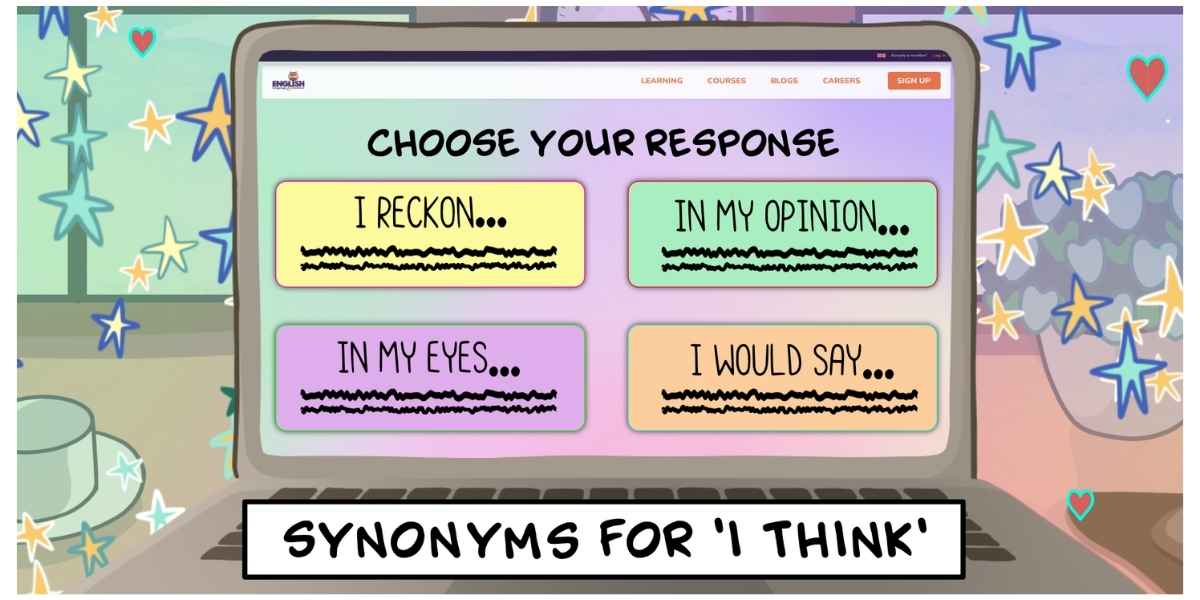
The phrase “I think” is one of the most commonly used expressions in English. Learning effective synonyms for “I think” is essential if you want to sound more fluent, natural, and professional.
Native speakers often use “I think” to introduce opinions politely without sounding too direct. However, repeating the same phrase can make your speech or writing feel dull. By using a variety of alternative phrases for “I think,” you can communicate more clearly and confidently.
Table of Contents
Why Synonyms for “I Think” Are Important
Using different ways to say “I think” helps you avoid repetition and keeps your communication engaging.
Overusing one phrase can weaken your message. Choosing the right alternative allows you to:
- Sound more professional
- Express ideas more clearly
- Adapt your tone to different situations
This is especially useful in business English, academic writing and everyday conversations.

Benefits of Learning Synonyms for “I Think”
Expanding your vocabulary gives you more flexibility in communication. Instead of repeating “I think,” you can:
- Match your tone (formal vs casual)
- Sound more confident or more polite
- Make your speech and writing more dynamic
Using varied expressions also improves clarity and helps your ideas stand out.
How Synonyms Improve Your English Skills
Learning alternatives to “I think” strengthens your overall language ability.
Each synonym carries a slightly different meaning. For example:
- “I believe” shows stronger confidence
- “I suppose” softens your opinion
Understanding these nuances helps you:
- Speak more fluently
- Write more effectively
- Communicate with greater precision
Common Synonyms for “I Think”
| Synonym | Example |
| I believe | I believe we should focus more on customer feedback before making changes. |
| In my opinion | In my opinion, the book was much better than the film. |
| I feel | I feel this strategy could improve our results. |
| I suppose | I suppose we could try another approach. |
| I reckon | I reckon they’ll arrive around 7. |
Formal Synonyms for I Think
| Synonym | Example |
| It is my belief that | It is my belief that education is the key to reduce inequality. |
| From my perspective | From my perspective, teamwork matters most. |
| I am of the opinion that | I am of the opinion that rules are needed. |
| I hold the view that | I hold the view that technology should serve people, not replace them. |
| As far as I am concerned | As far as I am concerned, honesty is essential. |
Casual Synonyms for “I Think”
| Synonym | Example |
| I guess | I guess we’ll just have to wait and see how it turns out. |
| To me | To me, this place feels like home. |
| I figure | I figure it’s better to try and fail than never try at all. |
| As I see it | As I see it, we need a better plan. |
| My take is | My take is that the ending was weak. |
Creative and Expressive Synonyms for “I Think”
| Synonym | Example |
| It seems to me | It seems to me that she’s really passionate about her work. |
| I tend to think | I tend to think people underestimate rest. |
| If you ask me | If you ask me, this restaurant is the best in town. |
| From where I stand | From where I stand, the deal looks fair. |
| I would say | I would say this is the smartest choice. |

How to Choose the Right Synonym
Choosing the right phrase depends on context, tone, and audience.
Consider the context
- Use formal phrases in professional or academic settings
- Use casual phrases in everyday conversations
Match your tone
- Strong opinion → I believe, I’m convinced
- Soft opinion → I suppose, I guess
Avoid repetition
Switch between different expressions to keep your communication fresh and engaging.
Looking Ahead
Using a variety of synonyms for “I think” is a simple yet powerful way to improve your English.
It helps you:
- Communicate more clearly
- Sound more natural and fluent
- Adapt your tone to any situation
By learning and practising these alternatives, you’ll expand your vocabulary and express your ideas with greater confidence.
Fill in the Blanks:
Instructions:
Fill in each blank using the correct word from the box.
Word Bank:
I believe • I feel • I suppose • I reckon • I guess • In my opinion • From my perspective • I would say
- ______ we should leave earlier to avoid traffic.
- ______ this movie is better than the first one.
- ______ we could try a different approach to solve the problem.
- ______ the project will take longer than expected.
- ______ this is the best restaurant in town.
- ______ we need more time to make a final decision.
- ______ it’s going to rain later today.
- ______ the team performed very well overall.
Learn more about expanding your vocabulary with 50+ Common English Words with Synonyms and Meanings