English Grammar for Beginners: Types of Verbs in English Explained
Every English sentence needs a verb. Whether you’re speaking, writing an email, answering an interview question, or having a conversation, verbs help express actions, states, and ideas.
If you’re beginning to learn English grammar, understanding the different types of verbs is one of the most important skills you can develop. Once you know how verbs work, building clear and correct sentences becomes much easier.
In this guide, you will learn:
- What a verb is
- Why verbs are important in English grammar
- The different types of verbs with simple examples
- How to identify verbs in a sentence
- Common mistakes beginners make
- A quick quiz to test your understanding
Table of Contents
By the end of this guide, you’ll have a strong foundation for using English verbs with confidence!
What Is a Verb?
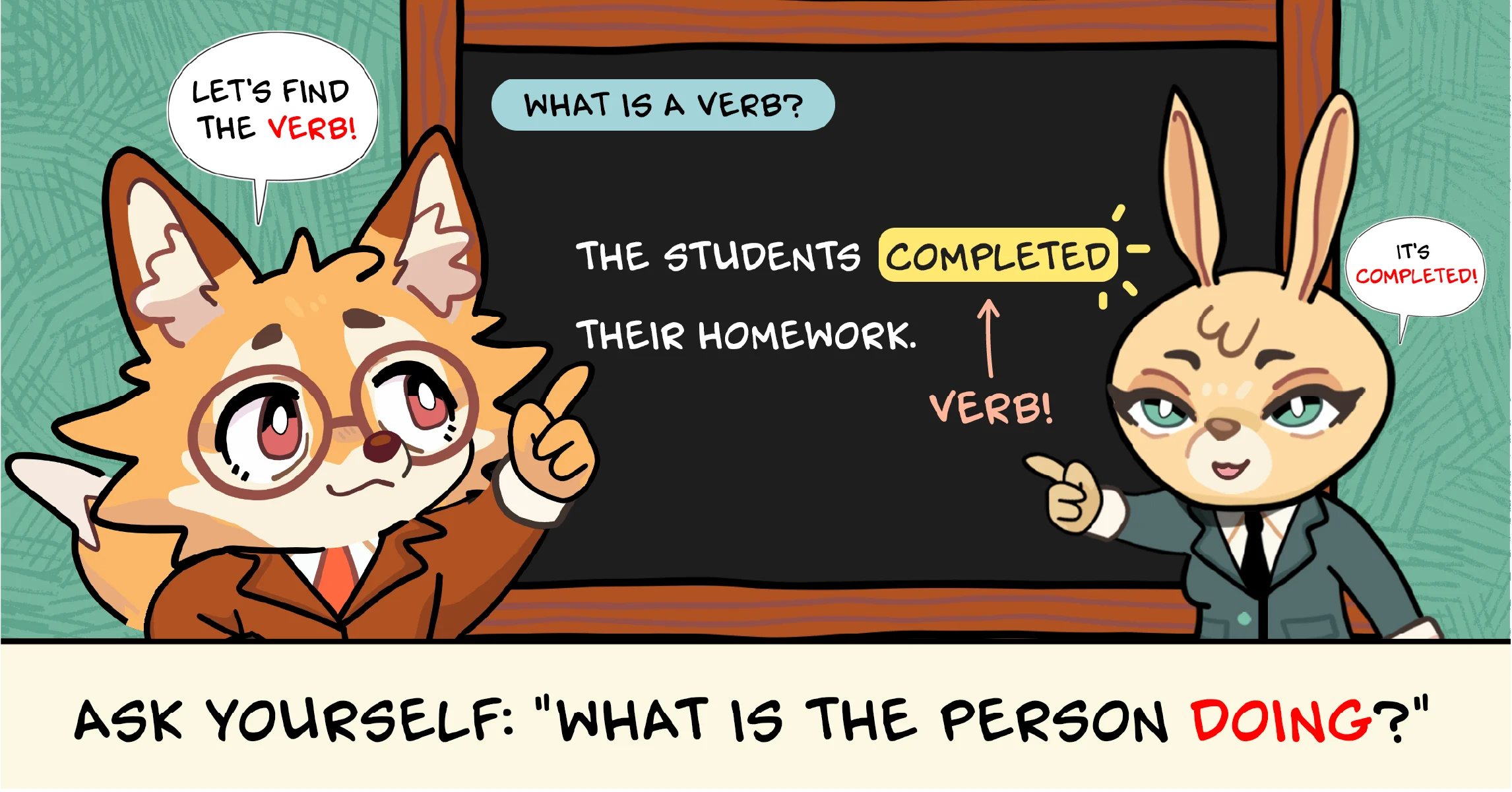
A verb is a word that shows an action, a state, or an occurrence.
Without a verb, a sentence is incomplete.
Examples
- She runs every morning.
- They are excited.
- The flowers bloomed yesterday.
In each sentence, the highlighted word tells us what is happening.
Think of a verb as the engine of a sentence. It tells the reader or listener what someone or something does or experiences.
Why Are Verbs Important?
Verbs help us:
- Describe actions
- Express thoughts and feelings
- Ask questions
- Give instructions
- Tell stories
- Communicate clearly
Without verbs, conversations and writing would not make sense.
Example:
❌ The children in the park.
✅ The children are playing in the park.
Main Types of Verbs in English
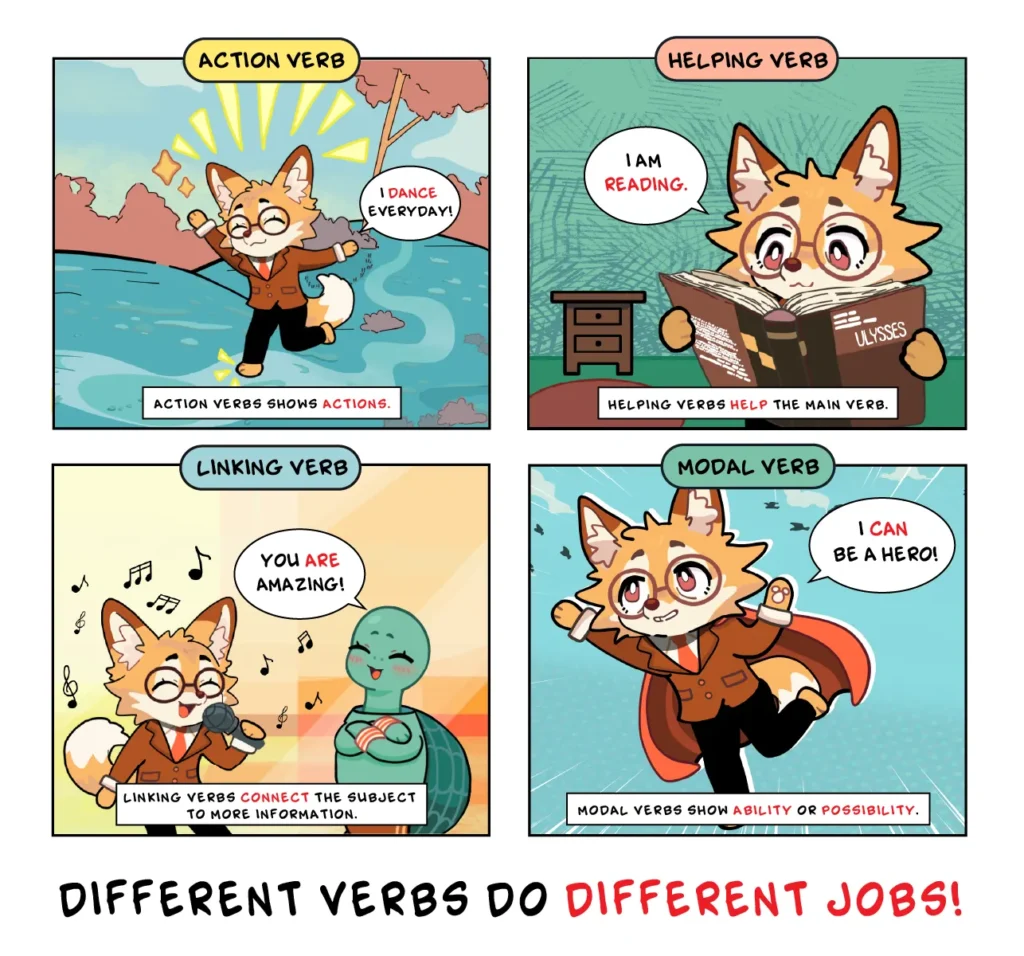
English verbs can be grouped into different categories based on the job they perform in a sentence. Some verbs show actions, others connect ideas, and some work together with another verb to express time, possibility, or ability. The table below provides a quick overview of the main verb types you’ll encounter as a beginner.
| Verb Type | Purpose | Example |
| Action Verbs | Show actions | She writes every day. |
| Linking Verbs | Connect the subject to the description | The soup smells delicious. |
| Helping Verbs | Support the main verb | They have finished the project. |
| Modal Verbs | Show ability, permission or possibility | You can swim. |
| Transitive Verbs | Need an object | She bought a laptop. |
| Intransitive Verbs | Do not need an object | The baby slept peacefully. |
| Regular Verbs | Add “-ed” in the past | walk → walked |
| Irregular Verbs | Change the form differently | go → went |
Action Verbs
Action verbs describe what someone or something does.
Examples.
- Emma reads every evening.
- Birds fly across the sky.
- The dog barked loudly.
- We played football after school.
Linking Verbs
Linking verbs connect the subject with more information rather than showing an action.
English uses several linking verbs. These verbs connect the subject with more information instead of showing an action. Some of the most common linking verbs are listed below.
- am
- is
- are
- was
- were
- seem
- become
- appear
- feel
- look
Examples
- She is happy.
- It appears to be raining.
- The weather became colder.
- You look tired.
Helping Verbs (Auxiliary Verbs)
Helping verbs work together with the main verb.
Common helping verbs include:
- be
- do
- have
Examples
- She is studying.
- They have completed the assignment.
- Do you know the answer?
- We were watching a movie.
Modal Verbs
Modal verbs express:
- Ability
- Permission
- Possibility
- Advice
- Necessity
Common modal verbs include:
- can
- could
- may
- might
- should
- must
- will
- would
Examples
- You can speak now.
- We should leave early.
- It might rain.
- You must wear a seatbelt.
Transitive Verbs
A transitive verb needs an object to complete its meaning.
Example:
She wrote a letter.
Here, the letter receives the action.
More examples:
- He kicked the ball.
- I opened the window.
- They built a bridge.
Intransitive Verbs
An intransitive verb does not need an object.
Examples
- The baby cried.
- The train arrived.
- Everyone laughed.
- She slept peacefully.
- The action is complete without an object.
Regular Verbs
Regular verbs follow a predictable pattern when forming the past tense. In most cases, you simply add “-ed” to the base form of the verb. The examples below show how common regular verbs change from the present form to the past form.
| Base Verb | Past Tense |
| walk | walked |
| clean | cleaned |
| cook | cooked |
| open | opened |
As you can see, regular verbs follow a simple pattern, making them easier for beginners to learn than irregular verbs.
Irregular Verbs
Irregular verbs form the past tense in different ways, so they do not follow the standard “-ed” rule. Because these forms are less predictable, learners usually need to memorize them through reading, listening, and regular practice.
| Base Verb | Past Tense |
|---|---|
| go | went |
| eat | ate |
| see | saw |
| buy | bought |
| write | wrote |
These verbs must be memorized through practice. Unlike regular verbs, irregular verbs do not follow a fixed pattern. The best way to remember them is through regular reading, listening, and speaking practice.
Common Mistakes Beginners Make
1. Forgetting the Verb
Just like a police interrogation, interrogative sentences are questions!
❌ My sister very kind.
✅ My sister is very kind.
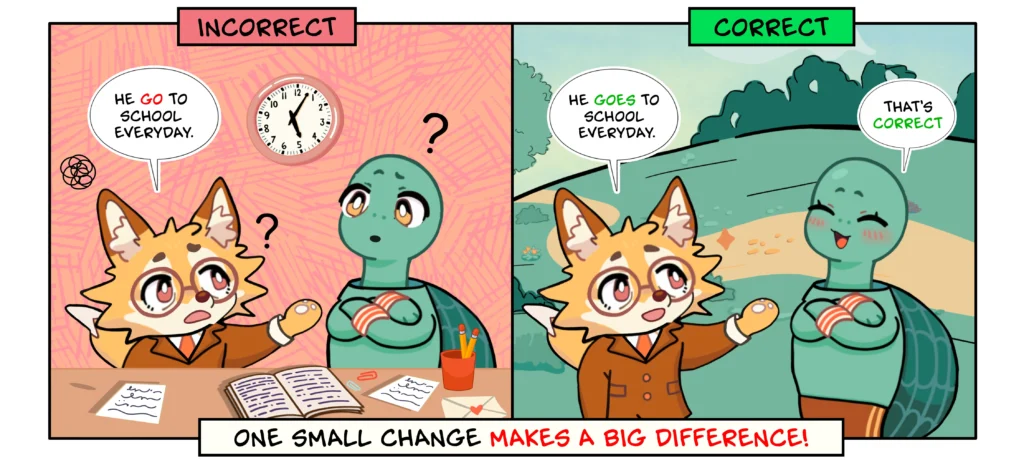
2. Using the Wrong Verb Form
❌ He go to school every day.
✅ He goes to school every day.
3. Confusing Helping Verbs and Main Verbs.
❌ She is study now.
✅ She is studying now.
4. Using the Wrong Past Tense
❌ Yesterday I goed home.
✅ Yesterday I went home.
Tips to Learn Verbs Faster
- Learn a few verbs every day.
- Read short English stories.
- Listen to native speakers.
- Practice making your own sentences.
- Keep a notebook of new verbs.
- Review irregular verbs regularly.
Continue Learning English Grammar
Now that you understand the different types of verbs in English, you can strengthen your grammar and speaking skills with these beginner-friendly guides:
- Master English Grammar by Learning the 8 Parts of Speech
https://englishlanguageandliterature.com/8-parts-of-speech/ - 100+ Active and Passive Voice Examples: Master Grammar Now
https://englishlanguageandliterature.com/active-and-passive-voice-examples/ - Reported Speech Examples: Rules, Tips & Exercises
https://englishlanguageandliterature.com/reported-speech-examples/ - Intonation in English: Types, Rules, and Examples
https://englishlanguageandliterature.com/intonation-in-english/ - Tips to Start Speaking English Online with Confidence
https://englishlanguageandliterature.com/mastering-english-speaking-online-tips-and-resources-for-fluency/
These articles will help you improve your grammar, pronunciation, and spoken English step by step.
Frequently Asked Questions
What is a verb?
A verb is a word that shows an action, state, or occurrence.
How many types of verbs are there?
The main types include action, linking, helping, modal, transitive, intransitive, regular, and irregular verbs.
What is the difference between helping and linking verbs?
Helping verbs support the main verb, while linking verbs connect the subject to additional information.
What is an action verb?
An action verb shows what someone or something does.
Final Thoughts
Learning the different types of verbs is one of the first steps toward mastering English grammar. Once you understand how each type works, you’ll find it much easier to build sentences, express ideas clearly, and communicate with confidence.
Start with the most common verbs, practice them in everyday conversations, and gradually expand your vocabulary. Remember, fluency doesn’t come from memorizing hundreds of rules. It comes from using them regularly.
Quick Challenge
Now it’s your turn to put your knowledge into practice. See if you can identify the type of verb used in each sentence below.
- She looks happy.
- We have finished our homework.
- They can swim very well.
- The birds flew south for the winter.