Intonation in English: Examples & Rules to Speak Naturally
Have you ever listened to someone speak English fluently and wondered why it sounded so natural, smooth, and expressive? A big part of that magic comes from intonation in English.
Intonation is the rise and fall of your voice when speaking. It’s not just about correct pronunciation or grammar, it’s about meaning, emotion, and clarity. Mastering intonation can make your English sound confident, natural, and professional, whether you’re in a casual conversation, presenting at work, or giving a speech.
In this guide, you’ll learn:
- What intonation in English is and why it matters
- The main types of intonation in English
- Rules and patterns to follow
- Examples with rising, falling, and question intonation
- How stress affects intonation in English language
- Practical exercises to improve your English intonation
By the end, you’ll be ready to speak English more fluently, clearly, and with the confidence of a native speaker.
Tip: Bookmark this guide and practice regularly intonation is learned through listening and repetition.
Table of Contents
What is Intonation in English?
Intonation in English language refers to the pitch patterns of spoken English the way your voice rises or falls across sentences. It communicates meaning beyond words:
- Emotions: happiness, surprise, doubt, or anger
- Attitude: politeness, agreement, hesitation
- Sentence types: questions, statements, commands
Without proper intonation, English can sound monotone, robotic, or confusing. For example, a question can sound like a statement if the intonation is flat.
Example:
- Statement: “You are coming.” (falling intonation)
- Question: “You are coming?” (rising intonation)
You can also explore our English Pronunciation Guide to improve sounds and rhythm.
The Importance of Intonation in English
Intonation isn’t just about sounding native. It plays several key roles:
- Clarifies meaning – Different intonation can change the meaning of a sentence.
- Expresses emotion and attitude – Makes speech engaging and natural.
- Highlights important words – Stress and pitch guide the listener’s attention.
- Indicates sentence type – Rising or falling intonation signals questions, statements, or commands.
- Improves comprehension – Listeners understand you more easily with correct intonation.
Example:
- “I can’t believe it.” (falling intonation → surprise/shock)
- “I can’t believe it?” (rising intonation → doubt or question)
suggestion: British Council: Intonation in English provides excellent audio examples for learners.
Stress and Intonation in English Language
Stress and intonation in English are closely connected. Stress refers to the emphasis on certain words or syllables, while intonation refers to the overall pitch pattern.
- Content words (nouns, verbs, adjectives) are usually stressed
- Function words (prepositions, articles, pronouns) are usually unstressed
- Stress helps listeners identify the most important information in a sentence
Example:
- “I didn’t say he stole the money.”
Depending on which word is stressed, the meaning changes:
- “I didn’t say he stole the money.” → Someone else said it
- “I didn’t say he stole the money.” → I implied it differently
- “I didn’t say he stole the money.” → He borrowed it, not stole it
Proper stress improves intonation accuracy and makes your English sound fluent.
Types of Intonation in English
There are four main types of intonation in English. Understanding them is crucial for speaking clearly and naturally.
1. Falling Intonation in English
Falling intonation occurs when the pitch of your voice drops at the end of a sentence. It is common in:
- Statements
- Commands
- Wh-questions (who, what, where, when, why, how)
Examples:
- Statement: “She is coming home.”
- Command: “Close the door.”
- Wh-question: “Where are you going?”
Check our English Sentence Types Guide for more examples.
Falling intonation signals certainty, completeness, and confidence.
2. Rising Intonation in English
Rising intonation occurs when your pitch rises at the end of a sentence. It is common in:
- Yes/No questions
- Expressions of uncertainty or doubt
- Polite requests
Examples:
- Question: “Are you coming?”
- Uncertainty: “I think it’s okay?”
- Polite request: “Could you help me?”
Rising intonation often invites response or feedback, making conversations more interactive.
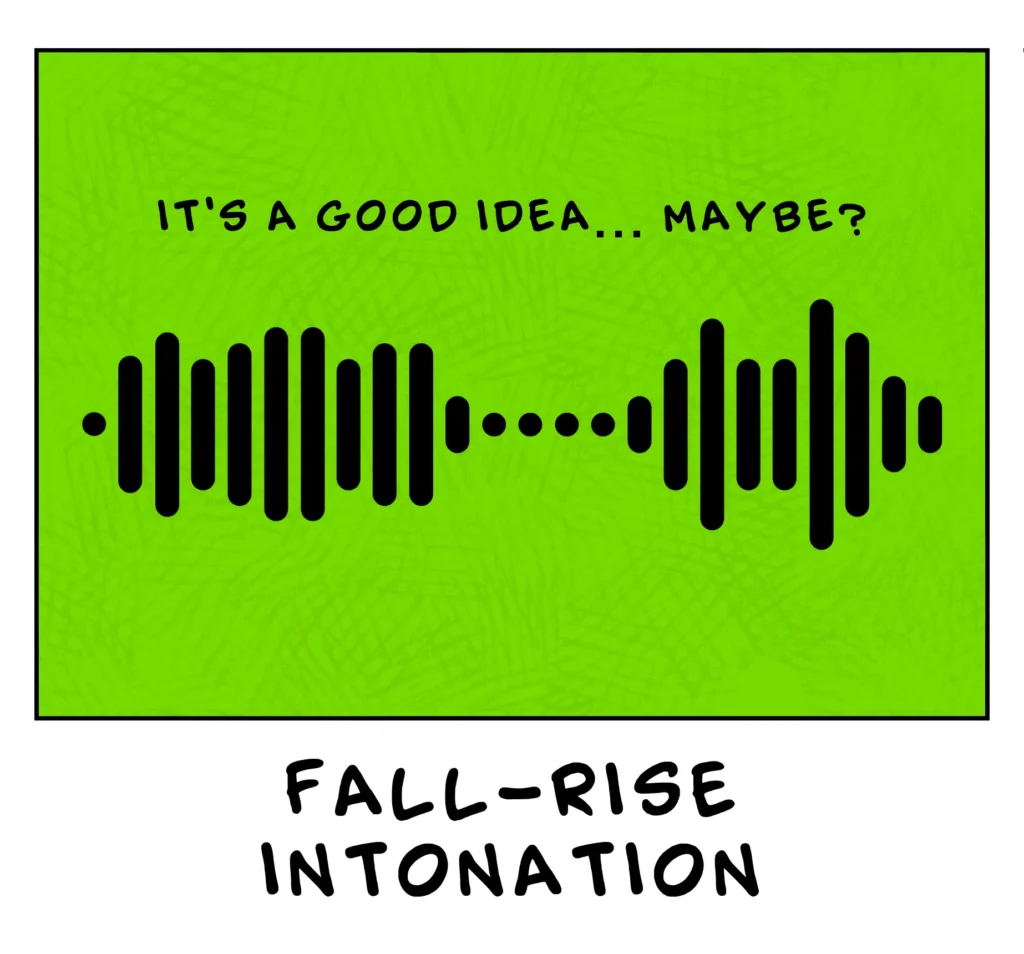
3. Fall-Rise Intonation
Fall-rise intonation starts high, drops, then slightly rises at the end. It indicates:
- Uncertainty or hesitation
- Politeness
- Contradiction or contrast
Examples:
- “I’m not sure about that…”
- “It’s a good idea… maybe?”
Tip: Listening to native speakers in podcasts or YouTube tutorials helps you recognize fall-rise patterns naturally.
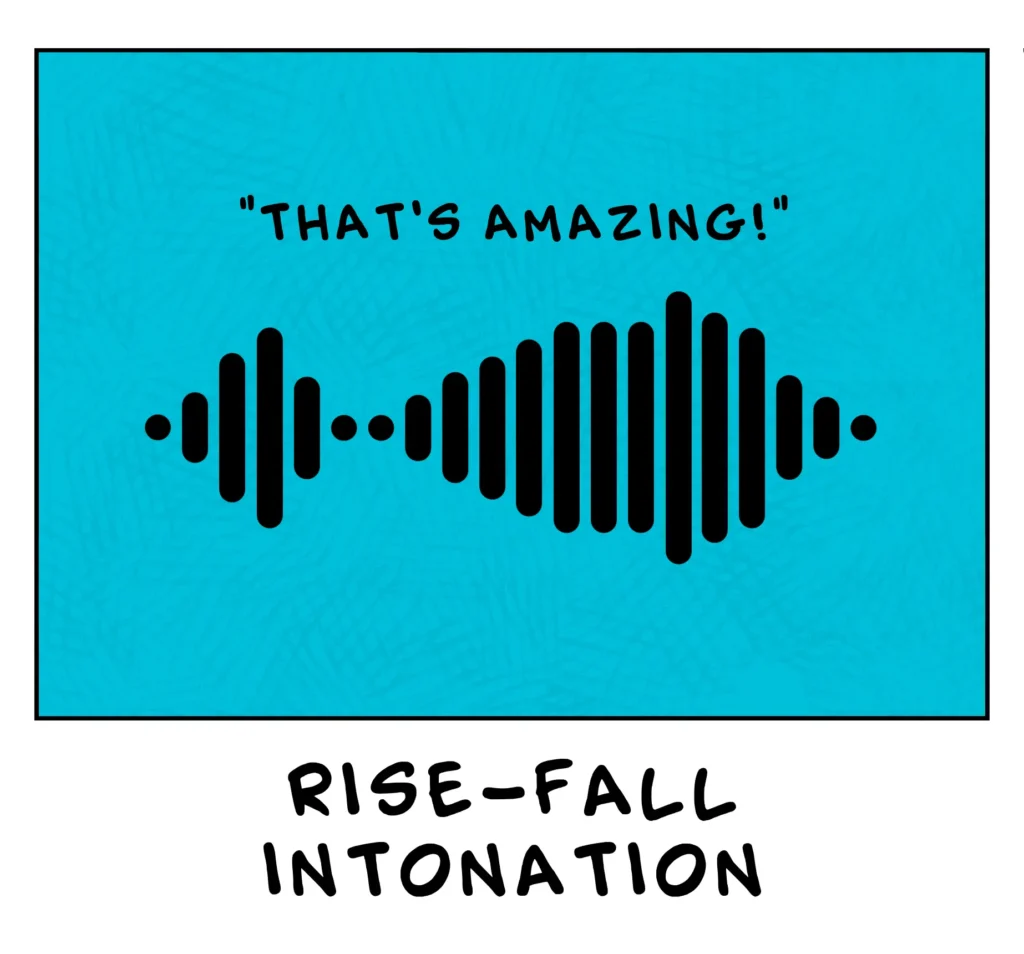
4. Rise-Fall Intonation
Rise-fall intonation starts rising, peaks, and then falls sharply. It conveys:
- Strong emotion
- Surprise, excitement, or emphasis
Examples
- “I can’t believe it!”
- “That’s amazing!”
Rise-fall intonation makes your speech dynamic and expressive, catching your listener’s attention.
Question Intonation in English
Question intonation in English is one of the most common patterns learners struggle with. The pitch pattern depends on the type of question:
- Yes/No questions → Rising intonation
- “Do you like pizza?”
- “Do you like pizza?”
- Wh-questions → Falling intonation
- “Where is the library?”
- “Where is the library?”
- Tag questions → Rising or falling depending on certainty
- “You’re coming, aren’t you?” (rising → uncertainty, falling → confirmation)
- “You’re coming, aren’t you?” (rising → uncertainty, falling → confirmation)
Pro Tip: Practice by reading dialogues aloud. Compare your pitch with audio examples from BBC Learning English.
Intonation in English Rules
Here are key rules for mastering English intonation:
- Statements usually end with falling intonation
- Yes/No questions usually end with rising intonation
- Wh-questions usually end with falling intonation
- Important words get stressed, secondary words unstressed
- Use rising-falling intonation for emphasis or excitement
- Polite requests often use slight rise at the end
Let’s see real-life examples in context:
| Sentence | Type | Intonation |
| “She is leaving tomorrow.” | Statement | Falling |
| “Are you coming tonight?” | Yes/No Question | Rising |
| “What time does the train leave?” | Wh-question | Falling |
| “I think it’s fine…” | Uncertainty | Fall-rise |
| “That’s incredible!” | Emphasis | Rise-fall |
Exercise: Read these sentences aloud, record yourself, and compare with native speakers.
Importance of Intonation in English
Why does it matter so much? Because intonation affects comprehension, emotion, and engagement.
- Without proper intonation, your sentences may confuse listeners.
- With correct intonation, you communicate clearly, sound fluent, and convey emotions effectively.
Example:
“She didn’t go.”
- Falling intonation → statement, neutral
- Rising intonation → question, surprised or doubtful
Related read: English Speaking Practice Tips
Practical Exercises to Improve Your Intonation
- Listen and Repeat
- Use podcasts, movies, or YouTube English tutorials. Mimic rising and falling patterns.
- Use podcasts, movies, or YouTube English tutorials. Mimic rising and falling patterns.
- Record Yourself
- Compare your intonation with native speakers. Adjust pitch where necessary.
- Compare your intonation with native speakers. Adjust pitch where necessary.
- Use Markers for Stress
- Mark stressed words in sentences. Practice speaking them clearly.
- Mark stressed words in sentences. Practice speaking them clearly.
- Practice Questions
- Write 10 yes/no and 10 wh-questions. Practice correct intonation for each.
- Write 10 yes/no and 10 wh-questions. Practice correct intonation for each.
- Dialogue Roleplay
- Partner or practice alone. Use rising, falling, fall-rise, and rise-fall intonations in context.
- Partner or practice alone. Use rising, falling, fall-rise, and rise-fall intonations in context.
FAQs about Intonation in English
Q1: What is intonation in English?
A: It’s the rise and fall of voice pitch in sentences that conveys meaning, emotion, or sentence type.
Q2: Why is intonation important in English?
A: It clarifies meaning, shows emotions, emphasizes important words, and indicates sentence types.
Q3: What are types of intonation in English?
A: Falling, rising, fall-rise, and rise-fall.
Q4: How does stress affect intonation?
A: Stressed words guide pitch and highlight important information in speech.
Q5: Can intonation change meaning?
A: Yes e.g., “You’re going.” (statement) vs. “You’re going?” (question).
Q6: How do I practice intonation?
A: Listen to native speakers, record yourself, read dialogues aloud, and mark stress in sentences.
Q7: What is question intonation in English?
A: Yes/No questions usually rise, Wh-questions usually fall, tag questions can rise or fall.
Q8: Are intonation rules the same in American and British English?
A: Mostly yes, though subtle pitch patterns may differ. Listening to both accents helps.
Q9: Can intonation make me sound fluent?
A: Absolutely. Proper intonation makes English sound natural, expressive, and confident.
Q10: Where can I hear good examples of intonation?
A: BBC Learning English, British Council, YouTube English tutorials, and podcasts.
Final Tip
Mastering intonation in English is a game-changer. It makes your speech:
- Clear and understandable
- Expressive and engaging
- Fluent and natural
Challenge: Pick 5 sentences daily. Practice rising, falling, fall-rise, and rise-fall intonation aloud. Record yourself and compare.
Share your favorite intonation practice tip in the comments below!