Academic Vocabulary Words: Definition, Examples, and Tips
The English language uncovers deeper layers when you’re progressing in your learning process! Whether you’re using it in a more academic setting such as writing an essay, preparing for an exam, or reading a research paper, you’ll come across words that sound more formal and precise than everyday English.
These are known as academic vocabulary words, and learning them can make a noticeable difference in how you write, read, and express yourself in an educational context.
A strong academic vocabulary helps you understand school or university much better, explain your ideas and thoughts more clearly, and carry yourself with confidence in a professional setting.
Table of Contents
What is Academic Vocabulary?
Academic vocabulary refers to any words or phrases that are used in classrooms, textbooks, research papers, and formal discussions or debates.
This type of vocabulary is different from everyday expressions because its context is professional and educational, which makes these words and phrases perfect to explain complex ideas, analyze information critically, and support or challenge arguments eloquently.
As the Cambridge Dictionary says more elegantly,
Academic vocabulary refers to the words and phrases used in academic writing and speech, particularly in formal and technical contexts. It includes words from various fields of study, such as science, technology, engineering, and mathematics, as well as social sciences and humanities.
Academic vocabulary is often characterized by its formal tone, complex sentence structures, and precise meanings. It is used to convey complex ideas, argue points, and support claims with evidence. Mastering academic vocabulary is essential for students, researchers, and academics to effectively communicate their ideas and engage with their peers.
How about a quick example?
Instead of saying show, an academic text might use demonstrate.
Now, let’s get into why all of this matters.
Why is Academic Vocabulary Important?
Building your academic vocabulary offers a valuable familiarity with words that’ll help you:
- Understand complex textbooks, articles, books, and research papers more easily.
- Write any of those, also, including reports, any type of assignment, or even your own thesis!
- Participate in classroom discussions, presentations, or lively debates.
- Perform better on any test or high-level exams such as your ASTs, IELTS, TOEFL, and more.
- And lastly, it’ll help you develop professional communication skills in the workplace!
Academic vocabulary is key for both learning academically and working professionally. It supports your future career!
It’s important to note that not all academic words serve the same purpose, which is why academic vocabulary can be divided into two categories:
- General academic vocabulary.
- And subject-specific vocabulary.

General Academic Vocabulary
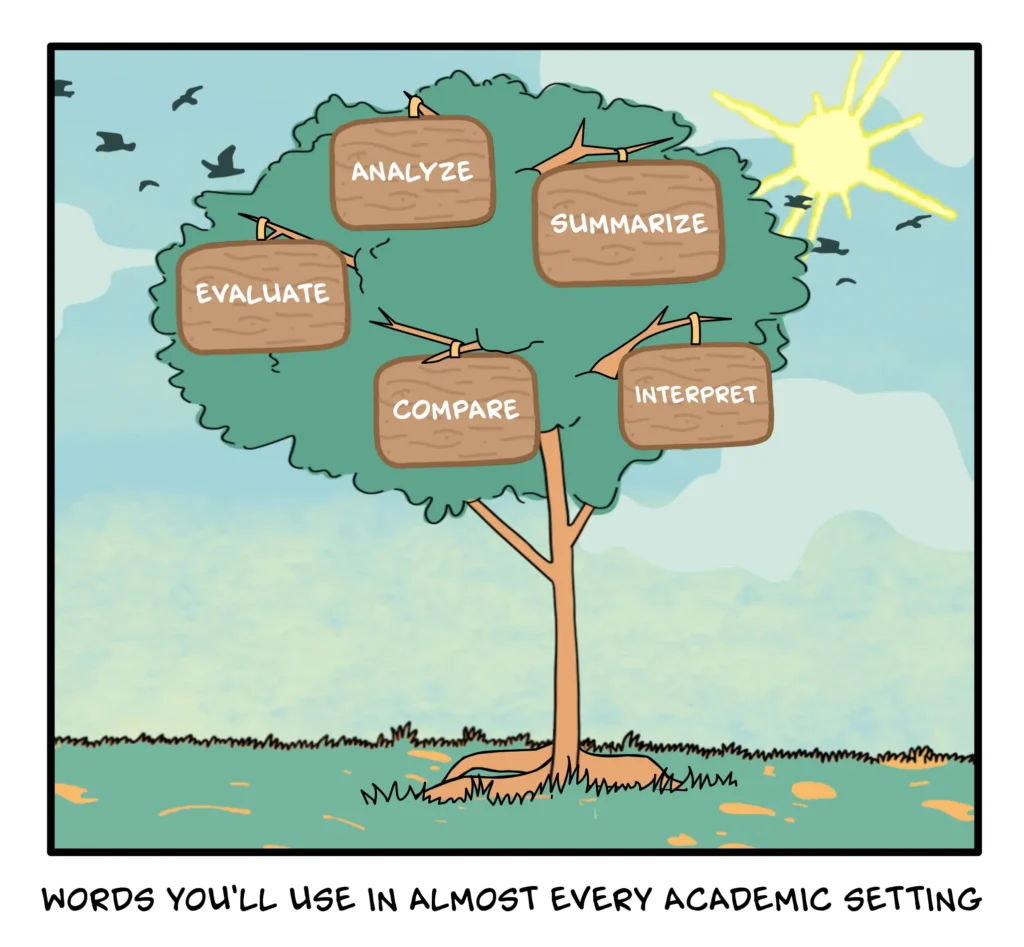
These are words that are useful in almost every academic setting, such as:
| Word | Example |
| Analyze | You should analyze the author’s argument before writing your own. |
| Evaluate | Students must evaluate the effectiveness of the proposed solution. |
| Compare | To get a better insight from the lesson, it would be good to compare the two historical events. |
| Summarize | Summarize the essay in your own words. |
| Interpret | Interpret the graphics using the information provided below. |
Subject-Specific Vocabulary
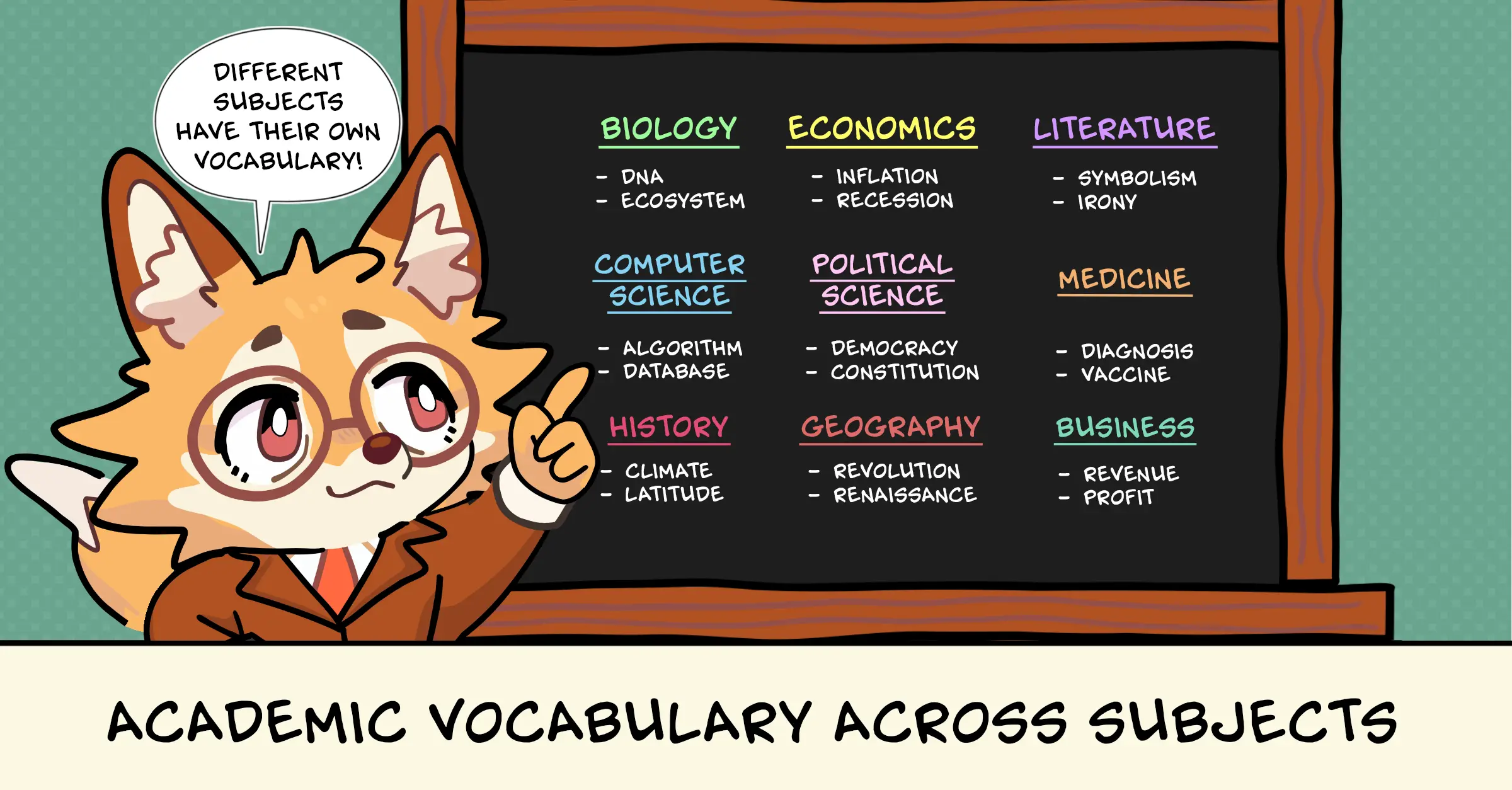
These words belong to specific fields of study.
For example:
- Words like photosynthesis, cells, ecosystem, mitosis, or DNA belong to → Biology.
- Inflation, supply and demand, recession → Economics.
- Metaphors, symbolism, irony, subplot, foreshadowing → Literature.
- Algorithm, database, syntax, encryption → Computer Science.
- Democracy, constitution, diplomacy, legislature → Political Science.
- Diagnosis, vaccine, anatomy, prognosis → Medicine.
- Climate, latitude, erosion, topography → Geography.
- Industrialization, revolution, renaissance, colonialism → History.
- Revenue, profit, asset, liability, stakeholder → Business.
As you progress in your academic learning in either school, college, or courses, you’ll get in touch with many of these subjects and end up mastering their general academic terms and technical vocabularies.
We can certainly explore that much further, with a few examples of how more words are introduced at different educational stages.
Academic Vocabulary by Education Level
Your years as a student carry you through various stages of learning that unlock new academic words that’ll support your academic and professional life.
These words and examples help you understand the sentence’s context, the word’s meaning, and also their proper usage. Here are some examples!
- Justify – You must justify your answer with a solid argument.
- Hypothesis – The scientists formed a hypothesis based on the initial data.
- Assess – The teacher assessed each presentation using a grading system.
- Demonstrate – The results demonstrate a clear improvement in student performance!
- Illustrate – The graph illustrates the relationship between the supply and demand of the product.
- Significant – Researchers discovered a significant difference between group A and group B.
- Infer – Scientists can infer the temperature of distant stars by analyzing the light they emit.
- Critique – The class critiqued the book by discussing the moral dilemmas in its plot.
Let’s also follow up with more advanced examples! You’ll probably encounter these in university assignments, dissertations, academic research, and more.
- Correlation – There is a strong correlation between exercise and mental health.
- Inductive –
- Framework – The study is based on a conceptual framework that explains consumer behavior.
- Citation – Always remember to include accurate citations or references for every source you use in your reports.
- Discrepancy – The thesis tutor noticed a discrepancy between the expected and actual results.
- Consequently – Consequently, the professor recommended further investigation of the study subjects.
- Empirical – The empirical evidence supports the proposed hypothesis.
- Implications – The results hold significant implications for further research.
How about a little compare and contrast to better illustrate the richness of academic vocabulary?
Compare and Contrast: Everyday Language vs. Academic Language
One of the easiest ways to incorporate academic vocabulary is by replacing everyday words with more precise alternatives.
Here are some simple examples:
| Everyday Language | Academic Language |
| The results were great. | The results were significant. |
| The team worked pretty well on a project. | The team collaborated effectively on their project. |
| The graph clearly shows that… | The graph illustrates… |
| The study says… | The study indicates… |
| The findings have a connection between… | The findings suggest a correlation between… |
| The information in the book is really helpful for the students. | The information in the book is highly beneficial for the students preparing for academic assessments. |
| A new academic study shows a solution to the problem. | A new academic study reveals a possible solution to this problem. |
Useful Tips
To better learn academic vocabulary, you can expose yourself to three useful activities:
- Reading academic texts, reports, or articles.
- Watching video essays on a specific academic topic.
- Using an ELA Academic Vocabulary Crossword Puzzle.
Conclusion
Building your academic vocabulary takes time, but every new word you learn helps you become a stronger reader, writer, and communicator!
Whether you’re completing school assignments, preparing for university, or studying for an English proficiency exam, expanding your academic vocabulary will make it easier to understand complex ideas and express your own with confidence.
In any case, you can count on our tailored courses to better support your learning process! Guided practice can get you even closer to your goals than you believe.
Now, how about a little assignment?
Complete each sentence using one of the words below.
Word bank: analyze, evaluate, synthesize, demonstrate, justify, empirical, correlation, significant.
- Students should _______ the author’s argument before writing essay.
- The research provides _______ evidence to support the conclusion.
- Please _______ your answer using examples from the text.
- The experiment _______ a clear relationship between exercise and concentration.
- There is a strong _______ healthy eating habits and work performance.
- The tutor will _______ your thesis presentation based on clarity, organization, and sources.
- Students must _______ information from several, trustworthy academic sources.
- The discovery had a _______ impact on future research and testing.
References
- https://dictionary.cambridge.org/
- https://dictionary.cambridge.org/dictionary/english/academic-study
- https://englishlanguageandliterature.com/academic-vocabulary-words/
- https://www.youtube.com/watch?v=Mak6uP8fVDs
Answers from assignment
- Analyze
- Empirical
- Justify
- Demonstrated
- Correlation
- Evaluate
- Synthesize
- Significant
Writer: María Carlota Coutinho Thomas
Designer: Shenaih Limbaga