
Common grammar mistakes in English often sneak into our daily writing. For example, If you’ve ever written sentences like ‘Your the best!’ instead of ‘You’re the best!’, that’s a common grammar mistake. Don’t worry, you’re not alone even native English speakers trip over grammar rules from time to time.
In fact, grammar mistakes are part of daily life. Students make them in essays. Professionals make them in emails. Writers make them in blogs and books. And English learners? They often feel overwhelmed by the endless rules, exceptions, and tricky structures.
So why do grammar errors happen so often?
- Speed. When you speak or write quickly, accuracy suffers.
- overgeneralization. Learners apply one rule everywhere. Example: adding -ed to all past tense verbs (buyed instead of bought).
- Confusion. English has irregular rules (children, not child.)
- Habit. If you learned it wrong once, you may keep repeating it.
This blog highlights the most common grammar mistakes in English with examples and corrections. You’ll find:
- Organized lists with clear explanations.
- Real examples and fixes.
- A correction table for quick reference.
- A quiz to test your knowledge.
- Practical tips for avoiding mistakes.
By the end, you’ll not only spot grammar errors, but also correct them confidently in exams, emails, and conversations.
And here’s the best part: learning grammar doesn’t need to feel like memorizing rules from a textbook. Think of it as upgrading your communication style. Just as you wouldn’t wear slippers to a formal job interview, you don’t want sloppy grammar showing up in your professional or academic writing.
If you want to strengthen your English fluency while fixing your grammar, check out our related guide on 20 Advanced English Idioms to see how grammar and expressions work hand in hand.
Table of Contents
2. What Are Common Grammar Mistakes?
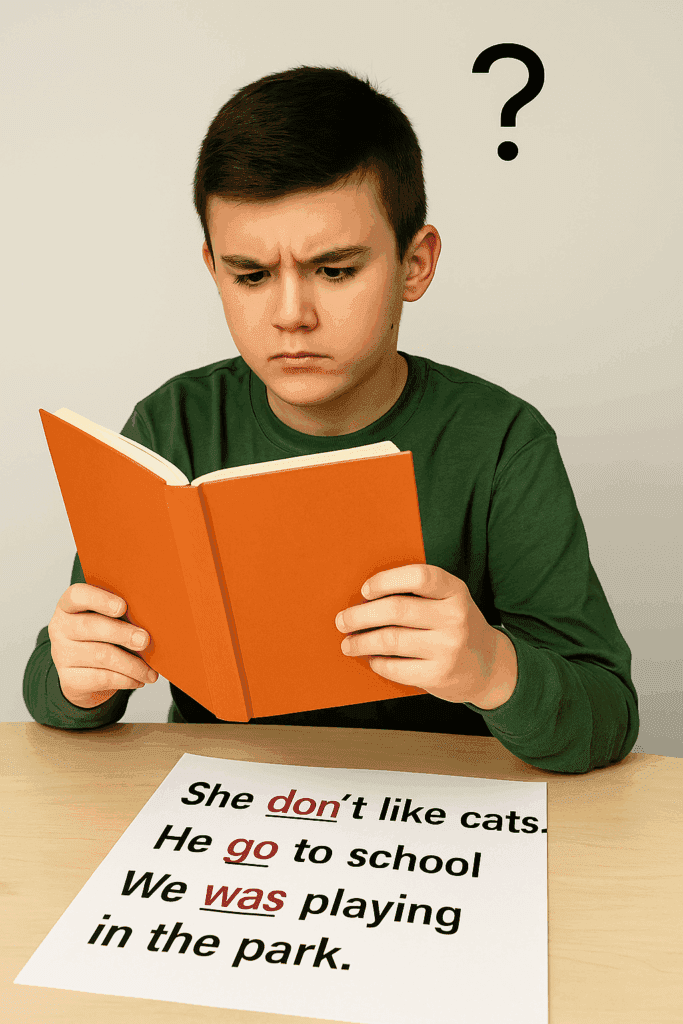
A grammar mistake happens when the rules of English structure are broken. These mistakes appear in both spoken English and written English.
- In speaking: “Me and him is going.”
- In writing: “Its raining heavily.”
Both sentences sound understandable, but they’re incorrect.
Minor slips vs. recurring errors
Not all mistakes are equal.
- Minor slips: Accidental typos or once-in-a-while errors. Example: writing “He go” instead of “He goes.” Most readers overlook them.
- Recurring errors: Mistakes learners make consistently due to misunderstanding. Example: always saying “I seen” instead of “I saw.” These hurt credibility and fluency.
Why learners struggle
- English grammar has exceptions (e.g., mouse → mice, not mouses).
- Different rules from other languages (in many languages, double negatives are correct, but in English they’re not).
- Context-based differences (American English vs. British English rules).
For a deeper understanding of sentence rules, see our post on Reported Speech Rules with Examples. Many learners confuse tense shifts here, which is a top source of grammar mistakes.
3. Why It’s Important to Avoid Common Grammar Mistakes
Think of grammar as the traffic system of language. Break one rule and people might still understand you. Break rules repeatedly, and communication crashes.
Four reasons grammar accuracy matters
- Clarity of communication
- Wrong: I no understand this lesson.
- Right: I don’t understand this lesson.
Correct grammar makes your message clear the first time.
- Professional success
A CV that says “I has experience” can cost you the job. Employers judge attention to detail through grammar. - Academic performance
Exams like IELTS, TOEFL, SAT deduct points for frequent errors. Grammar forms a major part of scoring criteria. - Credibility and trust
Would you trust medical advice from someone who writes “Your health are safe”? Grammar impacts how seriously people take your message.
For more on why grammar matters in exams and career settings, see Cambridge English exam resources.
4. Categories of Common Grammar Mistakes
Here are 25+ categories of mistakes, each explained with examples and fixes.
4.1 Verb Tense Mistakes
- Wrong: I have seen her yesterday.
- Right: I saw her yesterday.
More examples:
- Wrong: She didn’t went to class. → She didn’t go to class.
- Wrong: By the time I arrived, he eats dinner. → By the time I arrived, he had eaten dinner.
Verb tense errors are among the most common grammar mistakes in English, especially in exams.
4.2 Subject Verb Agreement
- Wrong: She go to school every day.
- Right: She goes to school every day.
Extra examples:
- Wrong: Everyone have finished. → Everyone has finished.
- Wrong: Neither of the answers are correct. → Neither of the answers is correct.
4.3 Pronoun Mistakes
- Wrong: Me and him are friends.
- Right: He and I are friends.
Extra examples:
- Wrong: Her went shopping. → She went shopping.
- Wrong: That book is mines. → That book is mine.
4.4 Preposition Errors
- Wrong: Married with a doctor.
- Right: Married to a doctor.
Extra examples:
- Wrong: She is good in singing. → She is good at singing.
- Wrong: Arrived to the station. → Arrived at the station.
4.5 Articles (a, an, the)
- Wrong: She is teacher.
- Right: She is a teacher.
Extra examples:
- Wrong: I need an advice. → I need advice.
- Wrong: He is best player in the team. → He is the best player in the team.
4.6 Confused Words (Homophones & Mix-ups)
- There / Their / They’re
- Its / It’s
- Your / You’re
- Than / Then
Example:
- Wrong: Their going to school. → They’re going to school.
See our guide on Synonyms for Amazing to expand vocabulary and reduce word mix-ups.
4.7 Adjective vs. Adverb
- Wrong: She runs quick.
- Right: She runs quickly.
Extra examples:
- Wrong: He speaks good. → He speaks well.
- Wrong: The test was hardly easy. → The test was hard.
4.8 Sentence Word Order
- Wrong: Always she is late.
- Right: She is always late.
Extra examples:
- Wrong: I to the store went. → I went to the store.
- Wrong: Quickly he runs. → He runs quickly.
4.9 Double Negatives
- Wrong: I don’t know nothing.
- Right: I don’t know anything.
Extra examples:
- Wrong: We can’t hardly wait. → We can hardly wait.
- Wrong: She didn’t see nobody. → She didn’t see anybody.
4.10 Punctuation Mistakes
- Misusing apostrophes
- Wrong: Its raining. → It’s raining.
- Wrong: Its raining. → It’s raining.
- Overuse of commas
- Wrong: I like apples, and, bananas, and, oranges.
- Right: I like apples, bananas, and oranges.
- Run-on sentences
- Wrong: I love reading it makes me happy.
- Right: I love reading because it makes me happy.
4.11 Dangling Modifiers
- Wrong: Running fast, the gate was missed.
- Right: Running fast, he missed the gate.
4.12 Passive Voice Misuse
- Wrong: The homework was done by me.
- Right: I did the homework.
4.13 Comparative & Superlative Errors
- Wrong: She is more prettier than her sister.
- Right: She is prettier than her sister.
4.14 Question Word Order
- Wrong: You are coming when?
- Right: When are you coming?
4.15 Capitalization Errors
- Wrong: i love english.
- Right: I love English.
5. Common Grammar Mistakes with Corrections and Explanation
Here you’ll find a list of common grammar mistakes in English along with their corrected versions. Each example includes a short explanation so you understand why the mistake is wrong and how to use the correct form in everyday writing.
| Mistake | Correction | Explanation |
| I seen her yesterday. | I saw her yesterday. | Past simple, not past participle. |
| She go to school. | She goes to school. | Subject–verb agreement. |
| Me and him played. | He and I played. | Subject pronouns needed. |
| Married with a doctor. | Married to a doctor. | Correct preposition is to. |
| She is teacher. | She is a teacher. | Articles required before singular nouns. |
| Your welcome. | You’re welcome. | Contraction you’re = you are. |
| She runs quick. | She runs quickly. | Adverbs modify verbs. |
| Always she is late. | She is always late. | Correct word order. |
| I don’t know nothing. | I don’t know anything. | Double negatives incorrect. |
| Its raining. | It’s raining. | “It’s” = it is. |
6. Quick Test: Spot the Mistakes
Correct these:
- She go to market yesterday.
- Its very cold today.
- Me and her was late.
- He don’t likes pizza.
- They asked where was I going.
- She is best student in class.
- The homework was done by me.
- Running fast, the bus was missed.
- We can’t hardly wait.
- i want to learn english.
Answer Key (hidden in collapsible section or at end).
7. Tips to Avoid Common Grammar Mistakes
- Read English frequently.
- Keep a grammar journal.
- Use tools like Grammarly or Hemingway.
- Learn from feedback in forums like English Stack Exchange.
- Practice speaking slowly to reduce errors.
8. FAQs
Q: What are the top 10 common grammar mistakes?
A: Verb tense, subject verb agreement, pronoun misuse, articles, prepositions, homophones, adverb/adjective mix-ups, double negatives, punctuation, run-ons.
Q: How can I improve grammar fast?
Read daily, write short pieces, get corrections, use grammar apps.
Q: Are grammar mistakes acceptable in spoken English?
Minor slips yes, but recurring mistakes affect fluency.
Q: Do grammar mistakes affect IELTS/TOEFL?
Yes. Grammar accuracy is a scoring criterion.
9. Conclusion
Grammar isn’t about sounding robotic it’s about expressing yourself clearly and confidently. Avoiding common grammar mistakes makes your English sharper, your writing more professional, and your speech more polished.
Keep practicing, take quizzes, and explore more guides on English Language and Literature to keep improving.