40 Conjunction Examples in English (Types, Rules, and Sentences)
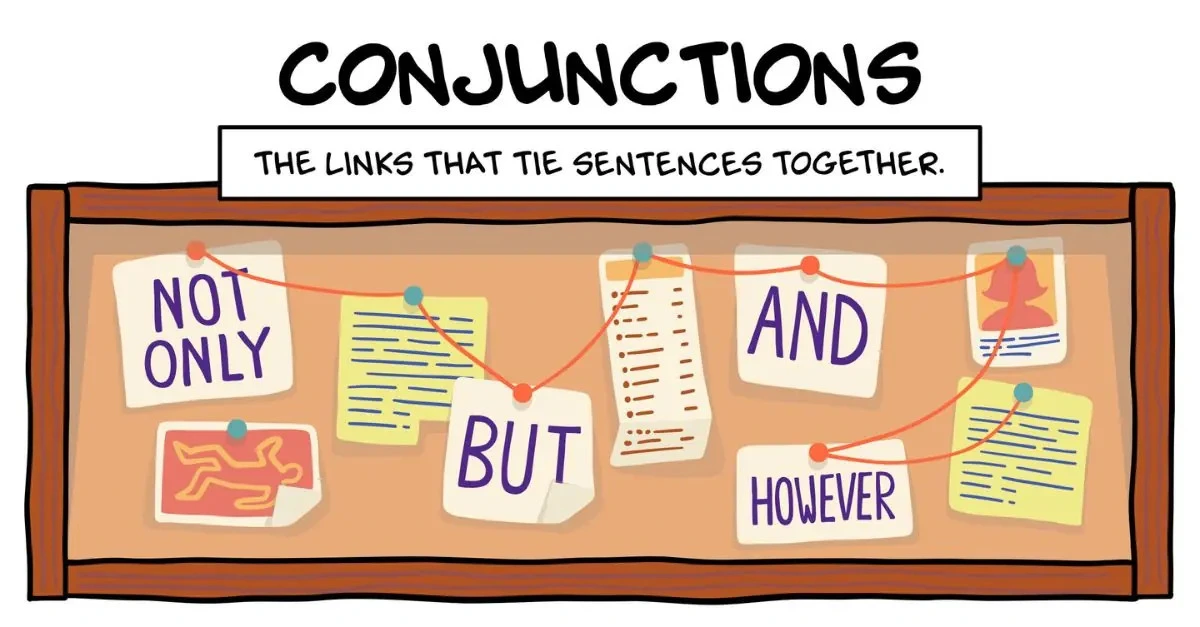
Learning conjunction examples is one of the fastest ways to improve your English grammar, writing and speaking fluency. Conjunctions help you connect ideas smoothly, allowing you to create clear and professional sentences instead of short, repetitive ones.
If you want to sound more natural in English, mastering conjunction words is essential.
Table of Contents
A conjunction is a word that connects words, phrases or clauses in a sentence. These connecting words help ideas flow logically and naturally. Without conjunctions, sentences can sound disconnected and repetitive.
Example Without a Conjunction:
I was tired. I finished my work.
Example With a Conjunction:
I was tired, but I finished my work.
In the second sentence, the conjunction shows contrast between the two ideas. Conjunctions are therefore essential for building compound and complex sentences in English.
Why Conjunction Examples Are Important for English Fluency
Learning different conjunction examples helps you communicate more effectively in both writing and speaking.
- Improve Sentence Clarity
Conjunctions clearly show relationships between ideas, such as cause, contrast, condition, or time.
Example:
It was sunny, but I took an umbrella.
The conjunction ‘but’ clearly shows contrast.
- Make Writing More Cohesive
Professional writing requires smooth transitions between ideas. Conjunctions help connect sentences and paragraphs, making writing feel more complete.
This is especially important for:
- Essays
- Reports
- Blog articles
- Professional emails
- Improve Spoken English
Native English speakers constantly use conjunctions when they talk. Using them helps you:
- Speak in longer sentences
- Avoid awkward pauses
- Sound more fluent and confident
- Avoid Short and Repetitive Sentences
Without conjunctions, writing often becomes choppy.
Example of Choppy Writing
I went to the store. I bought milk. I bought bread.
Improved Sentence
I went to the store, and I bought milk and bread.
Types of Conjunctions in English
There are three main types of conjunctions in English grammar:
- Coordinating conjunctions
- Subordinating conjunctions
- Correlative conjunctions
Understanding these types will help you use conjunction words correctly.
1. Coordinating Conjunction Examples
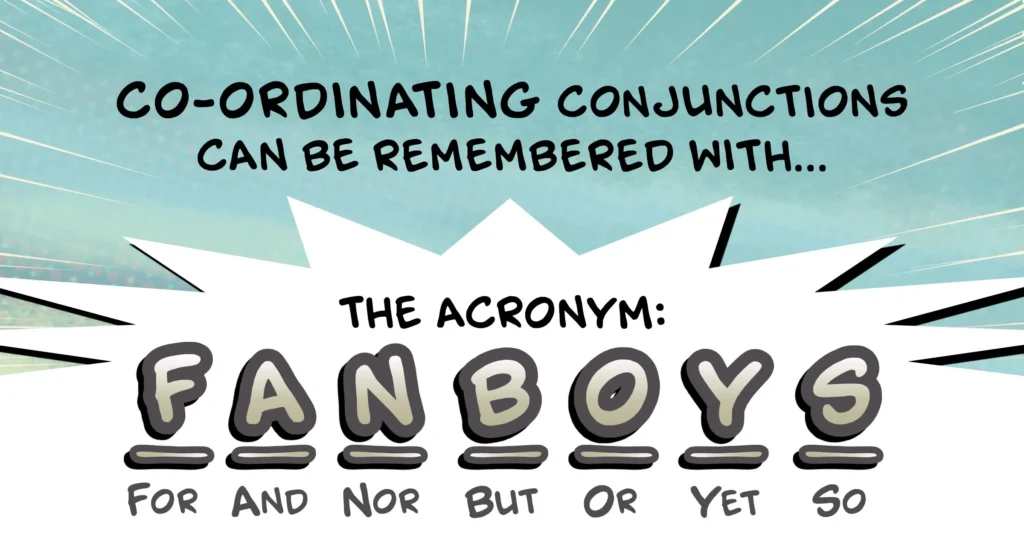
Coordinating conjunctions connect words, phrases, or independent clauses that have equal importance.
| Conjunction | Meaning | Example |
| For | To show reason or cause (like “because”) | I can’t stay, for I have a morning meeting. |
| And | To add information or connect similar ideas | She likes tea and coffee. |
| Nor | To add another negative idea | He didn’t call, nor did he send a text. |
| But | To show contrast or an exception | I wanted to go, but it rained. |
| Or | To show a choice or alternative | We can go now, or we can wait until later. |
| Yet | To show a surprising contrast (like “but”) | The work was hard, yet I enjoyed it. |
| So | To show the result or consequence | She needed help, so I offered to assist her. |
2. Subordinating Conjunction Examples
Subordinating conjunctions connect a dependent clause to an independent clause. They often show relationships such as time, cause, condition, or contrast.
| Conjunction | Meaning | Example |
| Because | To show cause or reason | I stayed home because it was raining. |
| Although | To show contrast or a concession | Although she was tired, she finished her work. |
| Since | To show time or reason | Since I started exercising, I feel better. |
| Unless | To show condition (meaning “except if”) | You can’t go unless you finish your homework. |
| While | To show time (at the same time) or contrast | While I was reading, the phone rang. |
| If | To show the condition | I will go to the party if you go too. |
| As | To show time, reason, or manner | She sang as she washed the dishes. |
| Before | To show time (earlier than) | Call me before you leave the office. |
| After | To show time (later than) | We left after the movie ended. |
| When | To show a specific time | I’ll tell you when I get there. |
| Whenever | To show any time | Whenever he visits, he brings flowers. |
| Where | To show a place | I want to go where the sun shines. |
| Wherever | To show any place | We can meet wherever you like. |
| Though | To show contrast (less formal than although) | I bought the shirt, though it was expensive. |
| Until | To show time (up to the point) | We will wait until the rain stops. |
| In order that | To show purpose | I saved money in order that I could travel. |
| Whether | To show a choice or possibility | I don’t know whether to stay or go. |
| As long as | To show condition/duration | You can borrow the car as long as you fill the tank. |
Subordinating conjunctions are essential for creating complex sentences in English.
3. Correlative Conjunction Examples
Correlative conjunctions work in pairs to connect equal sentence elements.
| Conjunction Pair | Meaning | Example |
| Either…or | To show a choice between two options | Either you start studying, or you will fail. |
| Neither…nor | To show two negative options (not this and not that) | Neither the book nor the movie was good. |
| Both…and | To show two things together | Both the singer and the band were excellent. |
| Not only…but also | To emphasize two things, with the second being surprising | Not only did he win, but he also broke a record. |
| Whether…or | To show doubt or choice | I wonder whether it will snow or rain. |
| As…as | To make a comparison | She is as talented as her sister. |
| Just as…so | To show similarity or equal measure | Just as he left, so did I. |
| Provided that | On the condition that | I will sign the contract provided that you agree to the terms. |
These conjunction pairs help emphasize relationships between ideas.
How Conjunctions Are Used in Real Life
Conjunctions appear in many everyday situations.
1. Academic Writing
Students use conjunctions to link arguments and ideas in essays.
Examples:
- ‘because’ for reasons
- ‘although’ for contrast
- ‘so’ for conclusions
2. Public Speaking
Speakers use conjunctions to guide their audience through complex ideas smoothly.
3. Blogging and Content Writing
Conjunctions help connect paragraphs and create smooth transitions, making content easier to read.
4. Everyday Conversations
Instead of saying:
“I can’t go out. I need to study.”
You can say:
“I can’t go out because I need to study.”
This sounds more natural and fluent.
How to Practice Using Conjunctions
The best way to master conjunctions is through consistent practice.
1. Write Your Own Sentences
Try rewriting simple sentences using different conjunctions.
Example:
Original: The food was cheap. It wasn’t good.
Coordinating: The food was cheap, but it wasn’t good.
Subordinating: Although the food was cheap, it wasn’t good.
Correlative: The food was neither expensive nor good.
2. Combine Short Sentences
Practice combining short sentences into longer, more natural sentences.
3. Edit Your Writing
Look for places where you can replace short sentences with conjunctions that connect ideas clearly.

Looking Ahead
Conjunction Examples Improve English Communication
Conjunctions are essential tools for building clear, fluent, and sophisticated sentences. By learning these 40 conjunction examples, you will improve your:
- English grammar
- Sentence structure
- Writing flow
- Speaking fluency
Start practicing today by using different conjunctions in your emails, messages, or conversations.
The more you practice these conjunction words in English, the more natural your communication will become.
Want to improve your English faster?
Join our WhatsApp English learning groups to practice grammar, vocabulary, and speaking with daily lessons and exercises.
Did you know?
“The word ‘and’ is one of the most frequently used conjunctions in English. It appears in everyday speech, writing, and even literature, helping speakers add ideas and keep conversations flowing naturally.”
Explore our guide to English grammar rules and discover how understanding them can help you write and speak with greater clarity and confidence.