30+ Behavior Idioms with Examples to Enrich Your English
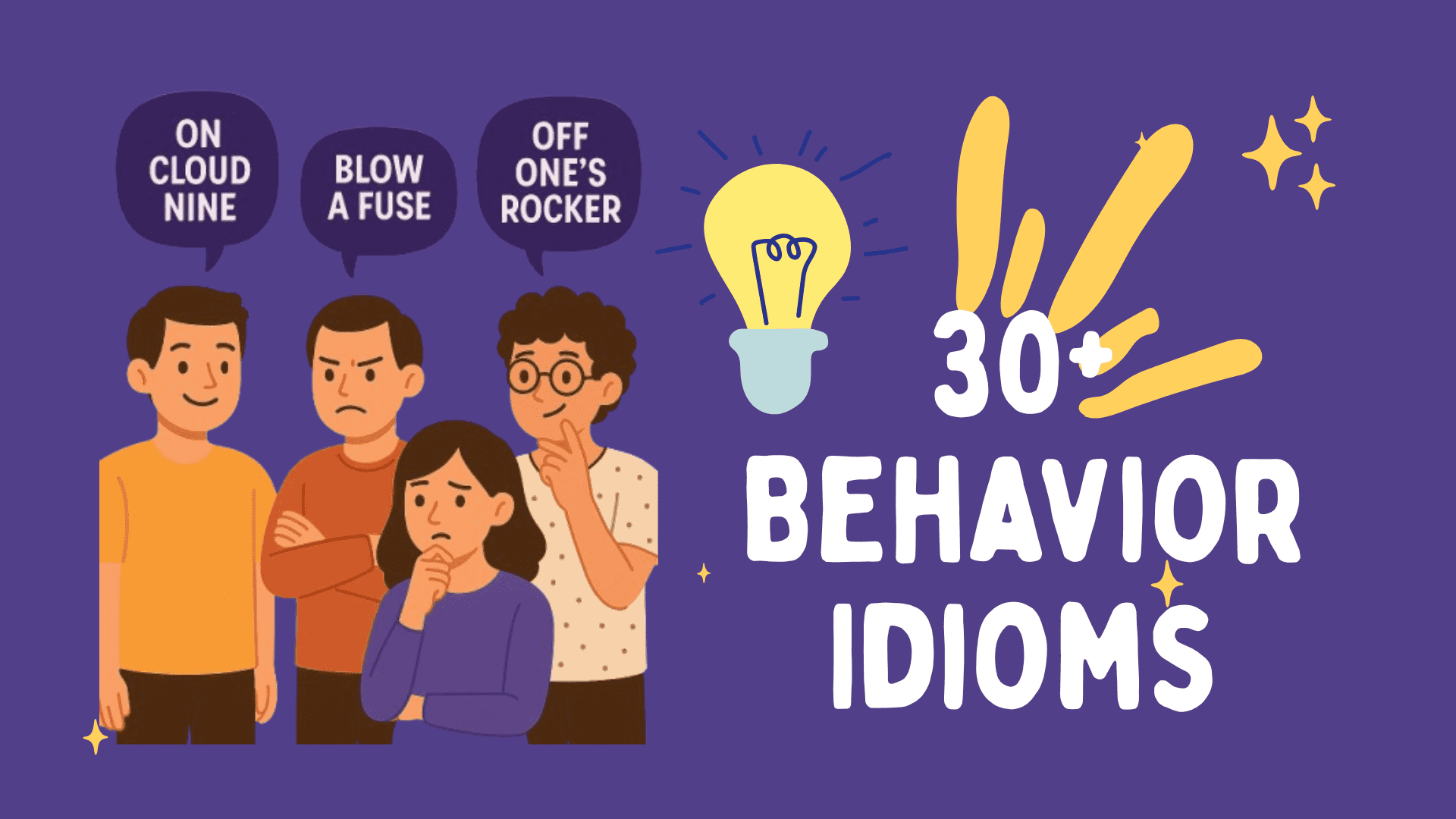

English is more than grammar rules and vocabulary lists. It’s also about colorful, culture-rich phrases that native speakers throw into everyday conversations. Among the most common are behavior idioms, expressions that capture how people act, react, or carry themselves.
If you’ve ever wanted to describe someone losing their temper, standing out in a crowd, or being especially generous, chances are there’s an idiom for that. When you master this idioms, your English becomes not just correct but alive.
In this guide, you’ll find 30+ behavior idioms carefully split into categories like positive, negative, social, quirky, and miscellaneous. By the end, you’ll know what these idioms mean and be able to use them naturally in conversations, stories, or professional contexts.
Table of Contents
What Are Behavior Idioms?
Behavior idioms are idiomatic expressions that describe actions, habits, or ways people act. They go beyond the literal meaning of their words and give you a figurative way to describe complex behaviors.
For example:
- Saying someone “keeps their cool” paints a picture of calmness in stressful situations.
- Saying someone “throws you under the bus” captures betrayal in a way plain words can’t.
- Saying someone “marches to the beat of their own drum” highlights individuality and independence in a vivid, memorable way.
Idioms appear in conversations, movies, business meetings, and even academic writing. Mastering them not only improves your vocabulary but also helps you speak with more cultural fluency.
For deeper insights into figurative expressions, check out our guide to advanced English idioms.
How Behavior Idioms Are Useful
1. Make Language Vivid
Behavior idioms bring life and energy into your speech and writing. Instead of using plain words, idioms add imagery that helps people visualize what you mean. For example, compare:
- Plain: “He worked very hard.”
- Idiomatic: “He went the extra mile.”
The second version is more colorful and sticks in the listener’s mind. Using idioms for behavior is like painting with bright colors instead of dull ones—it makes your message more memorable.
2. Communicate Traits Quickly
Idioms let you express complex traits in just a few words. Saying someone “blew his top” immediately tells readers or listeners that the person lost their temper, without you needing to explain at length. This makes your communication faster and sharper. Behavior idioms act like shortcuts: they condense detailed explanations into one striking phrase that everyone understands.
3. Add Cultural Flavor
Idioms often reflect history, humor, and traditions from English-speaking cultures. For example, the idiom “throw in the towel” comes from boxing, while “pass the buck” has roots in card games. By learning and using behavior idioms, you not only improve your English fluency but also connect with the cultural background behind the words. This makes your conversations feel more authentic and engaging whether you’re chatting casually, telling a story, or even giving a professional presentation.
Related: Unlock better English through understanding Western culture.
Why Behavior Idioms Make Your English Better
1. Boost Fluency
One of the biggest challenges English learners face is sounding natural. Behavior idioms help bridge the gap between textbook English and the way native speakers actually talk. For example, when you say someone “kept their cool” instead of “stayed calm,” you instantly sound more fluent. Learning these idioms trains your ear and tongue to match authentic English, which makes conversations smoother and more confident.
2. Improve Comprehension
Behavior idioms appear everywhere in TV shows, movies, books, podcasts, and even social media captions. If you don’t know them, you might miss half the meaning. For example, a character in a movie might say, “Don’t throw me under the bus,” and if you take it literally, it won’t make sense. By understanding idioms, you unlock deeper comprehension of English media and culture. That means you won’t just hear words you’ll understand the full message.
3. Enhance Storytelling
Whether you’re writing an essay, giving a presentation, or telling a personal story, idioms add rhythm, emotion, and personality. Instead of a plain sentence like “She was very nervous,” saying “She had butterflies in her stomach” creates a mental picture for the listener. Behavior idioms help you show, not just tell, and that makes your storytelling more engaging. Writers, public speakers, and even business professionals rely on idioms to hold attention and connect emotionally.
4. Help in Professional English
In business and academic contexts, idioms for behavior are incredibly useful. They allow you to describe teamwork, leadership, and workplace dynamics with precision. For example, “He passed the buck” is more powerful than “He avoided responsibility.” In meetings, presentations, or reports, idioms make your communication sharper and more memorable. Mastering behavior idioms gives you an edge in professional English because you can speak the language of collaboration and culture, not just grammar.
30+ Behavior Idioms with Examples
Below, you’ll find 30+ examples of behavior idioms. We’ve split them into categories and provided sample sentences so you can see how to use them.
Idioms About Positive Behavior
| Idiom | Meaning | Example Sentence |
| Go the extra mile | Do more than expected | “The teacher always goes the extra mile to help struggling students.” |
| Bend over backwards | Make great effort to help | “She bent over backwards to make the guests comfortable.” |
| Wear your heart on your sleeve | Show emotions openly | “He wears his heart on his sleeve, so you always know how he feels.” |
| Lead by example | Show the way by acting first | “Good leaders don’t just talk; they lead by example.” |
| Keep your cool | Stay calm under pressure | “Even in the heated debate, she kept her cool.” |
Idioms About Negative Behavior
| Idiom | Meaning | Example Sentence |
| Throw someone under the bus | Betray someone for self-gain | “He threw his colleague under the bus to save his own job.” |
| Blow your top | Lose your temper | “The coach blew his top after the team ignored his instructions.” |
| Pass the buck | Shift responsibility | “The manager kept passing the buck instead of solving the problem.” |
| Cry wolf | Raise a false alarm | “If you keep crying wolf, no one will believe you when it’s real.” |
| Have a chip on your shoulder | Act angry about past grievance | “He always has a chip on his shoulder about not finishing school.” |
Idioms About Unusual or Quirky Behavior
| Idiom | Meaning | Example Sentence |
| March to the beat of your own drum | Be independent, unconventional | “She has always marched to the beat of her own drum.” |
| Act the goat | Behave foolishly | “Stop acting the goat in front of the class!” |
| Go off the rails | Lose control, act strangely | “After the accident, he went off the rails for a while.” |
| Bite the bullet | Face something difficult with courage | “He bit the bullet and confessed his mistake.” |
| Stick out like a sore thumb | Be very noticeable | “Her bright red coat stuck out like a sore thumb in the crowd.” |
Idioms About Social Behavior
| Idiom | Meaning | Example Sentence |
| Break the ice | Make people comfortable | “He told a joke to break the ice at the party.” |
| Get on someone’s nerves | Annoy someone | “His constant tapping gets on my nerves.” |
| Play it by ear | Handle things without a plan | “Let’s play it by ear and see how the evening goes.” |
| Keep someone at arm’s length | Avoid closeness | “She kept her coworkers at arm’s length.” |
| Talk behind someone’s back | Gossip negatively | “They were talking behind his back after the meeting.” |
Miscellaneous Useful Behavior Idioms
| Idiom | Meaning | Example Sentence |
| Jump on the bandwagon | Join a popular trend | “Everyone jumped on the bandwagon of social media challenges.” |
| Hold your horses | Wait, slow down | “Hold your horses; the show hasn’t started yet.” |
| Hit the nail on the head | Be exactly right | “She hit the nail on the head with her analysis.” |
| Bite off more than you can chew | Take on too much | “He bit off more than he could chew by agreeing to five projects.” |
| Play with fire | Take dangerous risks | “You’re playing with fire if you ignore those warnings.” |
Explore more: English idioms list.
Where to Use Behavior Idioms in Real Life
In Everyday Conversation
Behavior idioms are perfect for daily chats because they instantly express emotions, habits, or actions in a way that feels natural. Instead of saying, “He was very angry,” you can say, “He blew his top when the Wi-Fi went down.” It’s faster, more colorful, and instantly understood. Using idioms in conversation also makes you sound more fluent and confident, because this is exactly how native speakers express themselves. Next time you’re talking about stress, personality, or funny habits, try slipping in a behavior idiom—it makes your speech relatable and engaging.
In Writing and Storytelling
If you’re writing a blog, essay, or even creative fiction, behavior idioms add figurative flair that keeps readers hooked. For instance, “She went the extra mile for her community” paints a much stronger image than “She worked hard.” Writers use idioms to show personality traits, conflicts, or emotions without long explanations. This is especially powerful in storytelling, where you want readers to feel the scene instead of just reading plain descriptions. For more on how to sharpen your storytelling skills, check out how to improve your English speaking skills online.
In Professional or Academic Contexts
Idioms aren’t just for casual talk—they’re also useful in formal settings. In the workplace, phrases like “pass the buck” or “take the initiative” make reports, presentations, or meetings more expressive. They can describe teamwork, leadership, or conflict in a concise way. For example, saying “The manager threw him under the bus” captures workplace betrayal far more vividly than plain words. In academic writing, idioms (used carefully) can add flavor to essays or discussions about human behavior, psychology, or literature. Just remember: in professional or academic contexts, choose idioms that fit the tone and avoid overly informal ones.
How to Practice and Remember Behavior Idioms
- Group by theme (positive, negative, quirky).
- Make flashcards for recall.
- Practice in the context of conversations, short stories, or role plays
- Watch English shows to hear idioms in action (top TV shows and movies).
- Use spaced repetition apps to memorize gradually.
See also: Maximizing your time for English learning.
Conclusion
Idioms are the secret sauce that makes English come alive. They let you capture behavior in just a few words, whether it’s anger, generosity, foolishness, or leadership. By practicing just 5 idioms a week, you’ll quickly see them flow naturally into your conversations and writing.
“Ready to take your English to the next level? Don’t just learn idioms; master them in real conversations. Start your learning journey today.”
❓ Frequently Asked Questions (FAQs) on Behavior Idioms
1. What are behavior idioms?
Behavior idioms are expressions that describe actions, habits, or attitudes without directly naming them. For example, “bite your tongue” means stopping yourself from speaking.
2. Why are behavior idioms important in English?
They make your English sound more natural, expressive, and fluent. Native speakers use them daily, so knowing them helps you understand conversations better.
3. Are behavioral idioms formal or informal?
Most are informal, used in daily conversations. Some can be adapted into semi-formal settings like workplace storytelling, but they’re rarely used in academic writing.
4. How do I practice behavior idioms effectively?
- Make flashcards
- Write short dialogues using idioms
- Watch shows, movies, or YouTube interviews and note idioms in context
- Practice with a language partner or tutor
5. What’s the difference between idioms and proverbs?
Idioms are figurative phrases with a fixed meaning (“hit the nail on the head”). Proverbs are traditional sayings that give advice (“The early bird catches the worm”).
6. Can behavior idioms help in IELTS, TOEFL, or other exams?
Yes. Examiners look for natural fluency. Using idioms sparingly and correctly can boost your speaking and writing scores.
7. How many behavior idioms should I learn as a beginner?
Start with 20–30 common idioms. Once you’re comfortable, expand to 50–100. The goal is to know them deeply, not just memorize lists.
8. What are some common behavior idioms used at work?
Examples include:
- “Burning the candle at both ends” (working too hard)
- “Throw in the towel” (give up)
- “Call the shots” (be in control)
9. Where can I find reliable resources to learn idioms?
Websites like Cambridge Dictionary (external link) and apps like Quizlet provide examples and practice exercises.
10. Can I create my own idioms?
Not really. Idioms are fixed expressions already accepted by native speakers. Instead of inventing new ones, focus on mastering the popular ones people actually use.