20+ Essential Idioms for Change With Meaning and Examples
Change is an essential part of life. Luckily, the English language has countless figurative ways to describe it. A powerful tool is idioms for change. Idioms make your English richer and more fluent. They are crucial for discussing your everyday, professional life, and creative storytelling.
Love learning new idioms? Join our free English WhatsApp Group where we share daily tips, examples, and exercises to boost your skills.
Table of Contents
What Are Idioms for Change?
An idiom is a figurative phrase whose meaning is different from the literal words. When we say idioms for change, we’re talking about expressions that capture shifts in habits, circumstances, emotions, or situations.
Why Do We Use Idioms of Change So Often?
Change is universal. Everyone experiences growth, setbacks, and new beginnings. Idioms give us a creative way to capture them.
- Personal Growth: stopping a bad habit, learning new skills.
- Career Moves: switching jobs, promotions.
- Life Transitions: marriage, moving, parenting.
Want to see how English opens global opportunities? Check out our article on English as the Key to Global Communication and Success.
How Idioms for Change Are Useful
Change idioms can actually transform how you communicate. As figurative speech, they:
- Enrich your speech and writing.
- Capture complex ideas.
- Make you sound fluent.
- Enhance storytelling.
Want to practice with real people? Join our English Learning WhatsApp Group and start using them today.
20+ Idioms for Change With Meaning and Examples
Here’s a carefully organized list of over 20 idioms for change. Each idiom includes its meaning and a sample sentence.
Idioms About Personal Change
These idioms capture self-growth, self-improvement, and new beginnings.
- “Turn over a new leaf”, means to improve your behavior, for example, “After years of being late, she turned over a new leaf and arrived on time.”
- “Start from scratch”, means to begin again with nothing, for example, “He lost his files but chose to start from scratch and rewrite his thesis.”
- “Reinvent oneself” means to change one’s image or lifestyle, for example: “After college, she reinvented herself as a confident professional.
- “Change one’s tune” means to change one’s opinion or attitude, for example: “He was against remote work, but later, he changed his tune.”
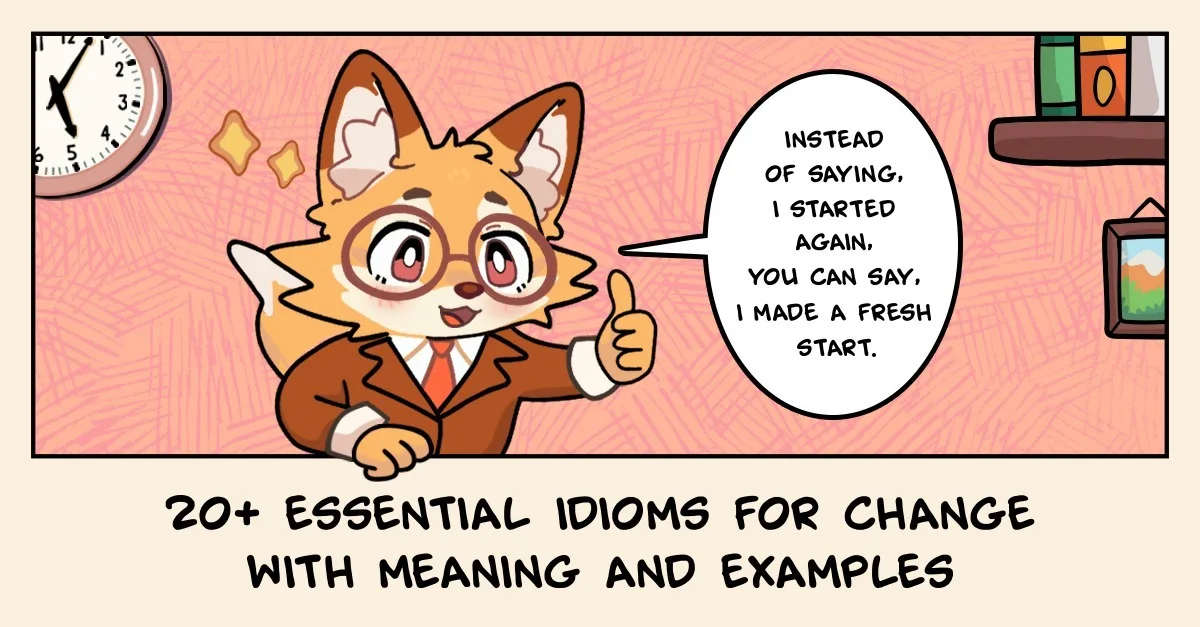
- “Make a fresh start” means to begin again positively, for example: “After moving abroad, he could make a fresh start.”

Idioms About Life and Circumstance Changes
These idioms describe external situations and transformations. They are better at describing when the things outside of your control change.
- “The winds of change” describes signs of transformation, for example: “With new policies, the winds of change swept through the company.”
- “A new lease on life” means a fresh opportunity or enthusiasm for living, for example: “After the surgery, she had a new lease on life.”
- “Go through a rough patch” means to experience difficult times, for example: “They hit a rough patch, but they worked through it.”
- “Out with the old, in with the new” means removing the old to welcome the new, for example: “During renovations, the motto was out with the old, in with the new.”
- “Change of heart” means a shift in feelings or opinions, for example: “He had a change of heart and forgave her.”
Idioms About Work and Career Change
Perfect for transitions at work, promotions, or role shifts.
- “Move up the ladder” means to get promoted, for example: “She moved up the ladder in her firm.”
- “Switch gears” means to change focus or activity, for example: “Mid-project, they had to switch gears to meet new demands.”
- “Step up to the plate” means to take responsibility, for example: “When the manager left, he stepped up to the plate.”
- “Shift gears” means to adjust quickly to new circumstances, for example: “The professor had to shift gears when students struggled with the topic.”
- “Turn the page” means to leave the past behind and start fresh, for example: “After the scandal, the politician tried to turn the page.”
Thinking about a career shift? Try using one of these idioms in your next LinkedIn post.
Miscellaneous Idioms for Change
These cover habits, perspectives, and decisions. Got another idiom for change we didn’t mention? Share it in the comments so others can learn too.
- “Change of scenery” means a new environment, for example: “She went hiking for a change of scenery.”
- “Break new ground” means trying something innovative, for example: “The scientist broke new ground in cancer research.”
- “Change one’s ways” means to improve behavior, for example: “He promised to change his ways.”
- “Make a U-turn” means to reverse a decision completely, for example: “The government made a U-turn on its policy.”
- “Shift one’s stance” means to change one’s position on an issue, for example: “The leader shifted his stance after the debate.”
Where to Use Idioms for Change in Real Life
In Everyday Conversation
Idioms for change naturally fit into daily talks. A person might “go through a rough patch” when they have problems in their personal life, or “turn over a new leaf” when they start exercising.
In Professional and Academic Settings
Using idioms in business or school can make your communication sharper. They can help in corporate settings especially, where language is more subtle and less direct. The “winds of change” can be used to imply a change in the work environment, or a company may “switch gears” to stay competitive.
In Creative Writing and Storytelling
Idioms add depth to fiction and non-fiction. They enrich the figurative language authors use to express their ideas in storytelling. When you want to captivate a reader, change idioms can be a great way to maintain their attention.
FAQs About Idioms for Change
What are idioms for change?
They are figurative phrases that describe transformation.
Why should I learn idioms for change?
They make your English sound fluent, natural, and expressive.
Are they the same as metaphors?
Not exactly. Idioms are fixed phrases; metaphors are comparisons.
How do I practice them?
Learn meanings, write examples, and join practice groups.
Do they appear in exams like IELTS/TOEFL?
Yes, using them naturally shows fluency and boosts scores.
Can I use them in storytelling?
Absolutely. They make stories more relatable and vivid.
Where can I learn more?
Explore our guides on English idioms or check resources like Cambridge Dictionary. Check out our personalized one-on-one course to improve your overall English language skills!
Still curious about idioms? Ask your question in the comments and we’ll answer it in a blog post!